


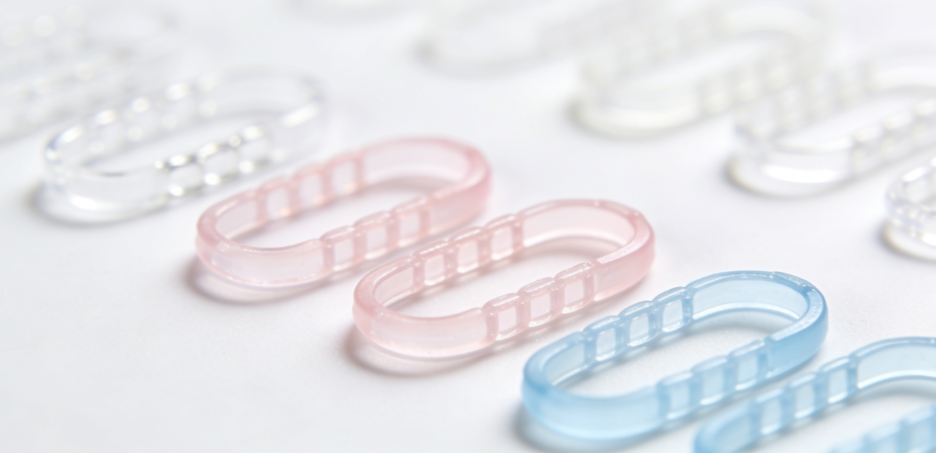
In the complex world of orthodontics, the success of malocclusion correction often rests on the smallest components: orthodontic elastics. While they may appear simple, these medical-grade loops are precision-engineered tools that apply specific physiological forces to move teeth into alignment. For clinicians and distributors sourcing from Denrotary, understanding the granular details of orthodontic elastic force levels and sizing is critical for patient outcomes.
This comprehensive guide decodes the technical specifications of intraoral elastics, exploring the relationship between diameter, force (measured in ounces), and material composition.
How is the Diameter of Orthodontic Rubber Bands Measured?
The diameter of an orthodontic elastic is the primary factor determining its reach and application within the oral cavity. Manufacturers generally use the Imperial system (inches), though metric equivalents (mm) are standard in clinical documentation.
Standard Size Categorization
Measurement is taken from the internal diameter (ID) of the ring in its relaxed state. The most common sizes used in clinical practice include:
-
1/8″ (3.18 mm): Typically used for high-force applications in a localized area.
-
3/16″ (4.76 mm): Often used for anterior-posterior corrections.
-
1/4″ (6.35 mm): The “mid-range” standard for various Class II or Class III mechanics.
-
5/16″ (7.94 mm): Used for longer spans, often across multiple teeth.
-
3/8″ (9.53 mm): Reserved for wide spans or specific surgical applications.
The Physics of Diameter and Stretch
A fundamental rule in orthodontics is that an elastic reaches its labeled force when stretched to three times its original diameter. For example, a 3/16 inch orthodontic elastic will exert its specified force (e.g., 4.5 oz) when stretched to 9/16 of an inch. If overstretched, the material enters the zone of plastic deformation, losing its ability to provide consistent tension.
What is the Difference Between 3.5 oz and 4.5 oz Dental Elastics?
When discussing orthodontic elastic force levels, “ounces” (oz) refers to the tension the band exerts. This is the “force” component of the biomechanical equation. Choosing between Light, Medium, or Heavy tension depends entirely on the stage of treatment and the desired tooth movement.
Force Level Comparison Table
| Force Category | Ounces (oz) | Grams (g) | Primary Clinical Use |
| Light | 2.0 oz – 2.5 oz | 56g – 71g | Finishing stages, sensitive periodontal tissues. |
| Medium | 3.5 oz – 4.0 oz | 99g – 113g | Standard Class II/III correction, space closure. |
| Heavy | 4.5 oz – 6.5 oz | 128g – 184g | High-force orthopedic movements, skeletal corrections. |
Heavy duty dental elastics (typically 6.5 oz) are utilized when significant resistance must be overcome, such as in cases involving impacted teeth or rigid archwires. Conversely, a 3.5 oz elastic provides a more gradual, constant force that is often more comfortable for the patient while still being effective for routine dental alignment.
How is the Tension of an Orthodontic Elastic Calculated?
Tension is not just a number on a package; it is a calculated variable influenced by the Elastic Modulus of the material. In a clinical setting, doctors use a Dontrix Gauge to measure the actual force being applied in the patient’s mouth.
The Formula of Force
The force exerted ($F$) follows a modified version of Hooke’s Law within its elastic limit:
Where:
-
$F$ is the force in ounces.
-
$k$ is the elastic constant of the specific medical grade orthodontic rubber.
-
$\Delta L$ is the change in length (displacement).
However, unlike a perfect spring, rubber elastics experience force decay. Within the first 24 hours, an elastic can lose up to 25-40% of its initial tension due to the moist, warm environment of the mouth and the absorption of salivary proteins. This is why daily replacement is mandatory.
What are the Benefits of Medical Grade Orthodontic Rubber?
The material science behind intraoral elastics materials is focused on two goals: biocompatibility and force consistency. Denrotary’s elastics are engineered to withstand the harsh oral environment.
1. Natural Latex Elastics
Most “Standard” elastics are made from high-quality natural latex.
-
Pros: Superior elasticity, excellent force memory, and cost-effectiveness.
-
Cons: Not suitable for patients with sensitivities.
2. Standard vs Non-Latex Elastics
As many as 5-10% of the population may have some form of latex sensitivity. This has led to the rise of synthetic polymers, usually medical-grade polyurethane.
| Feature | Natural Latex | Non-Latex (Synthetic) |
| Elasticity | High (Snap-back) | Moderate |
| Force Decay | Slower | Faster (Requires more frequent changes) |
| Clarity | Opaque/Amber | Highly Transparent (Aesthetic) |
| Allergy Risk | Yes | No |
What are the Signs of a Latex Allergy from Dental Elastics?
Clinicians must be vigilant when prescribing intraoral elastics materials. A reaction to medical grade orthodontic rubber containing latex can range from mild irritation to systemic distress.
Symptoms to Monitor:
-
Contact Dermatitis/Stomatitis: Redness, swelling, or itching of the lips and gingiva where the elastic makes contact.
-
Burning Sensation: A persistent “stinging” on the inner cheeks.
-
Systemic Reactions: Hives or respiratory issues (rare, but serious).
If a patient exhibits these signs, switching to Non-Latex alternatives immediately is the standard of care.
How to Optimize Elastic Selection for Different Malocclusions?
Choosing the right Heavy duty dental elastics vs. light tension bands depends on the mechanical goal.
Class II Correction
To move the upper arch back and the lower arch forward, clinicians typically use 3/16″ or 1/4″ elastics with a force of 3.5 oz to 4.5 oz. The elastic is stretched from the upper canine to the lower first molar.
Class III Correction
To pull the lower arch back, elastics are stretched from the lower canine to the upper first molar. Because the mandible is often stronger, slightly higher orthodontic elastic force levels (up to 6.0 oz) may be required.
Vertical Elastics (Box Elastics)
For closing an open bite, elastics are arranged in a “box” or “triangle” shape. Since these span a shorter distance, a 1/8″ size is frequently used to ensure enough tension is generated without overstretching the material.
Conclusion: The Precision of Denrotary Elastics
The difference between a successful treatment and a stalled one often lies in the details. By understanding elastic force in ounces, the nuances of 3/16 inch orthodontic elastics, and the necessity of medical grade orthodontic rubber, practitioners can provide faster, more comfortable results. For distributors, offering a range of sizes from 1/8″ to 3/8″ ensures that every clinical scenario is covered.
Explore the full range of high-precision elastics and orthodontic tools at Denrotary to ensure your practice is equipped with the best in material science.
FAQ: Professional Insights into Orthodontic Elastics
How often should patients change their orthodontic elastics?
Patients should ideally change their elastics 3 to 4 times a day. Because medical grade orthodontic rubber suffers from force decay when exposed to saliva and temperature changes, wearing the same band for 24 hours results in insufficient force to move teeth effectively. Frequent changes maintain a “constant” force profile.
Can I double up on elastics to move teeth faster?
No, patients should never “double up” unless specifically instructed by an orthodontist. Doubling elastics increases the orthodontic elastic force levels exponentially, which can cause excessive pressure, leading to root resorption (shortening of the tooth roots) or cutting off blood supply to the periodontal ligament.
Are colored elastics as effective as clear ones?
Yes, the pigment used in colored elastics does not significantly alter the mechanical properties or the elastic force in ounces. However, neon-colored elastics are generally made of latex. If a patient requires non-latex, they are typically restricted to clear or specialized synthetic materials.
Why do some elastics have animal names on the packaging?
Many manufacturers use animal names (e.g., Rabbit, Fox, Penguin) as a “shorthand” for 3/16 inch orthodontic elastics or specific force levels. This makes it easier for younger patients to remember which bag they need to use, though the technical diameter and ounce measurements remain the clinical gold standard.
How should orthodontic elastics be stored to prevent degradation?
To maintain the integrity of intraoral elastics materials, they should be stored in a cool, dry place away from direct sunlight. UV exposure and extreme heat can cause the rubber to become brittle, significantly reducing its elastic limit and causing it to snap prematurely during use.
Post time: Feb-04-2026