


Introduction
Correcting an overbite with orthodontic rubber bands depends on more than treatment mechanics alone; it also depends on how consistently those elastics are made. In Class II cases, small differences in latex quality, force retention, dimensions, and sterilization control can influence tooth movement, patient comfort, and clinical reliability. This article examines why orthodontic elastics manufacturers matter in overbite correction, what production standards affect performance, and how sourcing decisions shape treatment outcomes. By the end, readers will have a clearer view of the manufacturing factors behind predictable force delivery, safety, and long-term product consistency in everyday orthodontic practice.
Why orthodontic elastics manufacturers matter for overbite correction
The management of Class II malocclusions, commonly known as overbites, represents approximately 25% to 30% of all comprehensive orthodontic cases globally. The biomechanical success of these treatments relies heavily on the quality, consistency, and durability of intraoral rubber bands. Consequently, the role of specialized manufacturing facilities in the orthodontic supply chain is a critical factor for both clinical predictability and patient safety.
Because these elastomeric products remain under continuous tension in a harsh, moisture-rich oral environment, any deviation in manufacturing quality directly impacts the force vectors applied to the dentition. Understanding the operational standards of these manufacturers empowers procurement teams and clinicians to source materials that deliver precise biomechanical responses.
How elastics support overbite correction
Class II elastics mechanics typically involve anchoring the rubber bands from the maxillary anterior region (often the upper canines) to the mandibular posterior region (lower molars). This specific configuration requires a sustained, predictable force to effectively retract the maxillary segment while encouraging mandibular advancement.
To achieve optimal tooth movement without causing root resorption or periodontal trauma, the prescribed force levels usually range from 3.5 ounces to 6.5 ounces. If the elastomeric material degrades too rapidly or exhibits inconsistent elasticity, the applied force drops below the therapeutic threshold, stalling overbite correction and prolonging the overall treatment timeline.
What differentiates manufacturers in clinical use
Precision in the manufacturing process is the primary differentiator between standard and premium elastomeric products. The extrusion and subsequent cutting of the rubber tubing must maintain strict dimensional tolerances, often required to stay within +/- 0.05 millimeters. Even microscopic variations in the cross-sectional area of a band can drastically alter its force delivery.
Partnering with reputable orthodontic elastics manufacturers ensures that these strict dimensional tolerances are met consistently across millions of units. Advanced facilities utilize automated optical inspection systems to discard bands with irregular cuts, ensuring that clinicians receive uniform products that perform exactly as labeled.
Which market factors influence product selection
Global supply chain dynamics significantly influence the availability and selection of orthodontic elastics. The sourcing of premium raw materials—specifically surgical-grade natural rubber latex and advanced synthetic polyurethanes—dictates both the baseline cost and the performance ceiling of the final product.
Manufacturers producing upwards of 50 million bands monthly must navigate volatile commodity markets while maintaining uninterrupted production schedules. Buyers must assess a manufacturer’s supply chain stability, domestic warehousing capabilities, and raw material sourcing transparency to avoid backorders that could disrupt clinic operations.
What product specifications buyers should review
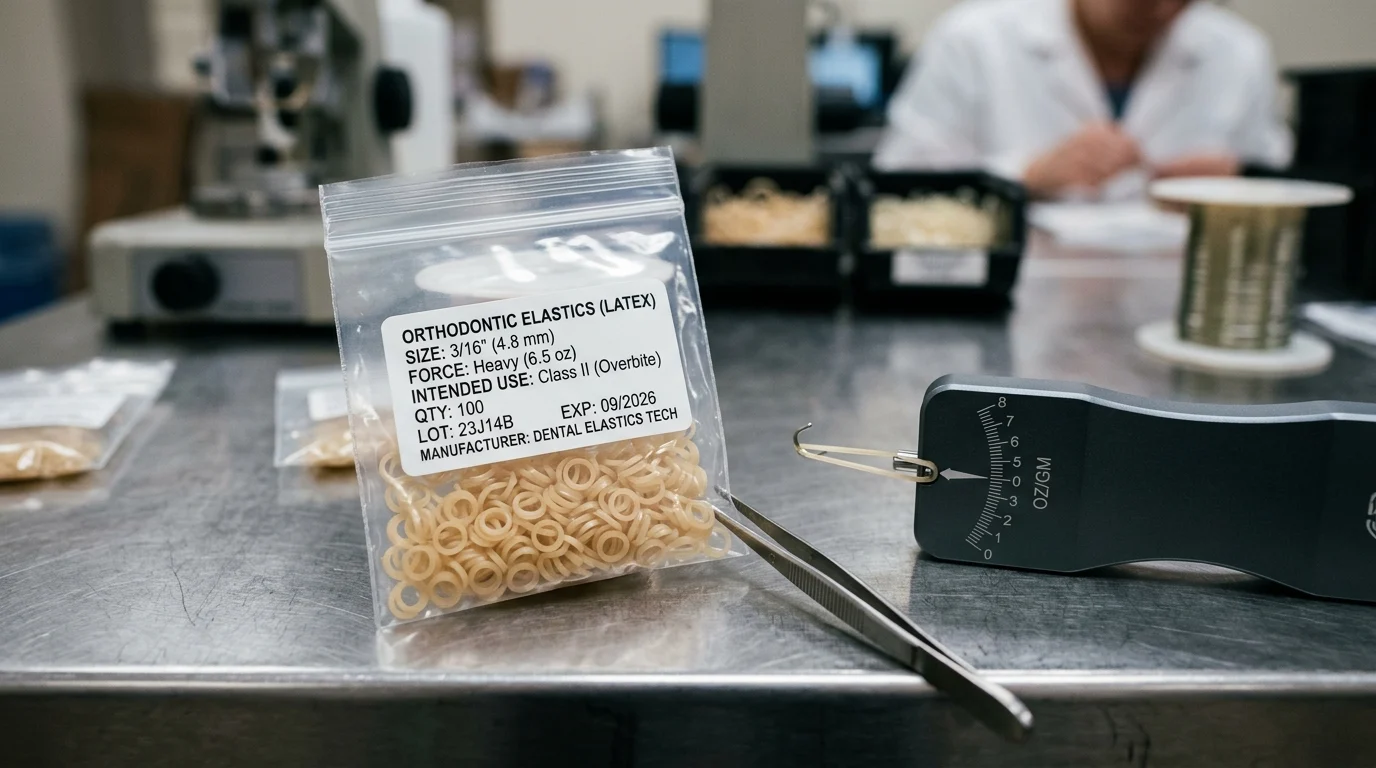
Evaluating product specifications is a critical step for procurement teams, Dental Service Organizations (DSOs), and independent clinicians. The physical properties and packaging configurations of the rubber bands dictate both the biomechanical efficacy of the overbite correction and the daily operational efficiency of the clinic.
| Material Type | Initial Force Retention (24h) | Elongation Limit | Typical Shelf Life |
|---|---|---|---|
| Natural Medical Latex | 70% – 80% | > 500% | 3 – 5 Years |
| Non-Latex (Polyurethane) | 50% – 60% | ~ 300% | 2 – 3 Years |
Force ranges, sizes, latex options, and packaging
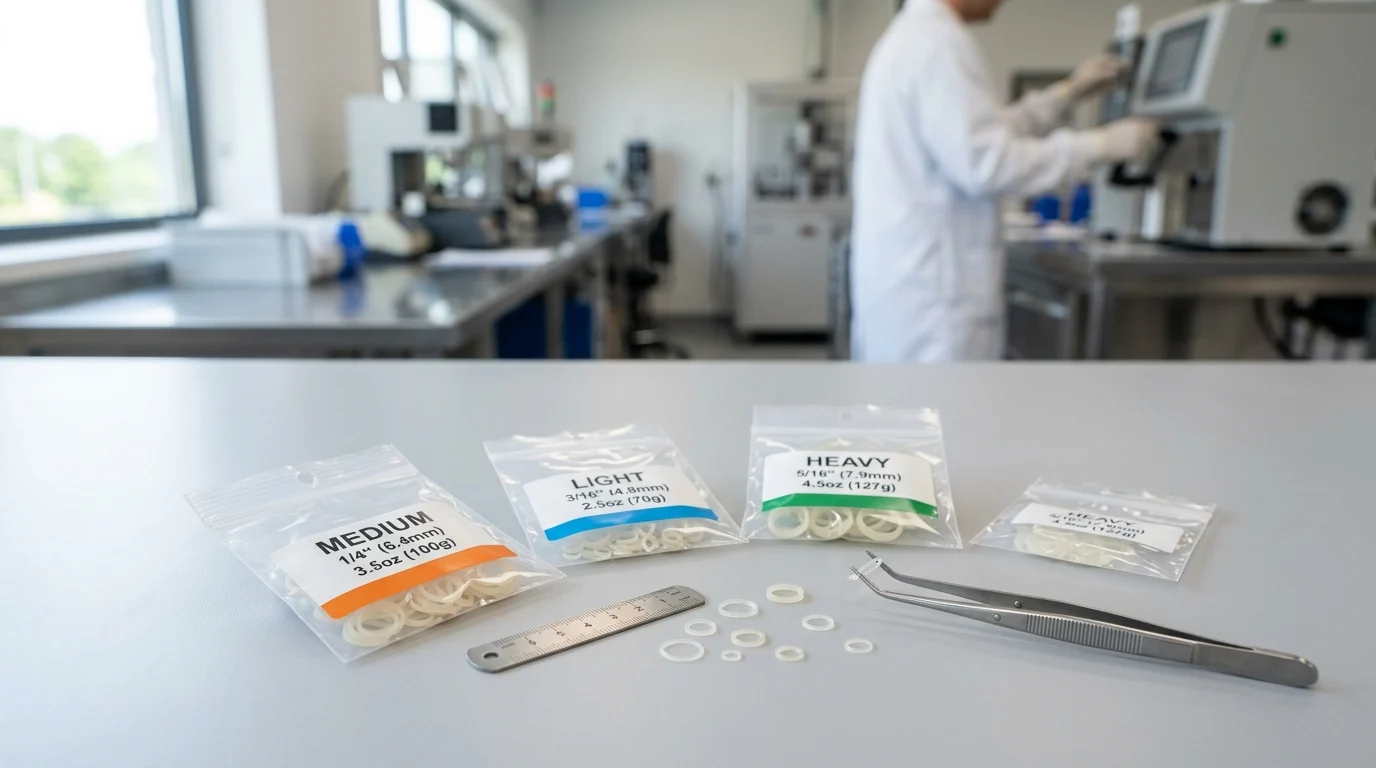
The standard sizing matrix for intraoral elastics is designated by inner diameter, most commonly including 1/8″, 3/16″, 1/4″, 5/16″, and 3/8″. These sizes are paired with specific force ratings, generally categorized into light (2.5 oz), medium (4.5 oz), medium-heavy (5.5 oz), and heavy (6.5 oz) variants, measured at three times their resting diameter.
Leading orthodontic elastics manufacturers provide extensive catalogs covering these size-and-force permutations. Additionally, packaging options vary from patient-ready distribution packs of 50 to 100 bands to bulk clinical boxes containing up to 50 individual patient packs, allowing clinics to optimize their inventory management based on patient volume.
Force consistency, elongation, and color coding
Force degradation is an inevitable characteristic of all elastomers, but the rate of decay varies significantly by material. High-quality natural latex typically loses 20% to 30% of its initial force within the first 24 hours of intraoral use due to moisture absorption and continuous stress. In contrast, non-latex alternatives may experience a steeper force decline of 40% to 50% over the same period.
To mitigate confusion during patient dispensing, manufacturers employ color-coding systems. Whether utilizing neon colors for pediatric appeal or subtle amber/clear tones for aesthetic adult cases, the colorants used must be non-toxic and fade-resistant. Furthermore, the packaging itself is often color-coded or marked with distinct animal graphics to improve patient compliance and ensure the correct size is utilized.
Key product attributes and clinical relevance
The clinical relevance of these material attributes cannot be overstated in overbite correction cases. An elastic band labeled as delivering 4.5 oz of force must reliably deliver that exact tension when stretched from the upper canine to the lower molar. If elongation limits are poor, the band may snap during speech or mastication.
Conversely, if the material exhibits excessive plastic deformation (stretching out without returning to its original shape), the actual force drops rapidly below 3.0 oz. This loss of tension fails to overcome the biological resistance of the periodontal ligament, resulting in delayed clinical outcomes and necessitating more frequent appointments.
How to assess quality systems, compliance, and risk
Navigating the regulatory landscape is paramount when selecting an elastomeric supplier. Because orthodontic rubber bands remain in the oral mucosa for extended periods, they are classified as medical devices and are subject to strict international quality and safety regulations.
Procurement professionals must rigorously audit potential manufacturing partners to ensure full compliance with these standards, thereby shielding their organizations from liability and safeguarding patient health.
Certifications, biocompatibility, and traceability
Reputable manufacturers operate under ISO 13485:2016 standards, which govern quality management systems specific to medical devices. Products distributed in the United States must comply with FDA Class I or Class II regulations, depending on specific marketing claims, while those in Europe require CE marking under the Medical Device Regulation (MDR).
Biocompatibility is validated through ISO 10993 testing protocols, ensuring the elastomers do not elicit cytotoxic, sensitizing, or irritating responses. Furthermore, strict traceability is maintained by assigning unique lot numbers to every production batch. This allows facilities to trace any individual 100-pack back to the exact date, machine, and raw material batch used during its creation.
Lot variation, defect risk, and allergen control
Mitigating clinical risk requires rigorous control over lot-to-lot variation. High-tier manufacturing facilities utilize statistical process control (SPC) to maintain defect rates below 0.1% (fewer than 1 in 1,000 bands). This ensures that instances of premature breakage, fused bands, or improper cuts are practically nonexistent in the final delivered product.
Allergen control is equally critical, particularly concerning latex proteins. Manufacturers must monitor extractable protein levels in their natural rubber lines to minimize sensitization risks. For non-latex (polyurethane) lines, facilities must enforce strict physical segregation—often utilizing entirely separate extrusion and cutting rooms—to prevent any cross-contamination that could trigger severe anaphylactic reactions in latex-allergic patients.
How sourcing, pricing, and supply logistics vary
The economics of orthodontic supplies require buyers to carefully navigate sourcing logistics, pricing tiers, and supplier reliability. While elastics are a high-volume consumable, optimizing their procurement can yield significant reductions in annual overhead.
| Buyer Category | Typical Order Volume (Packs) | Estimated Lead Time | Primary Cost Driver |
|---|---|---|---|
| Private Practice | 100 – 500 / quarter | 1 – 2 Weeks | Distributor Markups |
| Dental Service Org (DSO) | 5,000 – 20,000 / quarter | 4 – 8 Weeks | Custom Packaging (OEM) |
| Global Distributor | 100,000+ / quarter | 8 – 12 Weeks | Raw Material Volatility |
Main cost drivers in orthodontic elastics
The baseline cost of orthodontic elastics is heavily influenced by raw material commodity prices. The global market rates for surgical-grade natural rubber latex and synthetic medical-grade polyurethane dictate the primary material expenses. Additionally, the specialized curing agents and non-toxic colorants add to the overall formulation costs.
Beyond raw materials, capital depreciation of high-precision extrusion and cutting equipment forms a significant portion of the cost structure. Manufacturers must constantly recalibrate and replace cutting blades to maintain the required +/- 0.05 mm tolerances, a maintenance expense that is ultimately factored into the wholesale price per unit.
How practices, DSOs, and distributors compare suppliers
Procurement strategies vary significantly based on the scale of the purchasing entity. Independent orthodontic practices generally rely on regional dental distributors for just-in-time inventory, accepting higher per-unit costs (often $1.50 to $3.00 per patient pack) in exchange for convenience and low minimum order quantities (MOQs).
Conversely, DSOs and large-scale distributors engage directly with manufacturers to leverage economies of scale. Initiating inquiries through dedicated orthodontic elastics manufacturers portals allows high-volume buyers to negotiate tiered pricing, bringing the per-pack cost down significantly while establishing customized delivery schedules that align with quarterly usage forecasts.
Supplier shortlist and sample evaluation steps
Establishing a reliable supplier shortlist involves a structured evaluation protocol. Buyers should request physical samples from at least three different manufacturing facilities, specifying the exact sizes and force ratings (e.g., 1/4″ 4.5 oz) used most frequently in their clinics.
Sample evaluation should include objective dynamometer testing to verify force ratings at exactly three times the resting diameter. Clinicians should also conduct visual inspections for clean, uniform cuts and assess the durability of the packaging seals. Finally, running a limited clinical trial with a trusted subset of patients can provide real-world feedback on breakage rates and force retention over 24-hour wear cycles.
Which decision framework helps buyers choose a manufacturer
Formulating a robust decision framework requires buyers to synthesize strict clinical requirements with broader supply chain realities. The ultimate goal is to secure a reliable, cost-effective stream of high-quality elastics that facilitate predictable overbite correction without inflating clinical overhead.
By systematically evaluating manufacturer capabilities, regulatory compliance, and material specifications, procurement teams can transition from reactive purchasing to strategic sourcing.
How to weigh clinical consistency and patient adherence
The intersection of clinical consistency and patient adherence dictates treatment efficiency in overbite correction. If a specific brand of elastics exhibits breakage rates exceeding 2% or loses tension rapidly, patients experience frustration and their willingness to wear the bands continuously diminishes.
Therefore, procurement decisions cannot be based on unit cost alone. A marginally cheaper elastic that requires patients to use three bands per day instead of two ultimately increases consumption rates and prolongs treatment times. Buyers must weigh the upfront cost savings against the clinical value of superior elasticity and consistent force delivery.
Procurement recommendations by buyer type
Tailoring the procurement strategy to the organizational archetype yields the best financial and clinical results. Small to mid-sized orthodontic clinics should prioritize domestic distributors that offer rapid fulfillment, low MOQs, and carry vetted, premium brands with established track records.
Large institutional buyers, DSOs, and regional distributors must leverage their volume to secure direct manufacturer agreements. These entities should focus on negotiating long-term contracts that lock in pricing against raw material volatility, mandate strict Service Level Agreements (SLAs) for lead times, and explore OEM opportunities to brand patient packs with their own corporate identity.
Further reading:
Key Takeaways
- The most important conclusions and rationale for orthodontic elastics manufacturers
- Specs, compliance, and risk checks worth validating before you commit
- Practical next steps and caveats readers can apply immediately
Frequently Asked Questions
What elastic sizes are commonly used for overbite correction?
Common inner diameters are 1/8″, 3/16″, 1/4″, 5/16″, and 3/8″. For Class II overbite cases, clinicians often match size with 3.5–6.5 oz force based on the treatment plan.
Why does manufacturer quality matter for orthodontic rubber bands?
Small size or cut variations change force delivery and can slow overbite correction. Reliable manufacturers maintain tight tolerances and inspection standards so bands perform consistently as labeled.
Should clinics choose latex or non-latex elastics?
Latex usually offers better 24-hour force retention, while non-latex is useful for patients with latex sensitivity. Choose based on allergy needs, force decay expectations, and the prescribed wear schedule.
What should buyers check before ordering elastics from DenRotary?
Review force range, inner diameter, latex or non-latex material, packaging format, shelf life, and supply stability. DenRotary’s product pages and team can help match clinic volume and case needs.
How can packaging options improve clinic efficiency?
Patient packs of 50–100 bands simplify chairside dispensing, while bulk boxes support larger practices and DSOs. The right packaging reduces counting errors, saves time, and helps maintain stock control.

Post time: Jun-20-2026