



Power chains and elastic ligature ties are essential elements in dental instrumentation and orthodontic manufacturing. These tools enhance tooth alignment by applying consistent pressure on teeth, facilitating effective movement. The use of elastic ligature ties allows for increased flexibility, which significantly improves orthodontic comfort for patients. Meanwhile, the power chain benefits include the ability to close gaps efficiently, ensuring a more streamlined treatment process. Together, they contribute to optimal results in orthodontic care.
Key Takeaways
- Power chains apply continuous pressure to teeth, helping close gaps and align them faster.
- Elastic ligatures secure archwires to brackets, providing comfort and reducing patient appointment time.
- Regular replacement of elastic ligatures every 4 to 6 weeks ensures effective tooth movement.
- Maintaining good oral hygiene is essential to prevent plaque buildup around brackets and ligatures.
- Both tools enhance treatment efficiency, leading to improved patient satisfaction and outcomes.
Understanding Power Chains
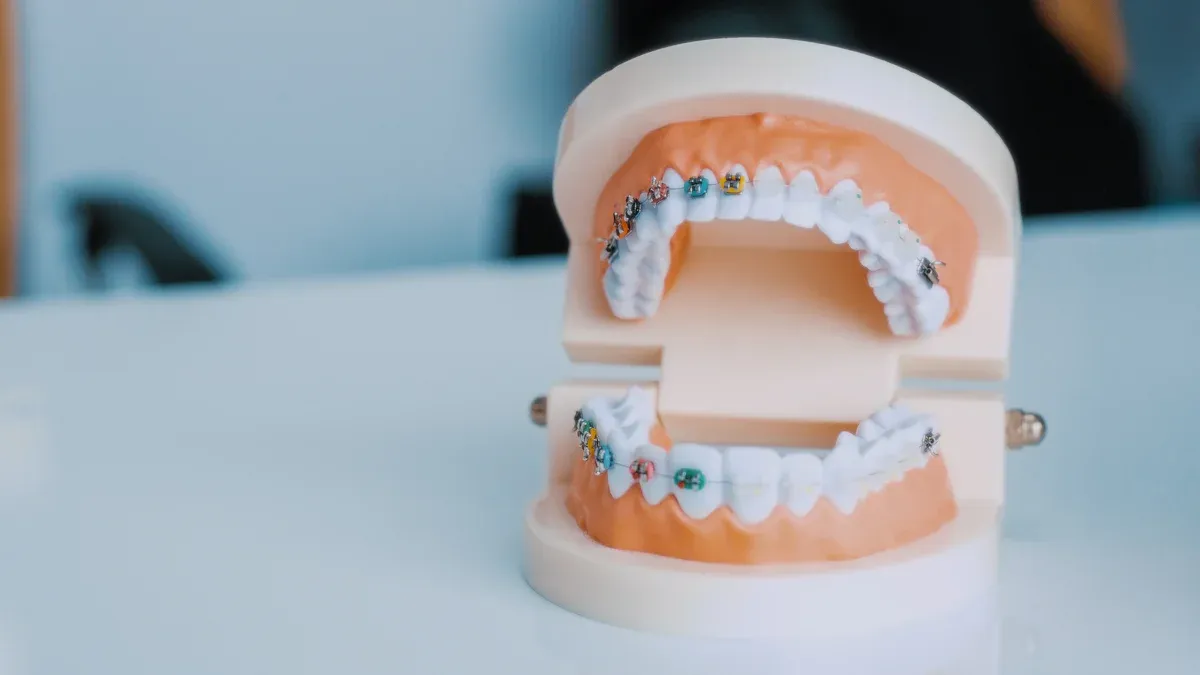
Power chains are a vital component in orthodontic treatment, designed to enhance tooth movement effectively. These chains consist of a series of connected elastic rings that apply continuous pressure to teeth, facilitating their movement into desired positions.
Types of Power Chains
Orthodontists classify power chains into several types based on their structure and intended use. The following table outlines the main types of power chains:
| Type | Description |
|---|---|
| Closed | There is no room between the power chain rings; each ring is directly linked to the next. |
| Short | The chain's rings are separated by a short distance. |
| Long | The power chain's rings are separated by an even greater distance. |
Materials Used in Power Chains
Power chains are primarily made from specific materials that ensure durability and flexibility. Common materials include:
- Polyesters
- Polyethers
These materials are formed through the polymerization of rubbers with multiple molecular structures connected by urethane bonds. This composition allows power chains to exert consistent force over time.
Force Delivery of Power Chains
Power chains deliver varying forces depending on their type. The following table compares the initial mean force and the force at week five for different chain types:
| Chain Type | Initial Mean Force (N) | Force at Week 5 (N) | Percentage Reduction (%) |
|---|---|---|---|
| Orthometric® Black | 5.98 | 2.09 | 65.05 |
| Orthometric® Clear | 6.62 | 2.03 | 69.49 |
| Open Black Chains | 4.75 | 1.69 | 64.47 |
| Closed Black Chains | 5.46 | 2.31 | 57.63 |
| Open Clear Chains | 4.23 | 1.95 | 53.98 |
| Closed Clear Chains | 4.90 | 2.09 | 57.31 |
Indications for Using Power Chains
Orthodontists often choose power chains for specific dental needs. Common indications include:
- Closing gaps more quickly
- Fixing crooked teeth
- Aligning the dental midline
Power chains are particularly effective after tooth extractions or when addressing spacing issues. They also assist in correcting bite alignment and promoting even spacing between teeth.
Understanding Elastic Ligatures

Elastic ligatures play a crucial role in orthodontic treatment by securing archwires to brackets. These small, flexible bands are made from elastic materials, allowing them to exert consistent force on teeth. Unlike power chains, which consist of multiple ligatures linked together, elastic ligatures function individually to hold each tooth in place.
Key Characteristics of Elastic Ligatures
- Material Composition: Elastic ligatures are primarily made from elastomeric materials, which are organic polymers capable of changing dimensions under load. They return to their original size once the load is removed. Common materials include:
Material Type Description Elastomeric Materials Organic polymers that can change dimensions under load and return to original size when load is removed. Polyurethanes Thermosetting polymers formed from polyesters or glycopolyesters and bi- or polyisothiocyanates. Orthodontic Ligatures Specific formulations of polyurethanes used in various commercial brands for orthodontic applications. - Force Delivery: Elastic ligatures exert a force that can decay significantly over time. Studies indicate that these ligatures can lose 50-70% of their force within the first 24 hours. This rapid force loss can impact the effectiveness of tooth movement, making timely adjustments essential.
Advantages and Disadvantages
Elastic ligatures offer several benefits in orthodontic treatment:
- Advantages:
- They reduce patient sitting time during appointments, as they are easy and quick to replace.
- Their flexibility allows for a more comfortable fit around the brackets.
- Disadvantages:
- They can accumulate plaque around brackets, necessitating diligent oral hygiene.
- Compared to metallic ligatures, they may not provide as firm a hold on the archwire.
Clinical Indications for Use
Orthodontists often choose elastic ligatures based on specific clinical needs. The following table summarizes the main indications for using elastic ligatures versus metallic ligatures:
| Aspect | Elastic Ligatures | Metallic Ligatures |
|---|---|---|
| Advantages | Reduces patient sitting time; easy and fast to replace | Better plaque control; firm hold on archwire |
| Disadvantages | Plaque accumulation around brackets; requires cooperation | Older method; less aesthetic options |
Mechanisms of Action
Power chains and elastic ligatures operate through distinct yet complementary mechanisms that enhance tooth movement in orthodontic treatment.
Power Chains
Power chains exert continuous light force on teeth, typically ranging from 80 to 300 grams. This force is crucial for effective tooth movement. The force decay rate for power chains averages between 8% to 12% per day, with an effective action period lasting approximately 72 to 96 hours. The following table summarizes the biomechanical mechanisms of power chains:
| Aspect | Details |
|---|---|
| Continuous light force | Initial force value: 80-300g |
| Force decay rate: 8-12% per day | |
| Effective action period: 72-96h | |
| Three-dimensional control | Horizontal: gap closing (0.5-1mm/week) |
| Vertical: teeth pressing in/out | |
| Axial: Torque assist adjustment | |
| Biomechanical advantages | Friction reduced by 60% compared to ligation wire |
| More uniform stress distribution | |
| Reduced risk of root resorption |
This table illustrates how power chains provide three-dimensional control over tooth movement, allowing for precise adjustments in alignment and spacing.
Elastic Ligatures
Elastic ligatures secure archwires to brackets, applying consistent and gentle pressure essential for efficient tooth movement. They maintain necessary tension throughout treatment, which supports smooth and predictable alignment. The design and material of these ligatures can influence frictional forces between the archwire and brackets. For instance, self-ligating brackets reduce friction by eliminating the need for elastic ligatures, allowing the archwire to slide more freely. This design ensures that more of the inherent force translates effectively into tooth movement.
In contrast to power chains, elastic ligatures may experience significant force decay. Studies show that elastomeric chains maintain optimal force for tooth movement for up to four weeks but can suffer from permanent distortion, affecting their mechanical properties. This difference highlights the importance of timely adjustments in orthodontic care.
Together, power chains and elastic ligatures create a dynamic system that enhances the effectiveness of dental instrumentation in orthodontics, leading to improved patient outcomes.
Benefits of Power Chains and Elastic Ligatures
Power chains and elastic ligatures offer numerous advantages in orthodontic treatment. Their unique properties enhance the effectiveness of dental instrumentation, leading to improved patient outcomes.
Advantages of Power Chains
- Continuous Force Application: Power chains apply consistent pressure across multiple teeth. This feature effectively closes gaps in the smile and promotes faster alignment.
- Faster Results: Clinical studies show that power chains achieve results more quickly than traditional elastic bands. They provide a reliable method for orthodontists to expedite treatment.
- Stability: Power chains offer greater stability compared to traditional steel-wire ligatures. This stability is crucial during various orthodontic procedures, ensuring that teeth move as intended.
Benefits of Elastic Ligatures
Elastic ligatures also contribute significantly to patient comfort and treatment efficiency. The following table summarizes their key functions:
| Function | Description |
|---|---|
| Securing the Archwire | Holds the archwire firmly within the bracket slot, ensuring effective force transmission. |
| Controlling Wire Play | Reduces unwanted wire mobility for better tooth movement control. |
| Maintaining Continuous Force | Resists degradation to maintain active tension, preventing treatment slowdowns. |
| Gentler, More Stable Tension | Soft elastomers distribute force comfortably, reducing soreness. |
| Reduced Irritation | Consistent sizing minimizes risk of irritation to cheeks and gums. |
| Less Food Accumulation | Higher-quality ties help keep brackets cleaner, reducing plaque retention. |
| Vibrant Colors Increase Compliance | Color choices enhance the experience for younger patients, improving cooperation and satisfaction. |
Together, power chains and elastic ligatures create a dynamic system that enhances the overall effectiveness of orthodontic treatment. Their combined benefits lead to improved patient satisfaction and better treatment outcomes.
Dental Instrumentation in Orthodontics
Dental instrumentation plays a crucial role in orthodontics, particularly when using power chains and elastic ligatures. Orthodontists rely on various tools to ensure precise placement and effective force application during treatment. The following list highlights some common instruments used alongside power chains and elastic ligatures:
- Auxiliary Mechanics Instruments:
- Chain and Spring Cutters
- Coil Spring Placing Pliers
- Power Chain Stretchers
- Distalizers & Separators Tools
- Banding and Bonding Instruments:
- Band Seaters
- Band Bending Pliers
- Bracket Placement Forceps
- Composite Placement Instruments
- Light-Curing Devices
- Ligature and Elastomeric Instruments:
- Ligature Directors
- Ligature Tie Tools
- Elastic Ring Placement Pliers
Selecting the appropriate dental instruments is essential for effective treatment. Orthodontists consider the specific functions of each tool to ensure optimal results. The table below summarizes key instruments and their functions:
| Instrument | Function |
|---|---|
| Ligature Director | Pushes the elastic tie under the archwire and secures it around the bracket wings. |
| Hemostat or Mathieu Plier | Grabs and stretches the elastic tie, allowing for easy manipulation. |
| Explorer | Checks the placement of the tie and ensures it is fully seated. |
Technological advancements have also improved the application of power chains and elastic ligatures. Innovations include new materials that are biocompatible and hypoallergenic, enhancing patient comfort. The table below outlines some of these advancements:
| Advancement Type | Description |
|---|---|
| New Materials | Advanced polymers that are biocompatible and hypoallergenic, reducing irritation and discomfort. |
| Smart Technology | Elastic ties with sensors that measure force and change color, aiding in precise adjustments and hygiene. |
| Durability | Longer-lasting ties that maintain strength, reducing the need for replacements and improving efficiency. |
| Antimicrobial Agents | New ties that help prevent plaque buildup, enhancing oral hygiene during treatment. |
| Biodegradable Options | Eco-friendly ties that simplify the debonding process and reduce waste. |
These advancements in dental instrumentation not only improve treatment efficiency but also enhance patient satisfaction throughout the orthodontic process.
Power chains and elastic ligatures significantly enhance orthodontic treatment effectiveness. They provide continuous force, facilitating efficient tooth movement and alignment. Research indicates that elastomeric power chains retain half their initial force for up to 15 weeks, demonstrating their reliability in closing gaps.
Key Benefits:
- Improved alignment and faster results.
- Enhanced patient comfort during treatment.
- Greater stability compared to traditional methods.
Orthodontists recommend maintaining proper oral hygiene while using these tools to prevent complications such as gum disease and tooth decay. Overall, power chains and elastic ligatures play a crucial role in achieving successful orthodontic outcomes.
FAQ
What are power chains used for in orthodontics?
Power chains are used to apply continuous pressure on teeth. They effectively close gaps and align teeth during orthodontic treatment, promoting faster results.
How often should elastic ligatures be replaced?
Orthodontists typically recommend replacing elastic ligatures every 4 to 6 weeks. Regular replacement ensures optimal force delivery and maintains effective tooth movement.
Are power chains painful?
Patients may experience mild discomfort when power chains are first applied. This discomfort usually subsides within a few days as teeth adjust to the pressure.
Can I eat normally with power chains?
Yes, patients can eat normally with power chains. However, they should avoid sticky or hard foods that may damage the chains or cause discomfort.
How do I maintain oral hygiene with elastic ligatures?
Maintaining oral hygiene is crucial. Patients should brush and floss regularly, focusing on areas around brackets and ligatures to prevent plaque buildup and gum disease.
Post time: Feb-05-2026