

Introduction
Bulk purchasing orthodontic brackets can lower unit costs, but scale also magnifies forecasting errors, compatibility issues, and supply disruptions. For DSOs and multi-location practices, the real challenge is not simply negotiating price; it is choosing the right mix of bracket types, slot sizes, materials, and vendor terms to support consistent clinical performance across sites. This article outlines five common mistakes that undermine savings and workflow efficiency, from overbuying low-use inventory to overlooking standardization and service reliability. By the end, readers will know what to check before placing a large order and how to turn procurement volume into practical operational value.
Why Bulk Ordering Orthodontic Brackets Requires a Strategic Plan
Procuring orthodontic brackets at scale represents a significant financial and operational commitment for Dental Support Organizations (DSOs) and large clinical networks. When executing bulk orders—typically defined as procurement volumes exceeding 1,000 to 5,000 full sets per quarter—organizations must move beyond transactional purchasing to implement a comprehensive strategic plan.
Failing to align procurement metrics with clinical realities can result in severe capital misallocation and disrupted patient care schedules. A strategic approach ensures that volume purchasing translates directly into measurable clinical and financial advantages.
Cost Control and Chairside Efficiency
Effective cost control in orthodontics extends far beyond the initial invoice. While bulk purchasing agreements can yield tier-based discounts ranging from 15% to 35% compared to piecemeal ordering, these savings are quickly negated if the inventory does not optimize chairside efficiency. Holding excessive inventory of rarely used brackets ties up vital working capital.
Clinical teams rely on consistent bracket performance to maintain tight appointment schedules. If a bulk-ordered bracket system suffers from inconsistent flash removal or unreliable ligation mechanics, the resulting increase in chair time—even by just 5 to 10 minutes per patient—can drastically reduce the daily revenue potential and operational throughput of the practice.
Bracket Types, Slot Sizes, and Materials
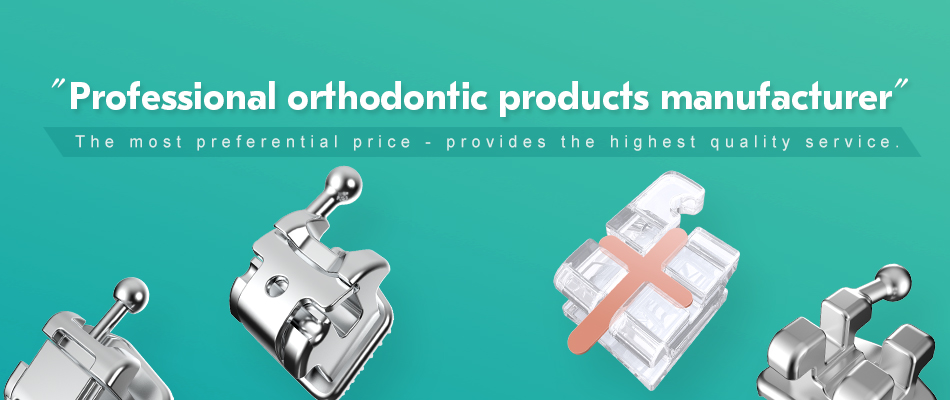
A strategic bulk order must precisely define the technical specifications of the brackets to match preferred clinical protocols. The market offers a myriad of bracket types, including metal injection molded (MIM) stainless steel, monocrystalline sapphire, and advanced self-ligating systems. Procurement teams must dictate precise slot sizes, typically choosing between the 0.018-inch and 0.022-inch standards, alongside specific prescription requirements such as Roth or MBT.
Furthermore, high-quality manufacturing requires stringent dimensional tolerances. For instance, torque values should ideally be maintained within a ±1 degree tolerance to ensure predictable tooth movement and minimize the need for compensatory wire bending by the orthodontist. Specifying these tolerances upfront prevents the acquisition of substandard bulk lots.
Common Specification Mistakes in Bulk Ordering

One of the most frequent causes of wasted capital in orthodontic procurement is the failure to establish rigorous, standardized specifications before initiating a bulk order. Industry data suggests that up to 20% of orthodontic inventory in large practices can become obsolete or remain unused simply due to specification mismatches between what was ordered and what clinicians actually require for their specific case distributions.
Lack of Standardized Specifications
A lack of standardized specifications often manifests when procurement managers mix prescriptions or base designs without conducting a data-driven clinical audit. For example, ordering a 50/50 split of 80-gauge mesh bases and laser-etched bases without consulting clinical directors can lead to bonding inconsistencies across the network.
Furthermore, failing to specify the exact bracket base contour—such as compound contouring for specific bicuspids—can result in elevated bond failure rates. Bulk orders must explicitly detail every parameter, including hook placements (e.g., hooks on cuspids and bicuspids only) and color-coding systems, to prevent chaos in inventory management and chairside application.
Overemphasis on Unit Price
Procurement teams are frequently incentivized to drive down the cost of goods sold (COGS), leading to a dangerous overemphasis on unit price at the expense of clinical reliability. Purchasing ultra-low-cost brackets can trigger a cascade of hidden operational costs, primarily driven by high bond failure rates and bracket deformation during treatment.
| Cost Strategy | Unit Price Range (per bracket) | Average Bond Failure Rate | Hidden Operational Costs |
|---|---|---|---|
| Aggressive Low-Cost | $0.40 – $0.90 | 5% – 8% | Excessive rebonding time, delayed treatment, patient dissatisfaction |
| Value-Optimized | $1.50 – $3.00 | 1% – 3% | Minimal; predictable inventory turnover and reliable outcomes |
| Premium / Brand-Name | $4.00 – $8.00+ | < 1% | High upfront capital, though highly reliable clinical outcomes |
Selecting a supplier solely because they offer a $0.50 unit price often ignores the metallurgical integrity of the product. A bracket that deforms under the torque of a heavy rectangular archwire necessitates replacement, costing the practice upwards of $50 in lost chair time, wasted materials, and overhead per incident.
How to Evaluate Orthodontic Bracket Suppliers
Evaluating and selecting the right manufacturing partner is a critical risk management exercise. Because bulk orders often involve direct-to-manufacturer OEM (Original Equipment Manufacturer) or ODM (Original Design Manufacturer) contracts, the minimum order quantities (MOQs) typically range from 2,000 to 10,000 pieces per specific bracket variant. Committing to these volumes requires rigorous supplier vetting to avoid receiving substandard medical devices.
Supplier Qualification Risks
Engaging with unverified brokers or substandard manufacturers introduces severe supplier qualification risks. A primary risk is the falsification or expiration of quality management certifications. Orthodontic brackets are regulated medical devices, and any legitimate manufacturing partner must hold an active ISO 13485 certification specific to medical device manufacturing.
Furthermore, procurement teams must verify the supplier’s Acceptable Quality Limit (AQL). For orthodontic brackets, an AQL of 1.0 for major defects (such as blocked slots or missing hooks) and 1.5 for minor defects is the industry benchmark. Failing to formally audit these qualifications can result in receiving thousands of brackets that are clinically unusable, leading to total write-offs.
Key Comparison Criteria
To systematically evaluate potential partners, procurement teams should utilize a weighted comparison matrix. This approach removes subjective bias and ensures all critical operational and clinical standards are met before authorizing a bulk transaction.
| Evaluation Criteria | Minimum Acceptable Standard | Ideal Target Standard | Weight in Decision |
|---|---|---|---|
| Production Capacity | 50,000 sets / month | > 100,000 sets / month | 20% |
| Defect Rate (AQL) | < 1.5% | < 0.5% | 30% |
| Average Lead Time | 45 days | < 30 days | 25% |
| Material Traceability | Batch-level tracking | Individual lot & raw material tracking | 25% |
By scoring suppliers against these key criteria, organizations can differentiate between high-tier manufacturers capable of sustaining long-term bulk agreements and lower-tier factories that may struggle with consistency across multiple production runs.
Compliance and Logistics Risks in Bulk Orders
The globalization of the orthodontic supply chain means that bulk orders frequently cross international borders, subjecting them to a complex web of regulatory frameworks and logistical variables. Mismanaging these elements can result in shipments being seized by customs or delayed for months, forcing clinics to purchase emergency stock at premium domestic prices to bridge the supply gap.
Regulatory Review Gaps
Regulatory review gaps are a primary cause of cross-border supply chain disruptions. In the United States, orthodontic brackets are classified as Class II medical devices, requiring the manufacturer to possess a valid FDA 510(k) clearance. In the European Union, compliance with the stringent Medical Device Regulation (MDR 2017/745) and proper CE marking are mandatory.
Procurement teams must also ensure that the bulk packaging complies with Unique Device Identification (UDI) requirements. A missing UDI barcode or an expired regulatory certificate can trigger immediate customs holds, leading to demurrage charges that can easily exceed $1,000 per week, alongside severe clinical stockouts.
Inventory Planning and Shipping Terms
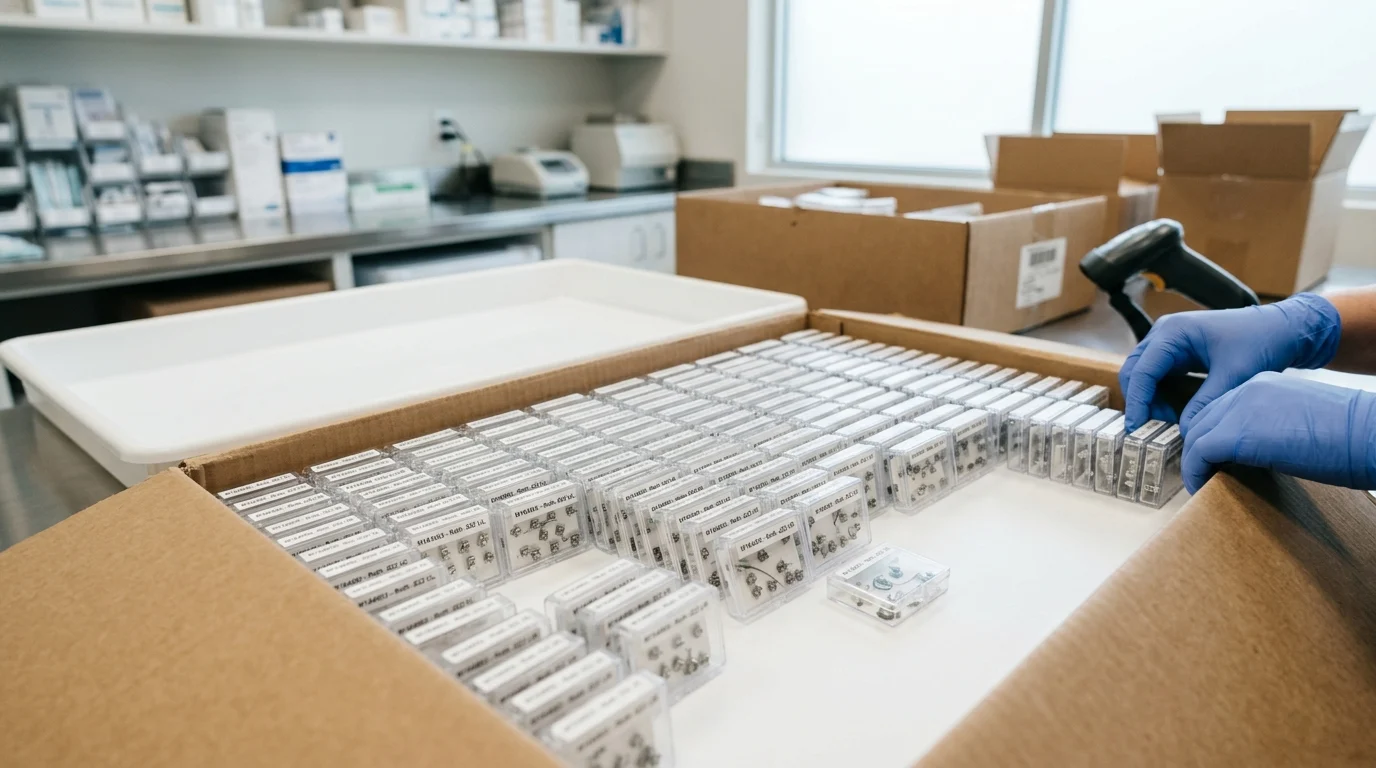
Effective inventory planning and the strategic selection of shipping terms (Incoterms) are vital for protecting margins on bulk orders. Organizations must calculate precise safety stock levels—typically maintaining 45 to 60 days of inventory—to absorb transit fluctuations and unexpected clinical demand spikes.
When negotiating logistics, buyers must weigh the cost-to-speed ratio. Air freight for a standard bulk order of 5,000 sets (approximately 50 to 60 kg) ensures delivery within 5 to 7 days but incurs premium costs ranging from $6 to $10 per kilogram. Conversely, sea freight under FOB (Free on Board) or DDP (Delivered Duty Paid) terms reduces transportation costs by up to 70% but extends lead times to 30 to 45 days. Balancing these logistics requires highly accurate forecasting models.
Decision Framework for Better Bulk Ordering

Transitioning from ad-hoc purchasing to a sophisticated bulk ordering model requires a disciplined decision framework. By bridging the traditional divide between financial objectives and clinical requirements, large-scale orthodontic providers can reduce their procurement cycle times by up to 30% while simultaneously elevating the standard of patient care and operational predictability.
Steps for Procurement and Clinical Teams
The procurement process must follow a sequential, collaborative pathway involving both supply chain managers and clinical directors. Step one involves a comprehensive clinical audit to determine exact usage rates, such as the precise ratio of 0.022-inch to 0.018-inch slot preferences across the network.
Step two requires ordering a controlled sample batch—typically 50 to 100 sets—for a clinical trial phase to validate bond strength, slot precision, and ligation ease. Only after clinical sign-off should step three commence: negotiating the bulk contract. These contracts should ideally lock in pricing and production schedules for a 12 to 24-month period, protecting the organization from raw material price volatility.
Balancing Quality, Compliance, Lead Time, and Cost
The ultimate objective of the decision framework is to successfully balance the core pillars of medical procurement: Quality, Compliance, Lead Time, and Cost. A successful bulk ordering strategy does not simply chase the lowest unit price; it optimizes total clinical value and supply chain resilience.
Target metrics for a mature procurement operation should include maintaining a clinical bond success rate of over 99%, ensuring 100% regulatory compliance on all inbound shipments, stabilizing lead times at under 4 weeks, and achieving a blended cost reduction of 15% to 20% compared to decentralized purchasing. By adhering to this framework, orthodontic networks can transform their supply chain into a strategic asset rather than a mere operational expense.
Key Takeaways
- The most important conclusions and rationale for Bulk Ordering Orthodontic Brackets
- Specs, compliance, and risk checks worth validating before you commit
- Practical next steps and caveats readers can apply immediately
Frequently Asked Questions
What specifications should be standardized before a bulk bracket order?
Lock in bracket type, slot size (0.018 or 0.022), prescription, hook placement, base design, material, and color coding before ordering.
Why is the lowest unit price often a bulk-ordering mistake?
Cheap brackets can increase bond failures, deformation, and rebonding time, which raises chairside costs far beyond the invoice savings.
How can buyers verify bracket quality before placing a large order?
Request samples, confirm CE/FDA/ISO13485 documentation, review tolerance consistency, and test bonding and handling with clinicians first.
Which bracket options does Denrotary offer for bulk orders?
Denrotary supplies metal, ceramic, sapphire, and self-ligating brackets, plus matching buccal tubes, arch wires, and other orthodontic accessories.
How can a clinic avoid overstocking the wrong orthodontic brackets?
Audit actual case mix and usage by prescription, slot, and material, then forecast quarterly demand instead of ordering by guesswork.

Post time: May-14-2026