
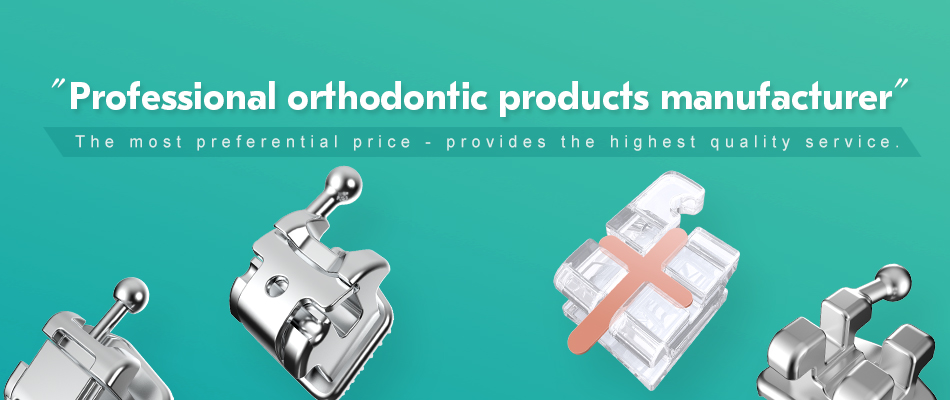

Effective capacity comparison starts with a simple rule: output alone does not define a strong orthodontic manufacturer. Buyers should evaluate how much can be produced, how consistently it is made, how it is inspected, how it is documented, and how quickly it can support OEM orthodontic products.
How to Compare Orthodontic Factory Production Capacity Effectively
The most useful comparison framework is built around five key metrics: monthly production volume, line automation level, in-process quality control, compliance readiness, and OEM customization speed. These indicators show whether a supplier can handle routine replenishment, urgent orders, and long-term program growth.
What an Orthodontic Factory Should Produce
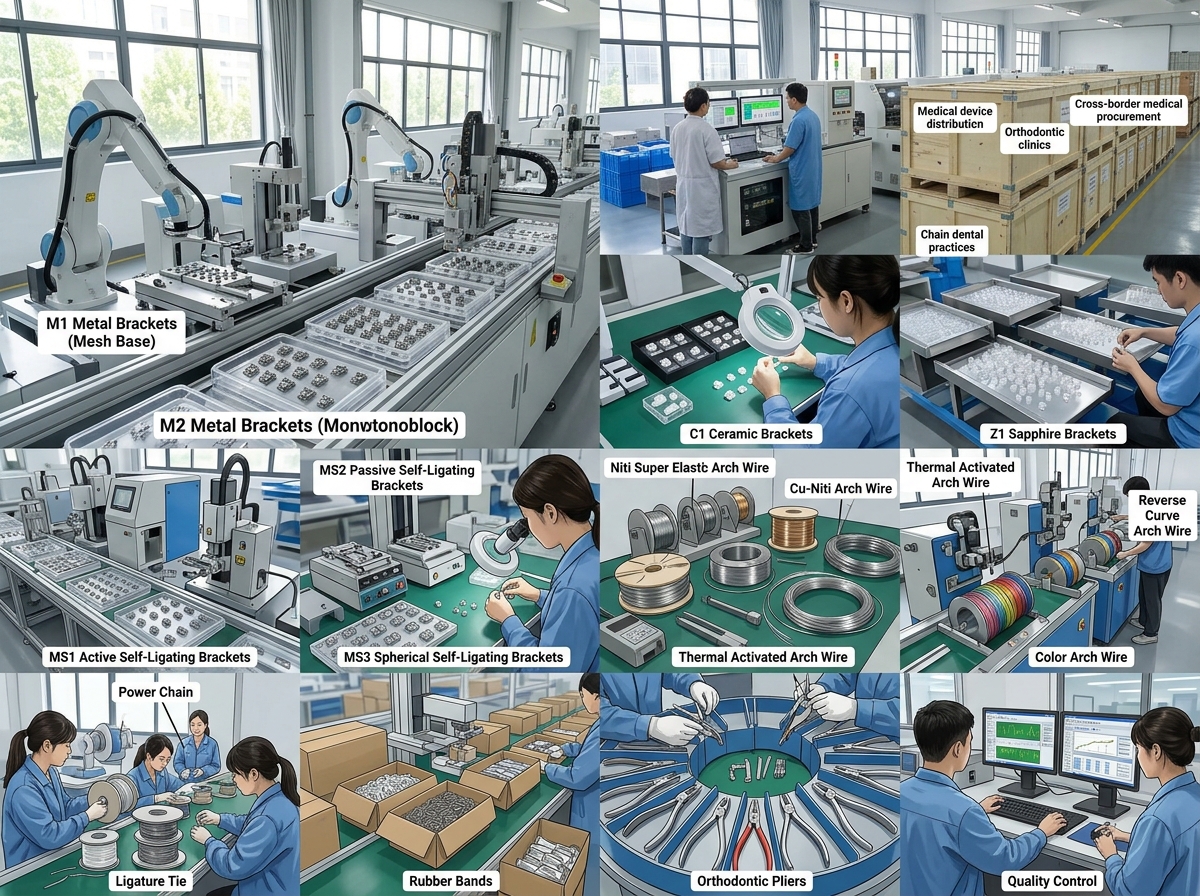
A complete orthodontic factory usually covers five product groups: bracket systems, buccal tube and band systems, archwire systems, elastic and ligation accessories, and orthodontic tools. This product structure matters because a broader portfolio often reflects better process integration and more stable production planning.
For example, Denrotary’s catalog includes orthodontic bracket systems, buccal tube and band systems, and orthodontic archwire systems, which suggests a vertically organized manufacturing model. It also extends to elastics and pliers, which is useful for clinics and distributors that want one-source procurement.
Capacity Indicator 1: Monthly Output and Line Utilization
Monthly output is the first capacity signal, but it should never be read in isolation. A factory may advertise high volume, yet still struggle with lead-time stability if its lines are overloaded or poorly balanced.
How to judge real output
Ask for average monthly output by product family, not a single combined number. Brackets, archwires, and elastic accessories have different cycle times, so separate figures reveal whether the factory can scale each category independently.
What buyers should verify
- Average monthly output by SKU family
- Peak-season capacity versus normal capacity
- Lead time for standard and custom orders
- Whether production is in-house or partially outsourced
When a supplier cannot explain these details clearly, the stated capacity may not reflect actual delivery performance.
Comparison Table: Output Signals That Matter in Orthodontic Manufacturing
| Metric | Why it matters | What strong performance looks like |
|---|---|---|
| Monthly output | Shows baseline supply ability | Stable volume across core product families |
| Line utilization | Shows whether the plant is overloaded | Balanced production with reserve capacity |
| Lead time | Shows delivery reliability | Predictable standard-order turnaround |
| SKU coverage | Shows portfolio depth | Multiple bracket, wire, and accessory types |
Capacity Indicator 2: Process Consistency and Automation
Process consistency is the second major sign of a capable orthodontic manufacturer. In medical device production, repeatability matters as much as throughput because small deviations can affect fit, bonding, and clinical performance.
Automation is important when it reduces variation, not when it is used as a marketing phrase. A factory with modern forming, polishing, inspection, and packaging systems is usually better positioned to maintain dimensional consistency and batch-to-batch uniformity.
What automation should support
Automation should improve bracket slot accuracy, archwire shape control, and accessory packaging consistency. It should also reduce manual handling in sensitive stages where contamination or deformation could occur.
Why this matters for OEM buyers
OEM orthodontic products often require stable specifications across repeated orders. If the factory cannot reproduce the same dimensions, surface finish, and packaging format, private-label programs become difficult to manage.
Comparison Table: Automation Features and Their Manufacturing Impact
| Factory feature | Production impact | Buyer benefit |
|---|---|---|
| Automated forming | Improves repeatability | More consistent product geometry |
| In-line inspection | Detects defects early | Lower rejection risk |
| Standardized packaging | Supports traceability | Easier distribution and inventory control |
| Controlled workflow | Reduces variation | More reliable reorders |
Capacity Indicator 3: Quality Control and Regulatory Readiness
Quality control is a core capacity metric because a factory is only truly scalable when it can produce acceptable products repeatedly. For medical devices, this also includes documentation, traceability, and regulatory discipline.
International buyers should look for quality systems aligned with ISO 13485, which ISO describes as the quality management standard for medical devices. The FDA also states that device establishments involved in commercial distribution in the U.S. must register annually, and registration/listing does not itself mean FDA approval.
Documents that signal readiness
Useful evidence includes batch records, inspection logs, material traceability, complaint handling procedures, and export compliance files. These documents show whether the factory can support audits and repeat orders without operational gaps.
Why compliance affects capacity
A plant with weak documentation may still produce volume, but it cannot reliably support regulated markets. That limitation reduces practical capacity because many buyers will not place large orders without proof of control.
For orthodontic procurement teams, AAO resources are useful for understanding how appliance selection affects patient management and treatment workflow.
 Capacity Indicator 4: OEM Flexibility and Product Breadth
OEM flexibility is a direct measure of whether a factory can support private-label growth. A strong supplier should be able to adjust packaging, labeling, slot prescriptions, material options, and kit combinations without disrupting core production.
Denrotary’s product structure shows this kind of breadth through metal, ceramic, sapphire, and self-ligating bracket options, plus archwires, buccal tubes, elastics, and pliers. That matters because a distributor can build a complete fixed-appliance program instead of sourcing each component separately.
What OEM flexibility should include
- Custom packaging and labeling
- Multiple bracket materials and designs
- Archwire variants for different treatment stages
- Accessory bundles for clinic or distributor programs
When these options are available, procurement becomes simpler and inventory planning becomes more efficient.
Capacity Indicator 5: Clinical Relevance and SKU Integration
Clinical relevance is the fifth capacity metric because production strength should match real treatment workflows. A factory that understands fixed orthodontics can better align its output with how clinicians use products across treatment stages.
For example, NiTi archwires are typically used for initial alignment, stainless steel wires are more common in later-stage control, and elastic chains support space closure. A factory that produces these categories together can serve the full treatment sequence more effectively.
How integrated SKU planning helps buyers
Integrated SKU planning reduces the risk of mismatched inventory. It also helps clinics and distributors order bracket systems, archwires, and auxiliaries in coordinated sets rather than as isolated items.
That coordination is especially important for OEM orthodontic products, where packaging consistency and treatment-stage logic often influence purchasing decisions more than unit price alone.
Supplier Directory: Where to Compare Factory Capacity
Buyers should compare a specialized orthodontic factory against other established suppliers in the same category, not against general dental vendors. A focused manufacturer is more likely to maintain tighter process control across brackets, wires, and auxiliaries.
For a product-led comparison, start with the main categories on Denrotary’s orthodontic product portfolio and then benchmark them against other well-known orthodontic suppliers that publish clear specifications, regulatory information, and export documentation. The best comparison is based on evidence, not brand familiarity.
Practical Checklist for Evaluating an Orthodontic Manufacturer
A practical factory audit should combine production, compliance, and commercial questions. This approach is more reliable than relying on a single factory tour or a short sales presentation.
- Ask for monthly output by product family.
- Review quality certificates and audit documents.
- Check whether the factory supports OEM packaging and labeling.
- Confirm whether core products are made in-house.
- Compare lead times for standard and customized orders.
If a supplier answers these questions clearly, it is usually easier to trust its long-term capacity.
Why Capacity Comparison Matters for Distributors and Clinics
Capacity comparison matters because supply interruptions affect treatment continuity, inventory cost, and customer trust. For distributors, a stable factory reduces stock risk. For clinics, it reduces the chance of delayed treatment steps or product substitution.
In practice, the best orthodontic factory is not always the largest one. It is the one that can consistently deliver the right product, in the right format, with the right documentation, at the right time.
FAQ
1. What is the most important metric when comparing orthodontic factory production capacity?
Monthly output is important, but it should be paired with consistency, quality control, and lead-time stability. A factory with moderate volume and strong repeatability may be more reliable than a larger plant with unstable delivery or weak documentation.
2. How can buyers verify whether an orthodontic manufacturer is truly OEM-ready?
Ask for OEM packaging samples, labeling options, batch traceability records, and customization timelines. A genuine OEM-ready supplier should explain how it handles private-label orders without disrupting standard production or quality inspection workflows.
3. Why do certifications matter in orthodontic procurement?
Certifications matter because orthodontic products are medical devices and often enter regulated markets. ISO 13485 supports quality management, while FDA registration and listing are relevant for U.S. commercial distribution. These signals help buyers assess compliance readiness.
4. Should a buyer prefer a factory with a broad product range?
Usually yes, if the broader range is supported by real manufacturing control. A complete portfolio can simplify sourcing for brackets, archwires, buccal tubes, elastics, and tools, but only if the supplier maintains consistent quality across all categories.
5. What is the best way to compare two orthodontic factories objectively?
Use the same checklist for both suppliers: output, automation, quality control, certifications, OEM flexibility, and delivery performance. Then request samples and documentation. Objective comparison works best when it focuses on evidence rather than sales claims.

Post time: Aug-03-2026