

Introduction
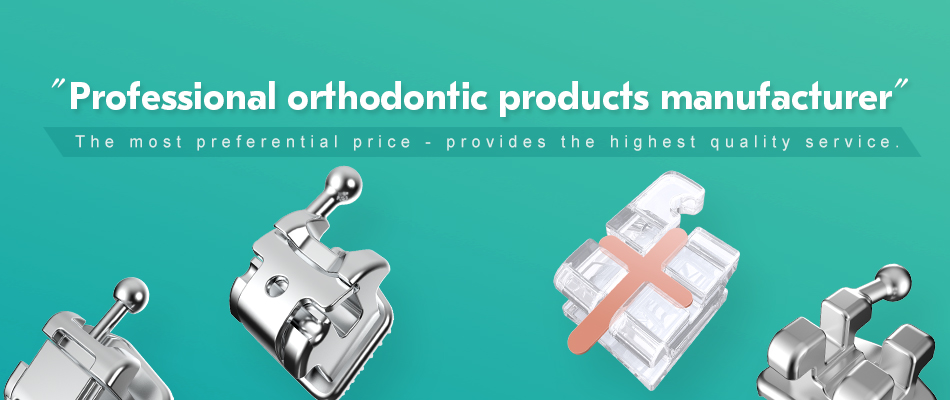
China has become a pivotal source for orthodontic brackets, not only because of lower manufacturing costs, but because many suppliers now offer the precision, compliance, and production scale that serious buyers require. For distributors, clinics, and procurement teams, choosing the right partner means looking beyond price to assess materials, manufacturing methods, certifications, and delivery reliability. This article highlights seven of the most reliable orthodontic braces suppliers in China and explains what sets them apart, so you can compare options more efficiently and approach sourcing with clearer criteria for quality, consistency, and long-term supply stability.
Why China Orthodontic Bracket Suppliers Matter
The global orthodontic supplies market relies heavily on manufacturing infrastructure located in East Asia. As dental service organizations (DSOs) and independent distributors seek to optimize their supply chains, partnering with reliable manufacturers becomes a strategic imperative. Chinese manufacturers have transitioned from low-cost, low-tier production to advanced medical device fabrication, leveraging state-of-the-art Metal Injection Molding (MIM) and automated CNC machining.
For procurement professionals, understanding the capabilities of these manufacturers is critical. The shift toward high-precision orthodontics means that buyers must evaluate facilities not just on unit price, but on metallurgical competence, regulatory adherence, and supply chain resilience.
Cost and supply advantages
The primary driver for sourcing orthodontic materials from China remains the significant cost arbitrage, which does not necessitate a compromise in clinical efficacy. Top-tier factories operate with economies of scale that allow for unit cost reductions of 30% to 50% compared to domestic Western manufacturing. Annual production capacities at leading facilities frequently exceed 500,000 to 1,000,000 bracket sets, ensuring consistent inventory availability even during peak demand cycles.
Furthermore, localized supply chains for raw materials—such as medical-grade 17-4 PH stainless steel and monocrystalline alumina—reduce upstream delays. Leading orthodontic bracket suppliers have vertically integrated their production lines, bringing tooling, molding, and polishing in-house to compress lead times from the industry average of 45 days down to 20-30 days for bulk OEM orders.
Key buyer selection criteria
Selecting a manufacturing partner requires rigorous evaluation beyond a standard supplier audit. Buyers must prioritize dimensional accuracy, specifically in the bracket slot tolerances, which must consistently hold within +/- 0.001 inches to ensure proper torque expression during treatment. A supplier’s metallurgical expertise directly impacts the incidence of bracket deformation and corrosion resistance in the oral environment.
Another non-negotiable criterion is the clinical defect rate. Reliable manufacturers maintain a defect threshold strictly below 0.5%, monitored via automated optical inspection (AOI) systems. Furthermore, buyers must assess a supplier’s capability to offer specialized base designs, such as 80-gauge mesh or laser-etched bases, which are critical for achieving bond strengths exceeding 10 MPa.
Top Orthodontic Bracket Suppliers in China
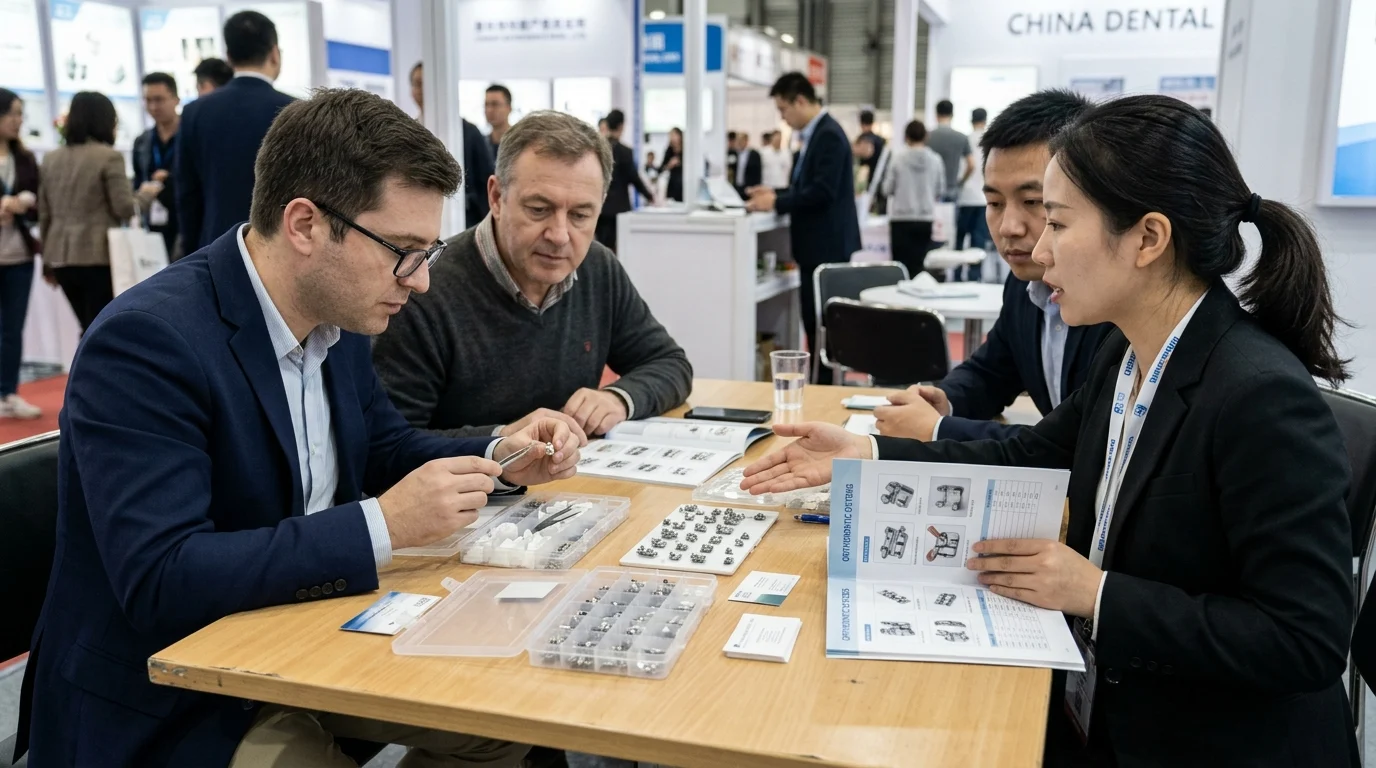
The landscape of Chinese orthodontic manufacturing is highly stratified, with a distinct upper echelon of suppliers dominating the export market. These top 7 manufacturers have distinguished themselves through sustained investment in R&D, stringent quality control architectures, and comprehensive international certifications. Recognizing the nuances between these industry leaders allows procurement teams to align their specific clinical and commercial requirements with the right manufacturing partner.
Supplier strengths and product focus
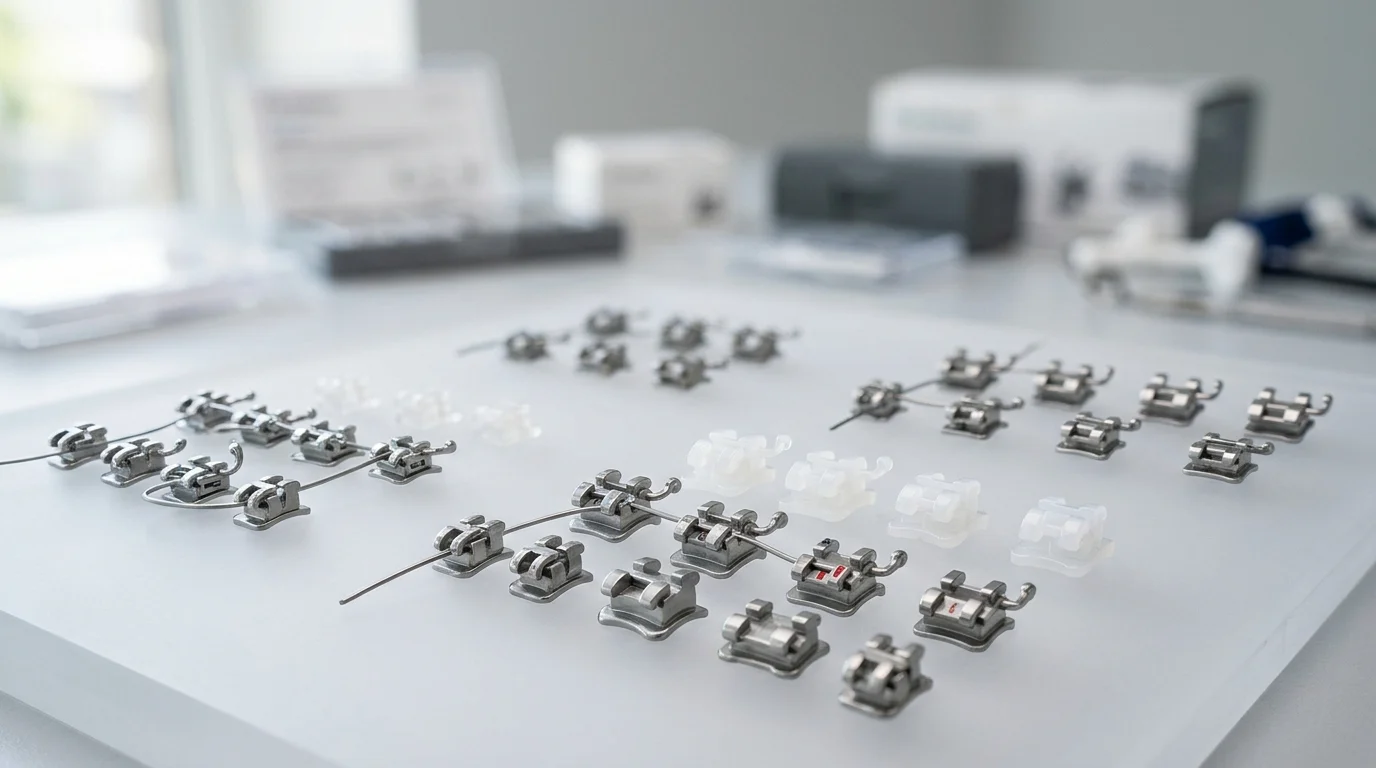
The most competitive manufacturers differentiate themselves through specific technological focuses. Some excel in the mass production of traditional Roth and MBT twin brackets, utilizing advanced MIM technology to ensure smooth contours and patient comfort. Others have pivoted heavily toward the fast-growing segment of self-ligating brackets, engineering passive and interactive clip mechanisms that require highly precise micro-assembly.
Additionally, aesthetic orthodontics has driven certain factories to specialize in ceramic and sapphire brackets. These materials demand entirely different manufacturing competencies, such as high-temperature sintering and diamond-slurry polishing. Exploring the catalogs of premier orthodontic bracket suppliers reveals a strategic split between high-volume standard brackets and high-margin, technologically complex self-ligating systems.
Comparison of leading suppliers
To navigate the top tier of manufacturers, buyers must compare operational metrics that directly impact supply chain fluidity. Below is a comparative matrix illustrating the typical operational parameters of leading Chinese bracket manufacturers based on current industry benchmarks.
| Supplier Tier | Typical MOQ (Sets) | Avg. Lead Time (Days) | Core Manufacturing Speciality | Defect Rate Target |
|---|---|---|---|---|
| Tier 1 (Enterprise OEM) | 500 – 1,000 | 30 – 45 | Self-Ligating, Custom MIM | < 0.2% |
| Tier 2 (Mid-Market Brand) | 100 – 300 | 15 – 25 | Standard Metal, Ceramic | < 0.5% |
| Tier 3 (Boutique/Specialty) | 50 – 100 | 20 – 30 | Sapphire, Lingual Systems | < 0.5% |
| Private Label Specialists | 200 – 500 | 40 – 50 | Custom Base Etching, Packaging | < 0.3% |
Enterprise-level suppliers typically demand higher Minimum Order Quantities (MOQs) but offer superior customization and lower unit costs at scale. Conversely, mid-market brands provide agility, catering to regional distributors who require faster inventory turnover and lower initial capital outlay.
Material and bracket type trade-offs
Procurement decisions frequently hinge on material trade-offs. Standard metal brackets manufactured via MIM from 17-4 PH stainless steel offer the best balance of durability, low friction, and cost-efficiency. However, they lack the aesthetic appeal demanded by adult demographics. Ceramic brackets, while highly aesthetic, are brittle; a fracture rate exceeding 2% during clinical debonding can significantly disrupt a clinic’s workflow.
Monocrystalline sapphire brackets represent the premium aesthetic tier, offering near-perfect transparency and superior strength compared to polycrystalline ceramics. Yet, their unit cost can be 300% to 400% higher than standard metal brackets, and the extended machining time limits the production scalability. Buyers must calculate these material trade-offs against their target market’s willingness to pay and the clinical preferences of their end-users.
Quality and Compliance Checks
In the medical device sector, quality assurance and regulatory compliance are not merely administrative hurdles; they are the foundation of market access and patient safety. Orthodontic brackets are generally classified as Class IIa medical devices in the European Union (under MDR) and Class II devices by the US FDA. Consequently, importing these products from China requires an airtight verification of the supplier’s quality management systems and product specifications.
Critical product specifications
Clinicians evaluate brackets on several strict technical parameters. The foremost is the prescription accuracy—specifically the built-in torque, angulation, and in-out dimensions. A deviation of even 2 degrees in torque can result in unwanted tooth movement, prolonging treatment times. Therefore, buyers must request statistical process control (SPC) data from the factory to verify lot-to-lot consistency.
Another critical specification is the retention mechanism of the bracket base. An 80-gauge woven mesh base is the industry gold standard, providing optimal surface area for adhesive penetration. Advanced suppliers may offer sandblasted or laser-structured bases, which can increase shear bond strength to a clinically optimal range of 12 to 15 MPa, minimizing the risk of premature debonding during mastication.
ISO and medical device verification
A supplier’s claim of quality must be substantiated by recognized third-party certifications. The absolute baseline for any reliable medical device manufacturer is ISO 13485:2016 certification, which dictates strict protocols for risk management, traceability, and process validation. Buyers must not only ask for the certificate but verify its authenticity and scope with the issuing registrar (e.g., TÜV SÜD, SGS).
For market-specific compliance, FDA 510(k) clearance is mandatory for the United States, while a CE Mark under the Medical Device Regulation (MDR 2017/745) is required for the European Economic Area. Sourcing from a factory lacking these credentials exposes the buyer to severe customs seizures, legal liabilities, and complete market exclusion.
Quality risks and total sourcing cost
Evaluating suppliers based solely on the FOB (Free On Board) unit price is a critical error that ignores the Total Cost of Quality (TCQ). Substandard brackets introduce hidden costs that rapidly erode initial savings. For instance, a poor mesh base can increase clinical debonding rates from a standard 1% to over 3%. For a mid-sized orthodontic clinic, replacing these failed brackets can incur an additional $1,500 to $2,000 per month in wasted chair time and materials.
Furthermore, inadequate metallurgical processing can lead to slot wear or clip failure in self-ligating systems, necessitating mid-treatment bracket replacements. Procurement teams must model these potential quality failure costs into their sourcing equations, often finding that paying a 10% to 15% premium for a top-tier, fully compliant manufacturer yields a significantly lower total sourcing cost over a multi-year contract.
How to Source and Negotiate Effectively
Executing a successful procurement strategy in China requires a structured, phased approach. Language barriers, time zone differences, and varying business practices necessitate clear communication protocols and rigorous vetting procedures. Moving from initial contact to a stable, high-volume supply chain involves careful negotiation of terms, exhaustive product testing, and robust logistics planning.
Step-by-step supplier qualification
The qualification process should begin with a detailed Request for Quotation (RFQ) that outlines specific technical requirements, target volumes, and compliance necessities. When communicating with orthodontic bracket suppliers, buyers should request a comprehensive technical dossier alongside the pricing. The next phase is sample evaluation; buyers should procure a minimum of 100 to 200 bracket sets across different prescriptions to conduct independent clinical and mechanical testing.
Following successful sample validation, a facility audit is highly recommended for high-volume buyers. Whether conducted in person or via a reputable third-party auditing firm (such as V-Trust or Asia Quality Focus), the audit should assess the factory’s raw material warehousing, CNC/MIM machinery maintenance, cleanroom protocols, and worker training records. Only after passing the audit should a trial order of 500 to 1,000 sets be placed.
Audits, private labeling, and payment terms
For distributors building their own brand equity, Original Equipment Manufacturer (OEM) and Original Design Manufacturer (ODM) capabilities are vital. Negotiating private labeling involves specifying exact packaging designs, laser-etched logos on the bracket bases, and custom color-coding systems. Buyers must ensure that intellectual property (IP) protection clauses, such as NNN (Non-Disclosure, Non-Use, Non-Circumvention) agreements governed by Chinese law, are executed before sharing proprietary designs.
Payment terms with Chinese medical suppliers typically follow a standard structure: a 30% telegraphic transfer (T/T) deposit upon order confirmation, with the remaining 70% balance due after production but before shipment, against the Bill of Lading. As the buyer-supplier relationship matures over 12 to 18 months, buyers can often negotiate more favorable terms, such as 30-day or 60-day net payment terms, improving cash flow.
Logistics, packaging, and after-sales support
Orthodontic brackets are high-value, low-volume goods, making them highly suitable for air freight. Standard air express (via DHL, FedEx, or UPS) typically takes 5 to 7 days for volumetric weights under 100kg. For larger OEM orders exceeding 300kg, standard air cargo offers a more cost-effective solution, albeit with a slightly longer transit time of 10 to 14 days.
Packaging specifications must be negotiated to prevent crush damage and contamination during transit. Brackets should be sealed in medical-grade blister packs with clear prescription labeling, then packed in double-corrugated export cartons. Finally, buyers must establish clear after-sales support protocols, including a predefined acceptable quality limit (AQL) and a streamlined process for claiming credit or replacements for any defective batches.
Choosing the Right Supplier for Your Business
Ultimately, the concept of the ‘best’ supplier is subjective and entirely dependent on the buyer’s specific business model, target market, and capital resources. A supplier that perfectly serves a massive DSO may be entirely unsuitable for a boutique regional distributor due to rigid MOQs and lack of packaging flexibility. Aligning supplier strengths with buyer profiles is the final step in the procurement journey.
Best fit by buyer type
Different procurement profiles require distinct sourcing strategies. The table below outlines the optimal alignment between buyer types and supplier characteristics.
| Buyer Profile | Primary Objective | Recommended Supplier Tier | Key Negotiation Focus |
|---|---|---|---|
| Large DSO / Corporate Chain | Absolute lowest unit cost, clinical consistency | Tier 1 (Enterprise OEM) | Volume discounts, multi-year fixed pricing, strict AQL |
| Regional Dental Distributor | Brand building, fast inventory turnover | Tier 2 (Mid-Market Brand) | Private labeling, low MOQs, flexible payment terms |
| Boutique / Premium Clinic | Highest aesthetic quality, advanced technology | Tier 3 (Specialty) | Material purity, custom prescriptions, rapid air freight |
| Start-up Supply Brand | Turnkey solutions, minimal capital risk | Private Label Specialists | Comprehensive packaging design, regulatory support |
By identifying their exact profile, buyers can immediately filter out incompatible factories, saving months of fruitless negotiation. For example, a regional distributor should prioritize a Tier 2 supplier that offers robust private labeling services and accepts MOQs as low as 200 sets, rather than struggling to meet the 1,000-set minimums of an enterprise-level facility.
Final shortlist and decision framework
Further reading:
Key Takeaways
- The most important conclusions and rationale for orthodontic bracket suppliers
- Specs, compliance, and risk checks worth validating before you commit
- Practical next steps and caveats readers can apply immediately
Frequently Asked Questions
What should buyers verify when choosing orthodontic bracket suppliers in China?
Check slot tolerance, defect rate below 0.5%, ISO/FDA/CE compliance, material grade, and on-time delivery history before placing bulk orders.
What MOQ is typical for orthodontic bracket suppliers?
Standard metal brackets often start around 100–300 sets, while enterprise OEM projects may require 500–1,000 sets.
How long do bulk orthodontic bracket orders usually take?
Reliable Chinese suppliers typically ship bulk OEM orders in 20–30 days, while more customized private-label orders may take 40–50 days.
Which bracket types do top Chinese suppliers usually offer?
Most leading suppliers provide metal twin brackets, self-ligating brackets, ceramic brackets, and sometimes sapphire or lingual systems.
Can Denrotary support OEM or private-label orthodontic bracket orders?
Yes, Denrotary focuses on orthodontic product manufacturing and can support OEM needs, including product selection and custom packaging inquiries.

Post time: Jun-10-2026