

Introduction
Choosing an orthodontic elastic factory is not just a purchasing decision; it directly affects force consistency, treatment reliability, regulatory compliance, and brand reputation. Because dental rubber bands must deliver predictable performance under real intraoral conditions, supplier quality depends on far more than price or catalog range. This article outlines what separates leading dental rubber bands suppliers worldwide, from material control and production precision to certification standards, packaging options, and export capability. By the end, readers will have a practical framework for evaluating manufacturers, comparing supply partners across regions, and identifying factories that can support both clinical expectations and long-term commercial growth.
Why the Right Orthodontic Elastic Factory Matters
Sourcing dental consumables requires stringent oversight, particularly when selecting an orthodontic elastic factory capable of sustaining clinical efficacy and global supply chain demands. Orthodontic elastics, commonly known as dental rubber bands, are critical auxiliary components used to apply continuous force for intermaxillary or intramaxillary tooth movement. The manufacturing precision of these small elastomeric rings directly dictates the predictability of treatment outcomes, making the choice of manufacturing partner a high-stakes decision for dental brands, distributors, and large-scale clinic networks.
Product consistency, clinical performance, and brand risk
The primary function of any orthodontic elastic is to deliver a specific, sustained force over time. In optimal conditions, natural latex elastics lose approximately 20% to 30% of their initial force within the first 24 hours of intraoral use due to moisture, temperature fluctuations, and continuous stretching. If an elastic factory utilizes substandard vulcanization processes or inferior raw materials, this force degradation can accelerate to over 50% in the same timeframe, stalling orthodontic progress and requiring more frequent patient interventions.
Beyond clinical performance, inconsistent manufacturing introduces severe brand risk. Elastics that exhibit high variance in wall thickness or internal diameter will yield erratic force levels across the same batch. Furthermore, bands that frequently snap under normal physiological loads (typically between 200% and 300% extension) can lead to patient discomfort, clinical complaints, and inevitable product recalls, damaging the reputation of the distributing brand.
Market trends shaping supplier evaluation
Global supply chain dynamics are shifting how distributors evaluate potential manufacturing partners. One major trend is the accelerating demand for latex-free alternatives. With the prevalence of latex allergies estimated at roughly 4.3% in the general population—and potentially higher among healthcare workers and frequent patients—top-tier facilities are heavily investing in medical-grade synthetic polyurethanes that mimic the elasticity of natural rubber without the associated antigenic proteins.
Additionally, buyers are consolidating their supply chains, favoring factories that offer end-to-end solutions. Facilities that integrate raw material compounding, precision cutting, and automated packaging under one roof are preferred, as they mitigate the risks of multi-vendor delays and reduce the carbon footprint associated with shipping intermediate goods across different regions.
What Defines a Reliable Orthodontic Elastic Factory

Evaluating a potential orthodontic elastic factory requires moving beyond marketing claims and strictly analyzing their technical specifications and operational infrastructure. A reliable supplier must demonstrate mastery over elastomeric chemistry and precision engineering to meet the exacting standards of the dental industry.
Material, force, size, sterility, and packaging standards
Orthodontic elastics are categorized by their lumen (internal diameter) and the force they exert when stretched to three times their original diameter. Standard sizes generally range from 1/8″ (3.2 mm) to 5/16″ (7.9 mm), with force profiles classified as light (2.5 oz), medium (3.5 to 4.5 oz), heavy (6.0 to 6.5 oz), and extra-heavy (up to 8.0 oz). A reliable factory must guarantee dimensional tolerances within ±0.1 mm to ensure the force ratings remain clinically accurate.
Material selection is equally critical. Factories must source premium surgical-grade latex or hypoallergenic elastomers. Because these products are placed directly into the oral cavity, sterility and biocompatibility are non-negotiable. Leading suppliers adhere strictly to ISO 10993 standards for biological evaluation of medical devices. Buyers can review comprehensive product catalogs to verify if a factory’s material grades align with local regulatory demands.
| Material Type | Primary Composition | Typical Force Retention (24h) | Allergy Risk | Shelf Life |
|---|---|---|---|---|
| Natural Latex | Cross-linked polyisoprene | 75% – 80% | Low to Moderate | 36 Months |
| Latex-Free | Medical-grade polyurethane | 65% – 70% | Zero (Hypoallergenic) | 48 – 60 Months |
Manufacturing controls, batch traceability, and private labeling
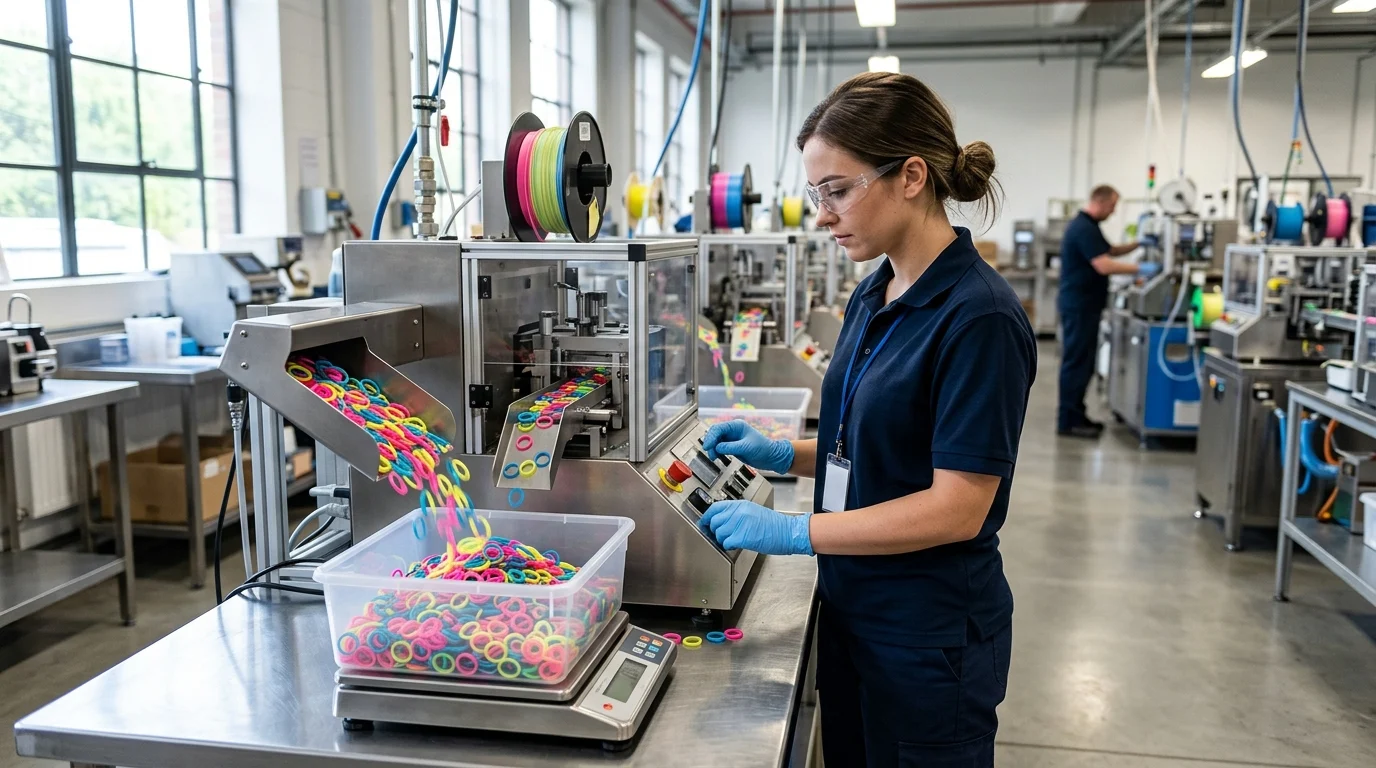
The physical environment in which the elastics are produced heavily influences the final product quality. Reliable factories operate ISO Class 8 (or stricter) cleanrooms for the cutting and packaging phases to prevent particulate contamination. Furthermore, rigorous batch traceability is mandatory. Every pouch of elastics must feature a lot number that traces back to the specific batch of raw polymer, the vulcanization temperature log, and the cutting operator.
For distributors seeking to build their own brand equity, private labeling capabilities (OEM/ODM) are essential. Top-tier factories offer automated bagging lines that can insert patient placers, print custom branding directly onto the tamper-evident foil or paper-poly pouches, and apply unique GS1-compliant barcodes. These automated controls also help maintain a critical quality threshold, targeting a defect rate (e.g., uncut bands or fused rings) of less than 0.1% per production run.
How to Compare Orthodontic Elastic Factory Options
Once technical competencies are established, the evaluation shifts to commercial viability. Comparing different facilities involves analyzing their business models, production flexibility, and the economic parameters that will govern the long-term partnership.
Key criteria for evaluating OEM and ODM suppliers
Original Equipment Manufacturer (OEM) and Original Design Manufacturer (ODM) capabilities differ significantly among suppliers. An OEM factory will produce elastics strictly to the buyer’s provided specifications, requiring the buyer to manage the sizing and force matrices. Conversely, a strong ODM partner has an internal R&D department that can suggest optimal polymer blends, design proprietary packaging systems, and even develop custom color-coding schemes (e.g., neon colors for pediatric patients) to differentiate the product in a crowded market. Assessing a factory’s history and infrastructure, often detailed in their about us documentation, provides insight into their capacity for true innovation versus mere contract manufacturing.
Cost, minimum order quantity, and lead time
Commercial terms dictate the financial feasibility of the supply chain. Minimum Order Quantities (MOQs) for custom-branded orthodontic elastics typically range from 10,000 to 50,000 bags per order, depending on the level of packaging customization required. Standard, unbranded bulk orders might have lower thresholds, but custom-printed foil pouches require higher volumes to offset the initial printing cylinder costs.
Cost per bag is heavily influenced by order volume, material choice, and packaging complexity, generally falling into a band of $0.15 to $0.40 USD per bag of 100 elastics. Lead time is the final critical metric. A highly optimized factory should offer standard lead times of 15 to 30 days for repeat orders, though initial orders requiring custom artwork approval and tooling may extend to 45 or 60 days. Buyers must balance the unit cost against the factory’s ability to deliver reliably within these timeframes to prevent stockouts.
Compliance, Quality Assurance, and Logistics Checks
Because orthodontic elastics are classified as medical devices in most jurisdictions, sourcing them requires strict adherence to international quality assurance protocols and complex logistics management. Ignoring these elements can result in customs seizures, regulatory fines, or degraded product upon arrival.
Certifications, testing records, and regulatory documents
Regulatory compliance serves as the definitive barrier to entry for reputable suppliers. At a minimum, the factory must hold an active ISO 13485:2016 certification, which governs quality management systems specific to medical devices. If the products are destined for the United States, the facility must be registered with the FDA, as orthodontic elastics are typically classified as Class I medical devices (exempt from 510(k) but subject to general controls). For the European market, CE marking under the Medical Device Regulation (MDR) is mandatory.
Beyond certificates, buyers should request routine testing records. Quality assurance protocols should include tensile testing, where sample rings are stretched to 300% of their resting diameter to verify breaking strength and force consistency. The factory should readily provide Certificates of Analysis (CoA) for every shipment, detailing the exact force values and dimensional checks performed on that specific lot.
Shipping methods, shelf life, and storage conditions
Elastomers are highly sensitive to environmental conditions, making logistics and storage critical components of the supply chain. Shipping methods must account for temperature fluctuations; consequently, climate-controlled ocean freight (reefer containers) or expedited air freight are preferred to prevent premature degradation of the rubber.
Shelf life and storage guidelines must be strictly enforced. Natural latex elastics generally have a shelf life of 36 months, while synthetic polyurethane variants can last up to 60 months. However, these lifespans are only valid if the products are stored away from direct ultraviolet (UV) light and ozone-generating machinery, and kept at controlled ambient temperatures.
| Storage Parameter | Optimal Range/Condition | Consequence of Deviation |
|---|---|---|
| Temperature | 15°C to 25°C (59°F to 77°F) | Heat accelerates cross-link breakdown; cold causes brittleness. |
| Humidity | 40% to 60% Relative Humidity | High humidity promotes fungal growth on natural latex. |
| Light Exposure | Zero direct UV / Sunlight | UV radiation causes rapid oxidation and snapping. |
How to Shortlist the Best Orthodontic Elastic Factory
Narrowing down a global list of potential suppliers to a single, trusted manufacturing partner requires a systematic, multi-phased approach. Bypassing steps in the qualification process often leads to costly misalignments in quality or supply continuity.
Step-by-step supplier qualification process
The qualification process should begin with a comprehensive desktop audit, reviewing the supplier’s ISO certifications, FDA registrations, and product catalogs. Once a shortlist is formed, buyers must initiate direct communication to request sample testing. It is advisable to order 50 to 100 sample bags across various sizes and force ratings. These samples should be subjected to independent, third-party dynamometer testing to verify the factory’s force claims. To begin this phase, buyers can utilize contact us portals to request technical data sheets and sample kits.
If the samples pass clinical and mechanical testing, the next step is a facility audit. While physical site visits are ideal, live video audits of the cleanrooms, extrusion lines, and packaging stations are acceptable alternatives. Finally, a paid trial order—typically around 5,000 bags—should be placed to evaluate the supplier’s communication, adherence to lead times, and consistency in bulk manufacturing compared to the initial samples.
Decision criteria for final supplier selection
The final supplier selection should be based on a weighted decision matrix rather than cost alone. A standard industry weighting might allocate 40% of the score to quality consistency and defect rates, 30% to regulatory compliance and traceability, 20% to unit cost and MOQ flexibility, and 10% to communication and geographic logistics. By rigorously applying these criteria, dental brands can secure an orthodontic elastic factory that protects patient outcomes and drives long-term commercial growth.
Further reading:
Key Takeaways
- The most important conclusions and rationale for orthodontic elastic factory
- Specs, compliance, and risk checks worth validating before you commit
- Practical next steps and caveats readers can apply immediately
Frequently Asked Questions
What should I check first in an orthodontic elastic factory?
Verify force consistency, size tolerance within ±0.1 mm, biocompatible materials, and batch traceability. Ask for test data, cleanroom details, and lot-number records before ordering.
Does DenRotary offer latex and latex-free orthodontic elastics?
Yes. DenRotary can supply natural latex and hypoallergenic latex-free options to match different clinical and market requirements. Confirm available sizes and force ranges with the sales team.
Why is force retention important for dental rubber bands?
Force retention affects how predictably teeth move between appointments. Poor-quality elastics can lose force too quickly, increasing breakage, patient complaints, and treatment delays.
Can an orthodontic elastic factory provide private labeling?
Many qualified factories do. DenRotary supports OEM/private label programs, including custom packaging and branding, which helps distributors and dental brands build a consistent product line.
How can I evaluate a supplier before placing a bulk order?
Request samples, compare force accuracy across batches, review certifications such as ISO-related compliance, and confirm lead times, packaging standards, and traceability for each lot.

Post time: Jun-12-2026