


Introduction
China has become a major source for orthodontic supplies, combining large-scale manufacturing with improving quality control, material standards, and product innovation. For clinics, distributors, and private-label buyers, choosing the right supplier now involves more than price: consistency, certification, production capacity, and support all directly affect outcomes and margins. This overview highlights the best orthodontic supplies companies in China and explains what sets them apart, from bracket and wire production to aligner-related materials and OEM capabilities. It also gives readers a practical framework for comparing manufacturers, so the companies discussed in the following sections can be evaluated with clearer business and clinical priorities in mind.
Why Orthodontic Supply Companies in China Matter
The global landscape of dental manufacturing relies heavily on the robust infrastructure found in China. As technological advancements accelerate, Chinese manufacturers have transitioned from producing basic clinical consumables to engineering highly sophisticated orthodontic systems, becoming integral to supply chains worldwide.
Chinese market trends in orthodontic supplies
Over the past decade, the Chinese orthodontic supply sector has experienced a compound annual growth rate (CAGR) exceeding 12%. This expansion is driven by aggressive investments in automated Computer Numerical Control (CNC) machining, Metal Injection Molding (MIM), and 3D printing technologies. Modern facilities are rapidly scaling production for advanced self-ligating brackets and customized clear aligner materials, allowing them to compete directly with established Western brands in terms of both structural precision and clinical durability.
Buyer expectations from distributors and clinics
Distributors and clinical practitioners demand stringent reliability from their international supply chains. Buyers expect product defect rates to remain strictly below 1%, alongside rapid order fulfillment and consistent inventory availability. Modern distributors also require suppliers to provide comprehensive product traceability, batch testing reports, and robust post-sales support. This shift indicates a move away from purely transactional purchasing toward integrated, long-term manufacturing partnerships.
Key Products and Quality Standards
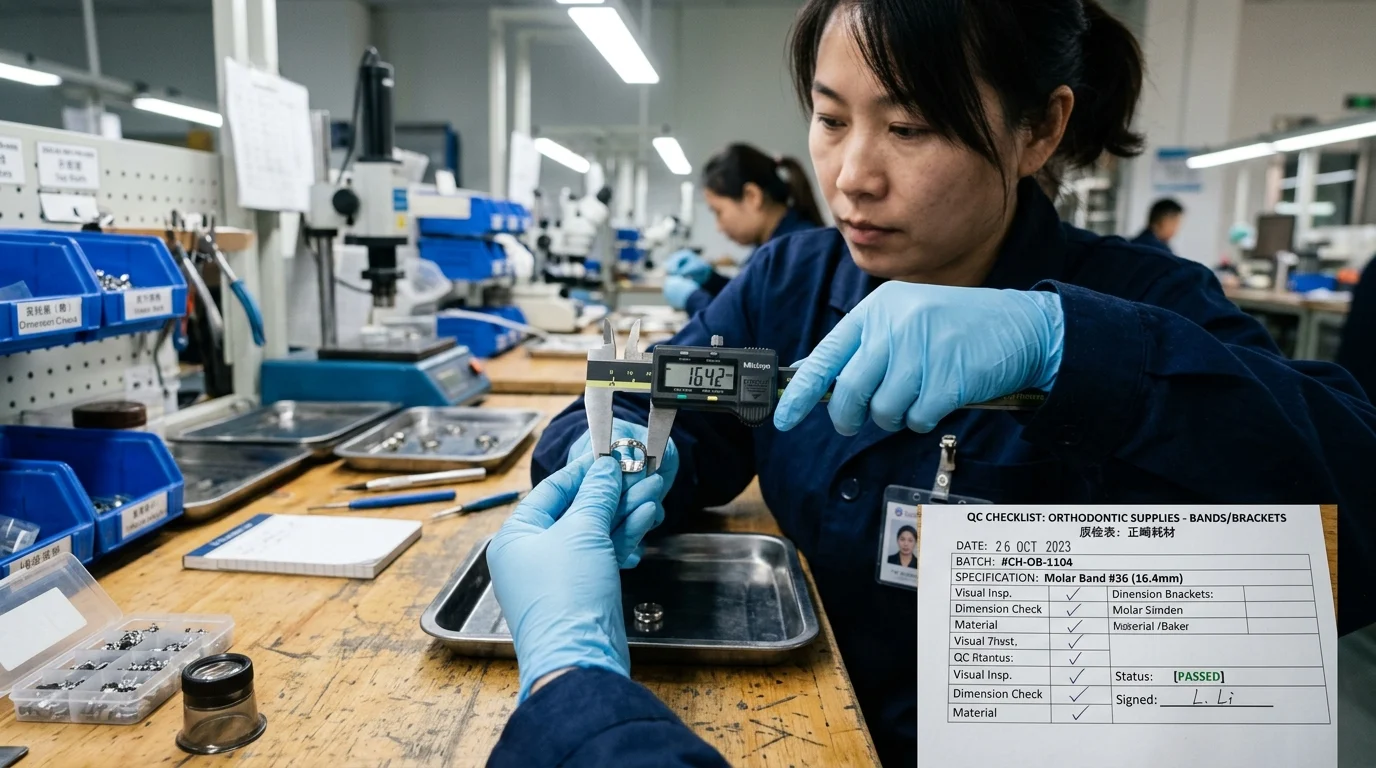
Maintaining clinical efficacy requires strict adherence to international material standards. The core orthodontic product categories manufactured in China encompass a vast array of precision-engineered components designed to facilitate predictable and safe tooth movement.
Core orthodontic product categories
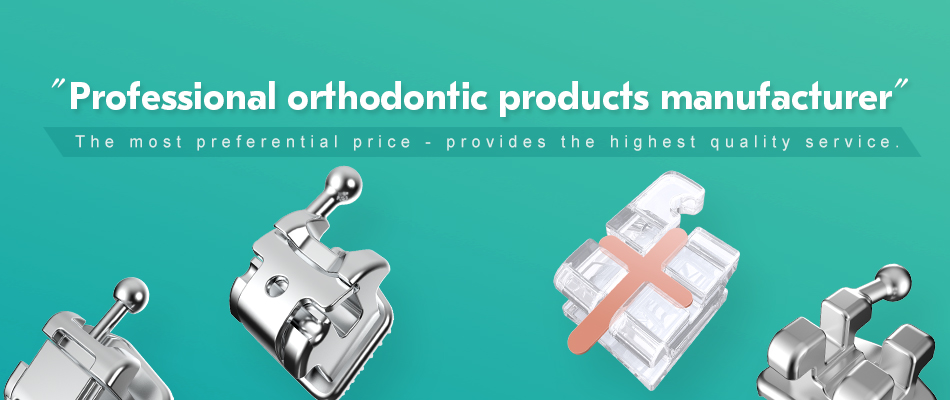
The primary catalog of orthodontic supplies includes metal and ceramic brackets, buccal tubes, molar bands, and archwires. Advanced manufacturers also produce elastomeric ligatures, power chains, and specialized orthodontic hand instruments. Each product category requires distinct manufacturing processes, ranging from high-heat injection molding for transparent ceramic brackets to complex metallurgical drawing techniques for shape-memory wires.
Material and consistency benchmarks
Material integrity dictates clinical performance and patient safety. High-quality brackets are typically forged from 17-4 PH or 316L medical-grade stainless steel to prevent intraoral corrosion and ensure structural rigidity. Archwires demand precise phase transition temperatures, which are often meticulously calibrated between 27°C and 35°C for thermally active variants. Furthermore, slot tolerances for brackets must be maintained within a strict +/- 0.02 mm margin to guarantee accurate torque and angulation expression during treatment.
Useful supplier comparison criteria
When comparing manufacturers, procurement teams must evaluate material certifications, manufacturing tolerances, and internal quality control methodologies. A structured comparison of these technical metrics prevents clinical failures such as unexpected wire breakage or premature bracket debonding.
| Component | Optimal Material | Required Precision Tolerance | Standard Testing Method |
|---|---|---|---|
| Metal Brackets | 17-4 PH Stainless Steel | +/- 0.02 mm | Base Shear Bond Strength Analysis |
| Archwires | Nickel-Titanium (NiTi) | +/- 0.01 mm | Three-Point Bending Test |
| Elastomers | Medical-Grade Polyurethane | Tear resistance > 40 kN/m | Tensile Strength Measurement |
How to Evaluate Suppliers
Identifying a reliable manufacturing partner requires a rigorous vetting process. A systematic evaluation of a supplier’s operational infrastructure and regulatory standing mitigates supply chain risks and ensures consistent clinical outcomes.
Commercial and operational selection criteria
Operational capabilities are just as critical as baseline product quality. Buyers must assess a facility’s monthly production capacity, which for established Chinese factories often exceeds 500,000 bracket sets per month. Furthermore, evaluating the responsiveness of the supplier’s export team through established supplier outreach channels provides vital insight into their ability to handle complex international orders, manage customs documentation, and execute rapid troubleshooting.
Compliance and documentation requirements
Regulatory compliance is non-negotiable in the global medical device sector. Reputable Chinese orthodontic suppliers must hold an active ISO 13485:2016 certification, which dictates the specific quality management systems required for medical device manufacturing. Additionally, components intended for international distribution should carry CE marking under the Medical Device Regulation (MDR) for the European market, or hold FDA 510(k) clearance for distribution within the United States.
Supplier audit and qualification steps
The qualification process should begin with a comprehensive desktop audit of all regulatory certificates, verifying their authenticity with the issuing bodies. This should be followed by independent third-party factory inspections. Before committing to high-volume commercial contracts, buyers are strongly advised to order a pilot batch of 100 to 200 sets to conduct independent clinical, chemical, and mechanical testing.
Cost, Logistics, and Sourcing Trade-Offs
Strategic sourcing requires a careful balance between unit economics, shipping logistics, and the specific manufacturing model employed by the supplier. Understanding these trade-offs is essential for optimizing procurement budgets.
Pricing, MOQ, and tooling considerations
Unit pricing in China is highly dependent on Minimum Order Quantities (MOQs). Standard MOQs for off-the-shelf orthodontic brackets typically range from 500 to 1,000 sets per order. If a buyer requires custom designs, proprietary torque values, or private labeling, tooling costs for new injection molds can range from $2,000 to $5,000. While this requires higher initial capital, it yields significantly lower per-unit costs at scale.
Shipping, packaging, and inventory factors
Orthodontic supplies are generally compact and possess a high value-to-weight ratio, making air freight a highly viable option. Air shipping typically requires 3 to 7 days for global delivery, whereas sea freight—which is more economical for bulky items like alginate powder or heavy equipment—takes 25 to 40 days. Strict adherence to sterilization and blister packaging requirements is essential to prevent contamination during transit, adding marginal weight but ensuring immediate clinical readiness upon arrival.
Factory direct vs OEM vs trading company
Buyers must strategically choose between sourcing directly from factories, utilizing Original Equipment Manufacturers (OEMs), or purchasing through trading companies. Each model presents distinct financial and operational realities.
| Sourcing Model | Typical MOQ | Cost Structure | Best Suited For |
|---|---|---|---|
| Factory Direct | 1,000+ sets | Lowest unit cost | High-volume regional distributors |
| OEM Partner | 2,000+ sets | Moderate (includes R&D) | Brands developing custom clinical lines |
| Trading Company | 100 – 500 sets | 15-20% premium | Small clinics or initial pilot testing |
How to Choose the Right Supplier
Finalizing a partnership with a Chinese orthodontic supplier involves synthesizing all gathered data into an actionable procurement strategy. Understanding the historical context and foundational stability of these industry leaders provides confidence in their long-term viability.
Decision framework for supplier selection
Procurement teams often utilize a weighted scoring model to objectively rank potential suppliers. A standard analytical framework might allocate 40% of the total score to quality and regulatory compliance, 30% to unit cost and tooling fees, 20% to production capacity and lead times, and 10% to communication and technical support. Implementing this structured approach prevents buyers from making critical supply chain decisions based solely on the lowest initial bid.
Final criteria for balancing quality and cost
The ultimate goal of supplier selection is to optimize the Total Cost of Ownership (TCO). While a specific factory might offer a bracket set for $0.50 less than a competitor, a higher clinical failure rate exponentially increases costs through chairside replacement time and reputational damage to the clinic. Factoring in a 2% to 3% financial buffer for potential defects, and prioritizing suppliers that offer robust warranties and transparent replacement policies, ensures a sustainable balance between upfront savings and long-term clinical reliability.
Further reading:
Key Takeaways
- The most important conclusions and rationale for Best Orthodontic Supplies
- Specs, compliance, and risk checks worth validating before you commit
- Practical next steps and caveats readers can apply immediately
Frequently Asked Questions
What should I check first when choosing a Chinese orthodontic supplier?
Verify ISO 13485, CE or FDA status, material certificates, and batch traceability. Then confirm defect rate targets below 1% and stable export support.
Which orthodontic products are most commonly sourced from China?
Common categories include metal and ceramic brackets, buccal tubes, molar bands, archwires, elastomeric ligatures, power chains, and orthodontic hand instruments.
What quality standards matter most for orthodontic brackets and wires?
Look for 17-4 PH or 316L stainless steel brackets, slot tolerance around +/-0.02 mm, and NiTi archwires tested for consistent thermal activation and bending performance.
How can DenRotary help buyers compare orthodontic supplies companies in China?
DenRotary can help you review product specifications, certifications, tolerance control, and sample quality so you can shortlist suppliers with reliable production and export capability.
Why do distributors prefer long-term orthodontic supply partners instead of one-off purchases?
Long-term partners usually provide steadier inventory, faster fulfillment, clearer documentation, and better after-sales support, which reduces procurement risk for clinics and distributors.

Post time: Jun-13-2026