

Introduction
China’s orthodontic wire market is becoming more sophisticated in 2026, with suppliers competing not only on price but also on alloy quality, dimensional consistency, production scale, and compliance with international standards. For buyers evaluating archwire partners, the key challenge is separating high-capacity, technically reliable manufacturers from companies with limited process control or inconsistent lead times. This overview highlights the leading orthodontic wire suppliers in China and explains how they compare on materials, manufacturing capability, certification, customization, and export readiness. It will help distributors, brands, and procurement teams narrow their options and move into supplier evaluation with clearer criteria.
Why source orthodontic wires from China
The global dental supply chain is shifting rapidly, and sourcing orthodontic consumables from China has evolved from a purely cost-driven strategy to a value-driven necessity. As clinical demands for precision and patient comfort increase, Chinese manufacturers have heavily invested in advanced metallurgical processing and automated production lines. By 2026, the industry standard in the region will be characterized by high-tech fabrication rather than traditional manual assembly.
For global dental distributors and clinical networks, understanding the current capabilities of Chinese manufacturers is critical. The integration of advanced computer numerical control (CNC) machining and rigorous thermal treatment processes allows these facilities to produce complex archwires that meet stringent international standards while maintaining highly competitive operational efficiencies.
How pricing, capacity, and lead times are changing
The landscape of pricing, production capacity, and fulfillment speed has transformed significantly. Driven by the adoption of automated laser cutting and continuous thermal processing, factory capacities have scaled, bringing standard lead times down to an average of 15 to 25 days for standard catalog items. Despite global fluctuations in raw material costs, particularly for nickel and titanium, economies of scale allow Chinese suppliers to offer pricing that typically sits 20% to 30% below equivalent Western-manufactured counterparts.
Furthermore, capacity planning has become more agile. Factories that previously required rigid, high-volume commitments are now utilizing flexible manufacturing systems. This allows them to seamlessly switch between different wire profiles and alloy types without incurring massive downtime, stabilizing pricing for buyers even during periods of high seasonal demand.
Which buyer segments benefit most
Several buyer segments stand to gain distinct advantages from this modernized supply chain. Large Dental Service Organizations (DSOs) benefit immensely from the high-volume capacity and consistent batch-to-batch quality, which ensures predictable clinical outcomes across hundreds of affiliated clinics. The ability to lock in long-term supply contracts at favorable rates directly improves the profitability of these expansive networks.
Mid-sized regional distributors and specialized dental brands also benefit, particularly from the growing flexibility in Minimum Order Quantities (MOQs). Where historical MOQs might have demanded tens of thousands of units, many modern facilities now accommodate orders as low as 500 to 1,000 packs for standard orthodontic wires. This lower barrier to entry allows smaller enterprises to diversify their product offerings without tying up excessive capital in inventory.
How to evaluate orthodontic wire options
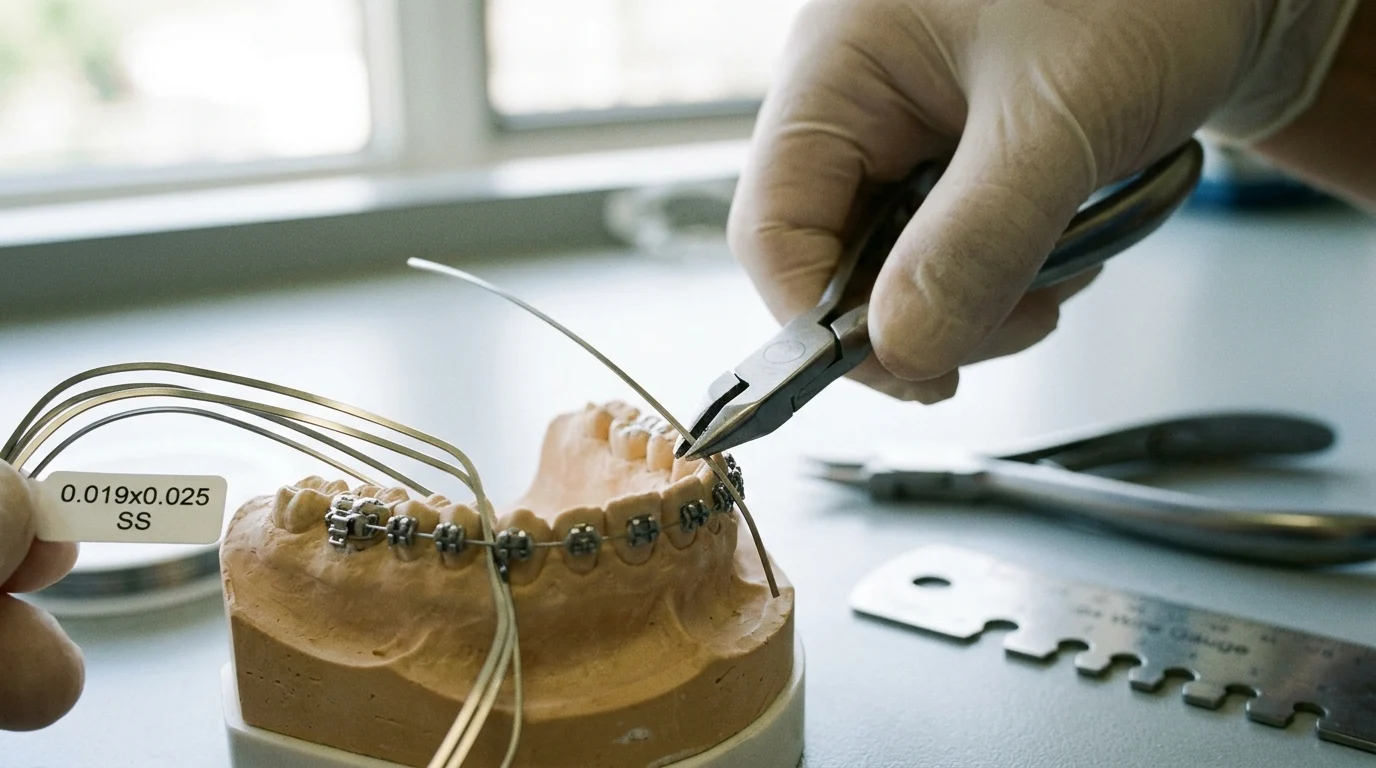
Selecting the optimal wire portfolio requires a deep understanding of metallurgical properties and clinical applications. Orthodontic treatment relies on a sequence of wires, each exerting specific continuous forces to move teeth safely and effectively. Buyers must rigorously evaluate supplier offerings to ensure the products align with the mechanical requirements of modern orthodontic techniques.
A comprehensive evaluation goes beyond simply checking a catalog; it involves scrutinizing the underlying material science, the precision of the manufacturing tolerances, and the business model under which the supplier operates.
Which specifications matter most
The physical and thermal specifications of the wires dictate their clinical efficacy. Critical dimensions, such as cross-sectional profiles, must adhere to strict tolerances. For example, a rectangular finishing wire specified at 0.019″ x 0.025″ must maintain those exact dimensions across its entire length to ensure proper torque expression within the bracket slot.
For Nickel-Titanium (NiTi) alloys, transformation temperature is paramount. The Austenite finish (Af) temperature should typically be calibrated around 35°C, ensuring the wire remains malleable at room temperature but becomes superelastic once activated by the patient’s body heat. Additionally, surface finish specifications matter; a lower friction coefficient, achieved through advanced electropolishing, reduces the resistance between the wire and the bracket, accelerating tooth movement.
How OEM, private label, and contract manufacturing differ
Buyers must choose the manufacturing model that best aligns with their business strategy. Original Equipment Manufacturing (OEM) involves the supplier producing items according to the buyer’s unique, proprietary specifications, requiring significant upfront engineering and tooling. This is ideal for brands introducing novel archforms or proprietary alloy blends.
Private label manufacturing allows buyers to select pre-engineered, off-the-shelf products and package them under their own brand identity. This model offers the fastest time-to-market and requires minimal R&D investment. Contract manufacturing sits in the middle, where the buyer and supplier often collaborate on minor design tweaks and share the responsibility of scaling production efficiently.
What comparison criteria buyers should use
When comparing different wire options, buyers should utilize a structured matrix that evaluates material type against clinical utility, baseline cost, and mechanical properties. Understanding these distinctions ensures the sourced portfolio covers all phases of orthodontic treatment.
| Material Type | Primary Clinical Phase | Relative Cost | Key Mechanical Property |
|---|---|---|---|
| Nickel-Titanium (NiTi) | Initial leveling and alignment | Moderate | Superelasticity / Shape memory |
| Stainless Steel | Space closure and detailing | Low | High yield strength and rigidity |
| Beta-Titanium (TMA) | Intermediate finishing | High | Formability with moderate force |
| Copper NiTi | Complex initial alignment | High | Precise thermal activation |
Using criteria such as those outlined in the table above, procurement teams can balance their inventory, ensuring they source cost-effective stainless steel in higher volumes while carefully selecting premium TMA or Copper NiTi from suppliers that demonstrate superior metallurgical control.
How to verify quality and compliance
Because dental supplies are classified as medical devices, verifying the quality and regulatory compliance of a manufacturing partner is non-negotiable. The implications of a failing wire—ranging from extended treatment times to patient injury—mean that procurement professionals must prioritize rigorous vetting over marginal cost savings.
A robust verification strategy requires examining both the formal certifications held by the facility and the internal quality control protocols used on the factory floor. Transparency in these areas is a hallmark of a reliable orthodontic wires manufacturer.
Which certifications and testing protocols matter
At a minimum, any reputable supplier must hold an active ISO 13485:2016 certification, which dictates the requirements for a comprehensive quality management system specific to medical devices. For products entering the European market, compliance with the Medical Device Regulation (MDR 2017/745) and a valid CE mark are mandatory. Buyers targeting the United States must ensure the facility is FDA registered and holds the necessary 510(k) clearances for their specific wire types.
Beyond facility certifications, product-level testing protocols are vital. Suppliers should routinely perform biocompatibility testing in accordance with ISO 10993 standards to guarantee the alloys do not induce cytotoxic, allergic, or inflammatory responses in the oral cavity. Requesting documentation of these independent laboratory tests is a standard and necessary step in the evaluation phase.
How to audit process capability and batch consistency
Formal certifications must be backed by consistent daily operations. Buyers should audit process capability by requesting Certificates of Analysis (CoA) for all incoming raw materials, particularly for medical-grade Nitinol and stainless steel billets. This ensures the foundational metallurgy is sound before drawing and shaping begins.
Batch consistency is verified through in-process inspections. Top-tier manufacturers utilize differential scanning calorimetry (DSC) to confirm the phase transformation temperatures of every NiTi batch. Furthermore, optical micrometers should be used to verify dimensional tolerances, with acceptable defect rates strictly maintained below a 0.5% threshold. A comprehensive audit will review these internal logs to confirm that the supplier’s stated quality matches their actual production output.
What drives total sourcing cost
Calculating the true cost of procurement requires looking far beyond the initial per-unit quote. The total landed cost encompasses raw materials, specialized packaging, international logistics, and import duties. A comprehensive financial analysis is necessary to maintain healthy profit margins without compromising on clinical quality.
Procurement teams must build detailed cost models that account for supply chain variables and identify where strategic negotiations can yield the most significant operational savings.
Which cost factors affect pricing
The baseline price of an archwire is heavily influenced by global commodities markets, specifically the spot prices for titanium, nickel, and medical-grade steel. When these raw material costs spike, suppliers inevitably adjust their pricing tiers. Additionally, the complexity of the manufacturing process plays a role; wires requiring advanced thermal programming, such as heat-activated Copper NiTi, command a premium over cold-drawn stainless steel.
Packaging is another critical cost driver. Bulk packaging in simple plastic tubes is highly cost-effective, but clinical end-users increasingly demand individually sealed, pre-sterilized autoclave pouches. This single-use packaging requirement can add an estimated $0.10 to $0.30 per unit. Buyers must balance the cost of premium packaging against the convenience and infection-control benefits it provides to the dental practitioner.
How to manage sampling, negotiation, Incoterms, and freight
Effective cost management begins with the sampling phase. Buyers should expect to pay for expedited shipping of validation samples, though the unit cost of the samples themselves is often credited toward the first bulk order. During negotiations, understanding the implications of different Incoterms is essential for controlling freight and liability costs.
| Incoterm | Buyer Responsibility | Ideal Procurement Scenario | Typical Freight Mode |
|---|---|---|---|
| EXW (Ex Works) | Maximum (Organizes all transit) | Consolidating goods from multiple local factories | Courier / Air Freight |
| FOB (Free on Board) | Moderate (Takes over at port) | Standard volume purchasing with established forwarders | Ocean / Air Freight |
| DDP (Delivered Duty Paid) | Minimum (Door-to-door delivery) | Smaller distributors lacking import infrastructure | Air Courier |
Because archwires have an exceptionally high value-to-weight ratio—a single 10kg master carton can hold upwards of 5,000 individual wires—air freight is almost always the preferred logistical mode. Managing these logistics effectively, choosing the right Incoterm, and negotiating favorable rates with forwarders can reduce the total landed cost by margins of 5% to 8%.
How to choose the right supplier
The final stage of procurement is establishing a long-term partnership with a facility that demonstrates both technical competence and business reliability. The right supplier acts as an extension of your own operations, safeguarding your brand’s reputation through consistent quality and timely deliveries.
Navigating the dense market of Chinese manufacturers requires a systematic approach to separate specialized medical device producers from general trading companies that lack technical oversight.
What supplier selection process buyers should follow
A structured selection process mitigates risk. Buyers should initiate contact with a detailed Request for Information (RFI) that demands proof of ISO certifications, facility size, and equipment lists. Following a successful RFI, buyers must procure sample batches for rigorous clinical and mechanical testing in their home market.
If the samples pass, the next step is a controlled trial order—typically around 2,000 units. This volume is large enough to test the supplier’s production lead times, communication responsiveness, and batch-to-batch consistency, but small enough to limit financial exposure. Only after a flawless trial order should a buyer transition to high-volume, automated replenishment cycles. For those ready to begin this vetting process, reaching out to established manufacturers to initiate supplier contact is the first practical step.
Which criteria separate strong suppliers from risky ones
Distinguishing a top-tier partner from a high-risk vendor comes down to verifiable infrastructure and corporate priorities. Strong suppliers operate dedicated cleanrooms—often rated at Class 10,000 (ISO 7)—for the final cleaning and packaging of medical devices. They also implement strict traceability protocols, such as laser-etching lot numbers directly onto the product or primary packaging, allowing for rapid recalls if necessary.
Furthermore, financial stability and a commitment to innovation are key indicators of a reliable partner. The best manufacturers reinvest a minimum of 5% to 8% of their annual revenue back into research and development. This continuous investment ensures they stay ahead of metallurgical advancements and regulatory shifts, providing their global buyers with a sustainable, long-term competitive advantage.
Further reading:
Key Takeaways
- The most important conclusions and rationale for orthodontic wires
- Specs, compliance, and risk checks worth validating before you commit
- Practical next steps and caveats readers can apply immediately
Frequently Asked Questions
What lead times should buyers expect from Chinese orthodontic wire suppliers in 2026?
For standard catalog wires, many Chinese factories now ship in about 15–25 days. Custom OEM or private-label orders usually take longer depending on specs and packaging.
Which orthodontic wire specifications matter most when comparing suppliers?
Check alloy type, exact dimensions, tolerance consistency, surface finish, and NiTi Af temperature. For finishing wires, precise rectangular size control is especially important for torque expression.
Who benefits most from sourcing orthodontic wires from China?
DSOs, regional distributors, and dental brands gain the most. They benefit from lower pricing, scalable capacity, and more flexible MOQs for standard wire lines.
What MOQ is common for standard orthodontic wires from Chinese manufacturers?
Many suppliers now accept around 500–1,000 packs for standard products. This helps smaller distributors test new SKUs without heavy inventory investment.
Can DenRotary support private label or OEM orthodontic wire sourcing?
Yes, DenRotary can support standard product sourcing and discuss private-label or OEM requirements based on wire type, packaging, and order volume. Contact their team to confirm specifications and production options.

Post time: Jun-09-2026