

Introduction
Choosing a bulk supplier for orthodontic brackets affects far more than unit price. FDA registration and CE certification signal that metal braces are produced under controlled quality systems, helping buyers reduce compliance risk, avoid inconsistent product performance, and protect downstream clinical outcomes. This article explains how certified suppliers support safer procurement at scale, which manufacturing and documentation standards deserve close review, and what commercial factors—such as capacity, defect control, and fulfillment reliability—should guide a final decision. With that foundation, it becomes easier to compare bracket specifications and select a partner that can meet both regulatory expectations and long-term supply needs.
Why choose a certified bulk metal braces supplier
Procuring orthodontic brackets in high volumes requires a rigorous evaluation of supplier credentials. For distributors and large-scale dental networks, selecting a manufacturing partner with recognized medical device certifications is not merely a compliance formality but a foundational requirement for clinical efficacy and risk management.
How certifications reduce regulatory and quality risks
Navigating the global medical device market necessitates strict adherence to regulatory standards. Suppliers holding FDA registration and CE marks demonstrate compliance with stringent quality management systems, drastically reducing the buyer’s exposure to regulatory penalties and product recalls. Certified manufacturing processes typically yield a defect rate of less than 0.5% for critical components like bracket wings and hooks, ensuring consistent clinical performance and safeguarding patient health against structural failures during treatment.
Which commercial factors matter most in supplier selection
Beyond regulatory safety, commercial viability plays a decisive role in procurement. Buyers must evaluate a supplier’s production capacity, financial stability, and historical fulfillment accuracy. Partnering with an established manufacturer can yield economies of scale, often reducing per-unit costs by 30% to 50% compared to fragmented, small-batch purchasing. Furthermore, reviewing a supplier’s corporate history and about us documentation provides insight into their long-term reliability and capacity to weather global supply chain disruptions.
What product specifications should buyers compare

A thorough technical evaluation is paramount when sourcing bulk metal braces. Buyers must look beyond basic dimensions to assess the metallurgical and engineering specifications that dictate clinical outcomes.
How bracket material, slot accuracy, and base design affect performance
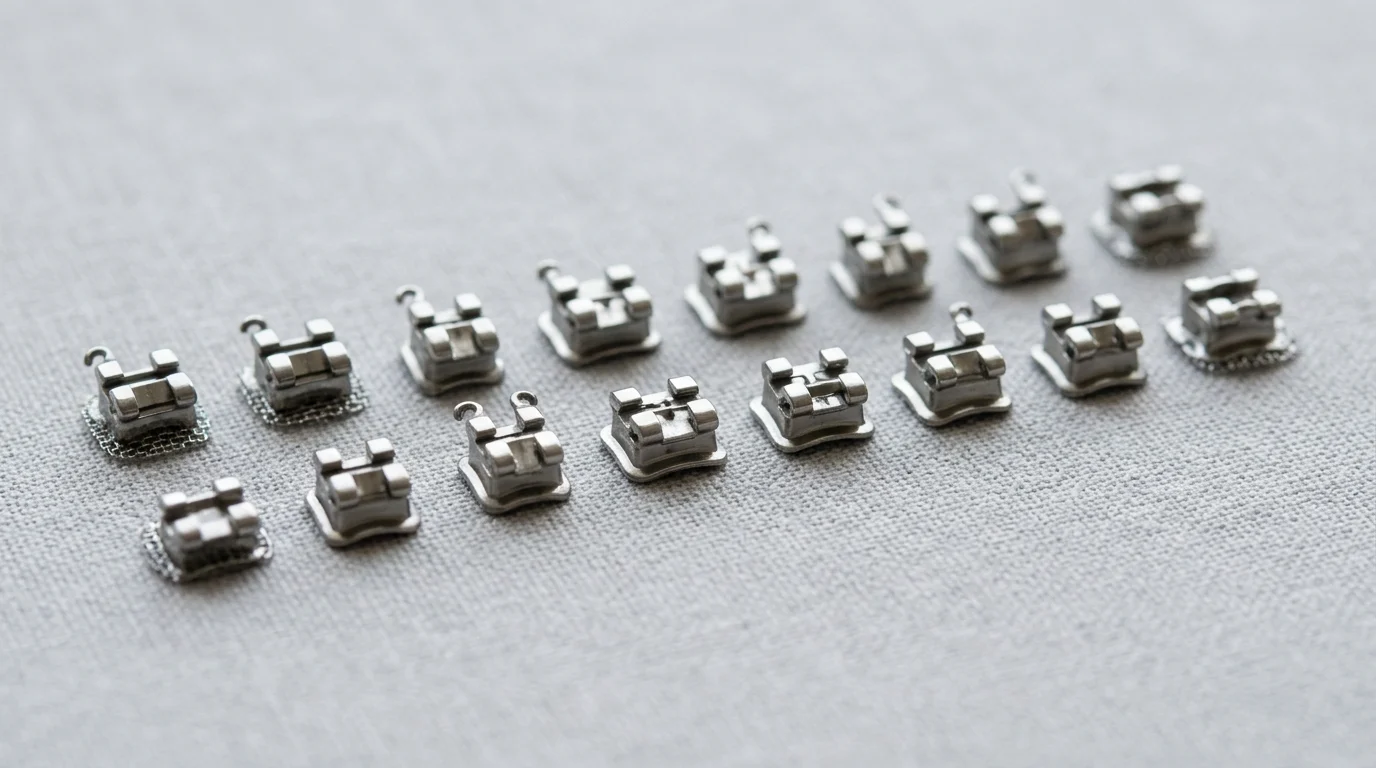
The structural integrity of metal braces relies heavily on the chosen alloy, with 17-4 PH (precipitation-hardened) stainless steel offering superior torque strength compared to standard 316L stainless steel. Slot accuracy is equally critical; premium brackets maintain slot tolerances of +/- 0.001 inches to ensure precise archwire engagement and predictable tooth movement. Additionally, the base design significantly impacts retention, with 80-gauge foil mesh bases consistently demonstrating optimal shear bond strengths in the range of 12 to 15 MPa.
How to compare private label and branded orthodontic brackets
The choice between private label (OEM) and supplier-branded (OBM) products depends on the buyer’s market strategy. Private labeling allows distributors to build brand equity but typically requires higher capital commitments, with Minimum Order Quantities (MOQs) for custom base laser-marking often starting at 5,000 sets. Conversely, purchasing pre-branded brackets offers faster time-to-market and lower MOQs, making it highly suitable for regional distributors testing new territories without heavy upfront investment.
Which comparison criteria best evaluate metal braces
To standardize the evaluation process, procurement teams should utilize a structured comparison matrix. Key criteria should include material composition, manufacturing technique (such as Metal Injection Molding), and torque precision.
| Specification Feature | Premium Requirement | Standard Requirement | Clinical Impact |
|---|---|---|---|
| Material | 17-4 PH Stainless Steel | 316L Stainless Steel | Prevents slot deformation under high torque |
| Slot Tolerance | +/- 0.001 inches | +/- 0.002 inches | Ensures accurate prescription expression |
| Base Design | 80-gauge sandblasted mesh | 60-gauge standard mesh | Maximizes bond strength (>12 MPa) |
How compliance requirements affect bulk purchases
Medical device regulations dictate that bulk purchasers must implement rigorous compliance checks. Failure to verify certifications can lead to severe legal and financial repercussions across international borders.
What FDA, CE, ISO 13485, and biocompatibility requirements mean
International standards form the baseline for orthodontic device safety. ISO 13485 certification mandates a comprehensive Quality Management System (QMS) specific to medical devices. In the European Union, the Medical Device Regulation (MDR) requires clinical evaluation reports, while the FDA requires a 510(k) clearance for Class II devices. Furthermore, ISO 10993 biocompatibility testing is mandatory to ensure patient safety, specifically requiring that nickel leaching rates remain below the strict threshold of 0.2 µg/cm²/week.
How to verify technical documents and test reports
Buyers must not take compliance claims at face value. It is essential to request and authenticate primary documents, including the FDA 510(k) clearance letter, the CE Declaration of Conformity, and independent third-party laboratory test reports. Verifying these documents directly through regulatory databases ensures the supplier’s credentials are current and applicable to the specific bracket models being purchased, rather than just a general facility certification.
Which compliance gaps cause customs delays and market risk
Incomplete or fraudulent compliance documentation introduces severe supply chain vulnerabilities. Missing Unique Device Identifier (UDI) labels or invalid CE certificates can trigger immediate customs holds. Such regulatory gaps frequently cause delays of 14 to 21 days at the port of entry, accumulating demurrage fees that can range from $500 to $2,000 per shipment, while simultaneously exposing the buyer to potential market withdrawal orders and reputational damage.
What sourcing and logistics steps improve results
Optimizing the procurement process requires strategic alignment between sourcing protocols and logistical planning. Efficient supply chain management directly impacts the final profitability of bulk orthodontic orders.
How to audit suppliers and confirm manufacturing capability
Conducting a comprehensive supplier audit is the first step in verifying manufacturing capability. Buyers should assess the supplier’s Metal Injection Molding (MIM) lines, CNC machining centers, and automated polishing facilities. A robust facility should demonstrate the capacity to handle high-volume runs without degrading quality, typically maintaining a standard lead time of 30 to 45 days for bulk orders exceeding 10,000 sets.
How to compare MOQ, samples, and contract terms
Negotiating favorable contract terms requires a clear understanding of industry benchmarks. Initial sample evaluations usually involve testing 10 to 50 sets in a clinical setting. Once validated, buyers must navigate Minimum Order Quantities (MOQs), which generally range from 500 to 2,000 sets for standard Roth or MBT prescriptions. Standard payment structures often require a 30% advance deposit, with the remaining 70% balance due upon successful pre-shipment inspection.
What landed cost factors buyers should calculate
Calculating the true cost of acquisition requires moving beyond the Ex-Works (EXW) or Free on Board (FOB) price. Buyers must account for freight, insurance, and import duties to determine the landed cost. Reaching out to a supplier contact can help clarify packaging dimensions and shipping weights for accurate freight estimation.
| Cost Component | Typical Percentage of Landed Cost | Variable Factors |
|---|---|---|
| Ex-Works Unit Price | 65% – 75% | Material grade, order volume, private labeling |
| International Freight | 10% – 15% | Air vs. Sea freight, volumetric weight |
| Customs Duties & Tariffs | 5% – 25% | Trade agreements, country of origin, HTS codes |
| Insurance & Clearance Fees | 2% – 5% | Value of goods, broker fees |
How buyers should make the final supplier decision
Selecting the optimal bulk supplier is a multi-dimensional decision that impacts long-term business success. A systematic approach ensures that all critical variables are weighted appropriately before committing to a contract.
Which scorecard criteria best balance compliance, quality, and cost
Procurement teams should employ a weighted scorecard to objectively evaluate potential manufacturing partners. A highly effective distribution of criteria allocates 40% of the total score to quality and regulatory compliance, 30% to unit cost and financial terms, and 30% to logistical reliability and production capacity. This balanced matrix prevents buyers from prioritizing aggressive pricing over clinical safety or supply chain stability.
What decision process works for distributors, brands, and clinics
The final decision-making process must align with the specific operational model of the buyer. High-volume distributors moving over 10,000 sets per month must prioritize scalable production and tariff mitigation strategies. Private label brands require partners with sophisticated custom packaging capabilities and strict non-disclosure agreements. Conversely, large clinical networks purchasing directly must focus on ready-to-use kitting, consistent prescription accuracy, and streamlined inventory integration.
Further reading:
Key Takeaways
- The most important conclusions and rationale for orthodontic brackets
- Specs, compliance, and risk checks worth validating before you commit
- Practical next steps and caveats readers can apply immediately
Frequently Asked Questions
Why should I choose an FDA and CE certified metal braces supplier?
Certification helps reduce regulatory risk, supports import compliance, and improves consistency in orthodontic brackets for large-volume orders.
What bracket specifications should I compare before buying in bulk?
Check stainless steel grade, slot tolerance, base mesh design, and torque precision. These factors directly affect bonding strength and treatment accuracy.
Can DenRotary support private label orthodontic brackets?
Yes, OEM/private label options are available for bulk buyers. Confirm MOQ, logo marking, packaging, and lead time with DenRotary before ordering.
How can I verify a supplier’s compliance documents?
Request FDA, CE, ISO 13485, and biocompatibility reports, then match certificate details with the exact bracket model and manufacturer name.
Is branded stock or OEM better for distributors?
Branded stock suits faster launch and lower MOQs. OEM is better for building your own brand when you can commit to higher volumes.

Post time: Jun-05-2026