


Introduction
In orthodontic treatment, straightening teeth is only part of the process; the upper and lower jaws also need to meet in the right position for a stable bite. Dental rubber bands provide the controlled interarch force that braces or aligners alone often cannot deliver, helping guide jaw movement over time. This article explains how these small elastics work, what kinds of bite problems they are commonly used to correct, and why consistent wear matters for treatment results. With that foundation, the following sections look at the mechanics, clinical uses, and practical considerations behind their role in jaw alignment.
Why dental rubber bands matter for jaw alignment
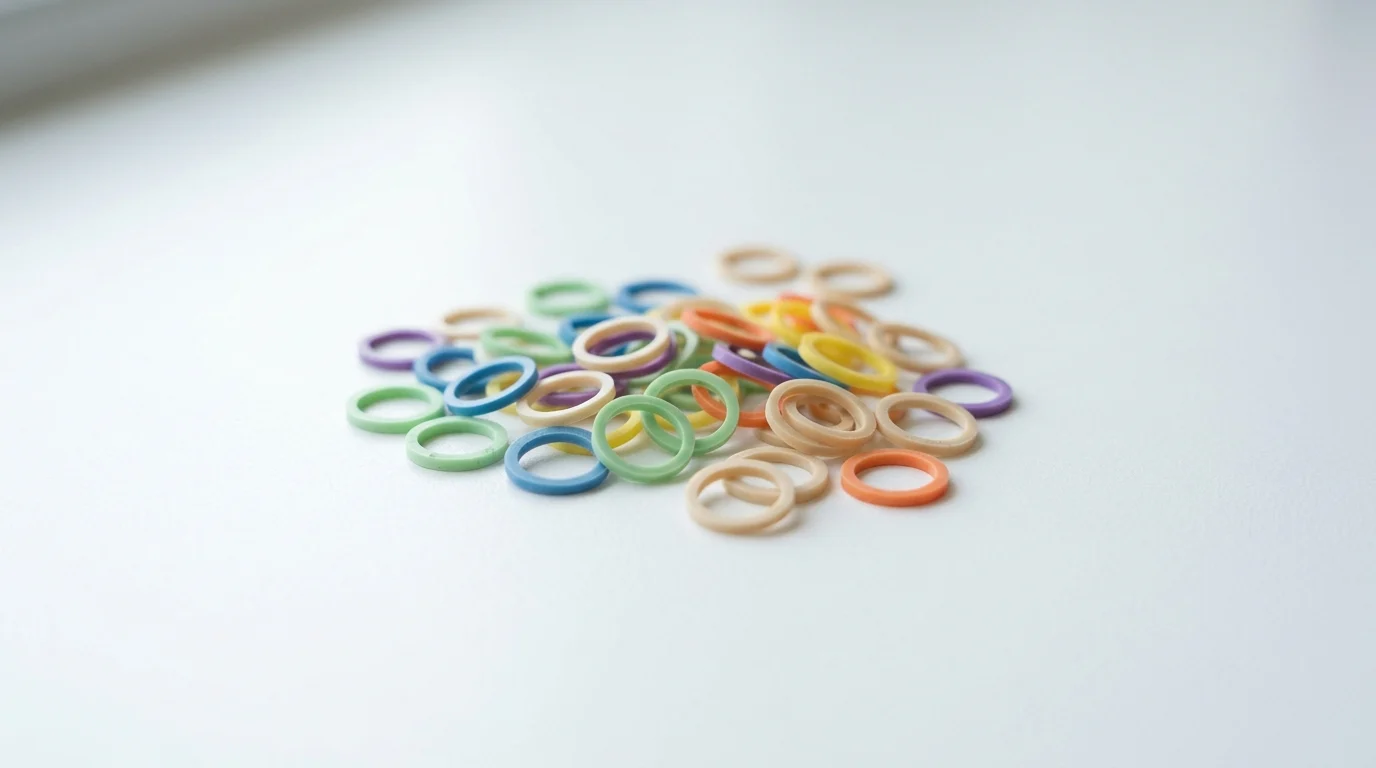
Orthodontic treatment relies on a combination of components to achieve functional and aesthetic occlusion. While brackets and wires align individual teeth along the dental arch, intermaxillary elastics—commonly known as dental rubber bands—are essential for coordinating the upper and lower jaws. These small latex or non-latex rings generate continuous, directional tension that wires alone cannot produce.
Depending on the clinical requirement, the applied force typically ranges from 2.5 to 8.0 ounces per band, providing the precise mechanical pressure needed for jaw repositioning. Without this interarch force, achieving a proper bite relationship is mechanically impossible in most comprehensive orthodontic cases.
How rubber bands support bite correction
The primary function of orthodontic elastics is to bridge the gap between the maxillary (upper) and mandibular (lower) arches. By attaching to specific hooks on brackets or clear aligners, they exert a continuous pull that gradually shifts the jawbone structure and surrounding periodontal ligaments.
This interarch coordination is crucial because perfectly straight teeth are functionally inadequate if the upper and lower dental arches do not interlock correctly during mastication. The bands provide the necessary leverage to guide the mandible into a stable, physiological resting position relative to the maxilla.
Which malocclusions they commonly address
Elastics are highly versatile and are prescribed to treat a wide spectrum of malocclusions. For Class II malocclusions (overbites), bands generally connect the upper canines to the lower molars, drawing the lower jaw forward and the upper teeth slightly backward.
Conversely, Class III malocclusions (underbites) require bands linking the lower canines to the upper molars to retract the mandible. They are also instrumental in closing anterior open bites—where vertical elastics pull the upper and lower front teeth together to establish overlap—and correcting midline deviations where the centers of the upper and lower arches do not align.
How dental rubber bands improve jaw alignment

The efficacy of dental elastics is rooted in biomechanics and material science. When stretched between designated anchor points, the bands attempt to return to their original diameter, thereby exerting a constant pull on the dental structures.
However, the oral environment—characterized by continuous moisture, temperature fluctuations, and salivary enzymes—causes these polymers to degrade rapidly. Clinical studies indicate that standard latex elastics lose approximately 30% to 50% of their initial force within the first 24 hours of continuous wear, necessitating strict replacement schedules to maintain active tension.
How orthodontic rubber bands work
Orthodontic rubber bands function by leveraging vector forces to stimulate cellular responses within the jawbone. When continuous tension is applied, it triggers a process known as bone remodeling: osteoclasts break down bone tissue on the compressed side of the tooth root, while osteoblasts form new bone on the tension side.
This biological mechanism allows the entire arch or specific segments of the jaw to migrate slowly into the desired anatomical position. The elasticity of the bands provides a dynamic force that adapts safely as the patient speaks, yawns, or swallows, ensuring that the pressure remains within a therapeutic threshold.
How force, wear schedule, and attachment points affect results
The final alignment outcome is heavily dependent on the force magnitude, the patient’s adherence to the wear schedule, and the specific attachment configuration. Orthodontists calculate the exact vector of pull required and select bands accordingly, categorizing them by diameter (e.g., 1/4″, 5/16″) and force rating.
To achieve optimal bone remodeling, patients are typically instructed to wear the elastics for 20 to 22 hours per day. Deviations from this schedule allow the periodontal ligaments to relax and teeth to drift back, significantly prolonging the overall treatment timeline.
| Force Category | Typical Pull Strength | Common Clinical Application |
|---|---|---|
| Light | 2.5 oz – 3.5 oz | Early treatment phases, minor midline adjustments |
| Medium | 4.0 oz – 5.0 oz | Standard Class II and Class III bite corrections |
| Heavy | 6.0 oz – 8.0 oz | Severe malocclusions, finishing stages of treatment |
Dental rubber bands vs other jaw alignment methods
While dental rubber bands remain the standard for interarch correction, they are not the only mechanism available to orthodontists. Alternative solutions include fixed functional appliances like the Herbst appliance, Forsus springs, and historically, extraoral headgear.
The primary differentiator between these methods lies in patient compliance. Clinical data suggests that patient compliance with removable elastics often hovers between 40% and 60%, whereas fixed appliances deliver continuous force with 100% compliance. However, fixed methods introduce a different set of clinical and financial variables that must be weighed.
When rubber bands are preferred over springs or fixed appliances
Rubber bands are generally preferred as a first-line treatment due to their non-invasive nature and cost-effectiveness. Unlike rigid springs or fixed metal arms that hold the jaw in a forced position, elastics allow for a full range of mandibular motion, making eating and speaking much more natural.
Furthermore, because elastics are removable, patients can maintain optimal oral hygiene, significantly reducing the risk of plaque accumulation and decalcification around bulky fixed appliance anchors. Fixed appliances are typically reserved for severe skeletal discrepancies, cases requiring massive force vectors, or situations where patient non-compliance has completely stalled treatment progress.
How effectiveness and comfort compare across options
When evaluating effectiveness and comfort, each modality presents distinct trade-offs. Elastics offer superior comfort regarding soft tissue irritation, as there are no large metal hinges to chafe the buccal mucosa (inner cheeks). However, their effectiveness is entirely contingent on the patient’s discipline and willingness to tolerate a mild, continuous ache.
Fixed appliances, while initially more uncomfortable and restrictive to jaw movement, can sometimes expedite jaw alignment by providing unyielding, 24-hour mechanical force. Despite this, the lower physical profile, aesthetic flexibility (including clear or tooth-colored options), and lower risk of hardware breakage make elastics the more universally accepted choice for mild to moderate jaw alignments.
Practical factors that affect results
The gap between a theoretical orthodontic treatment plan and the actual clinical outcome is largely bridged by practical, day-to-day variables. Even with the perfect prescription of force vectors, the biological response of the jawbone requires consistent environmental conditions.
Maintaining force levels above a 70% functional threshold is critical; dipping below this level allows teeth to drift back toward their original positions, effectively erasing days of alignment progress and extending the time in braces.
How compliance and clinical setup influence outcomes
Patient compliance is the single most significant variable in elastic-driven jaw alignment. Wearing bands for only 12 hours instead of the prescribed 20 to 22 hours does not yield half the result; it often yields zero net movement due to the relapse effect during the hours the bands are removed.
Additionally, the clinical setup—specifically the integrity of bracket hooks or clear aligner cutouts—must remain intact. If an attachment point bends, breaks, or is bypassed by the patient, the vector of force is fundamentally altered. This can drive the jaw out of alignment, creating new bite interferences that necessitate corrective appointments.
What risks and limitations to monitor
While generally safe, the use of intraoral elastics carries specific risks that require professional monitoring. The most common complication is soft tissue irritation or allergic contact stomatitis in patients with undiagnosed latex allergies, which necessitates an immediate switch to synthetic polyurethane alternatives.
Furthermore, if patients apply the bands to the wrong teeth—a common error when mirroring instructions at home—they risk creating unintended crossbites. Incorrect application can also place excessive, unnatural strain on the temporomandibular joint (TMJ), potentially leading to muscular pain, joint clicking, and headaches.
How often bands should be replaced
To combat the rapid degradation of elastomer materials in the mouth, strict replacement protocols are mandatory. As the material absorbs water and is subjected to mechanical stretching, its elasticity decays rapidly.
Orthodontists universally recommend replacing rubber bands three to four times daily—typically after meals and before sleep. This frequent rotation ensures that the applied force remains within the therapeutic window, preventing the bands from becoming passive, ineffective tethers.
| Replacement Frequency | Force Retention (Approximate) | Clinical Effectiveness |
|---|---|---|
| Once daily | 40% – 50% | Poor (High risk of relapse) |
| Twice daily | 60% – 70% | Moderate (Slower progress) |
| 3 to 4 times daily | 85% – 100% | Optimal (Maximum bone remodeling) |
How to decide if dental rubber bands are appropriate
Determining the appropriate intervention for jaw alignment requires a comprehensive clinical evaluation. While dental rubber bands are ubiquitous in orthodontic practices, they are not a panacea for all skeletal anomalies.
Their application is generally limited to correcting dental and minor skeletal discrepancies of approximately 2 to 4 millimeters. When jaw misalignments exceed this threshold, or involve severe skeletal asymmetries in non-growing adult patients, more invasive procedures such as orthognathic surgery or temporary anchorage devices (TADs) are often evaluated as primary or concurrent treatments.
What criteria determine candidacy
Candidacy for elastic therapy hinges on several anatomical and behavioral criteria. The patient’s growth phase is highly influential; adolescents experiencing active pubertal growth spurts are ideal candidates because their skeletal structures are highly responsive to orthopedic forces.
In adults, while rubber bands can successfully achieve dentoalveolar camouflage (moving the teeth to mask the underlying jaw discrepancy), actual skeletal modification is minimal without surgical intervention. Furthermore, the clinician must assess the patient’s psychological readiness; a history of poor compliance with oral hygiene strongly contraindicates a treatment plan heavily reliant on removable elastics.
How to set realistic expectations
Establishing realistic expectations at the outset of treatment is vital for patient retention and clinical success. Patients must understand that the initial phase of wearing elastics will induce localized soreness and muscular fatigue in the jaw, typically peaking within the first 48 to 72 hours before subsiding.
Treatment duration varies widely based on severity, but consistent wearers can expect to see measurable changes in their bite alignment within 3 to 6 months. Ultimately, understanding that the success of the alignment is a shared responsibility between the precision of the orthodontic prescription and the daily diligence of the patient ensures a smoother, more predictable path to a functional bite.
Further reading:
Key Takeaways
- The most important conclusions and rationale for dental rubber bands
- Specs, compliance, and risk checks worth validating before you commit
- Practical next steps and caveats readers can apply immediately
Frequently Asked Questions
What do dental rubber bands actually do for jaw alignment?
They connect the upper and lower arches to create steady interarch force, helping correct overbites, underbites, open bites, and midline shifts.
How many hours a day should dental rubber bands be worn?
Most patients are told to wear them 20 to 22 hours daily, removing them only for eating, brushing, or as instructed by the orthodontist.
How often should dental rubber bands be changed?
Usually at least once or twice a day because elastic force drops quickly in the mouth. Follow your orthodontist’s exact replacement schedule.
Can I use stronger or different dental rubber bands from another source?
No. Only use the size and force prescribed for your case. Using the wrong elastics can slow treatment or move teeth and jaws incorrectly.
Where can I learn more about orthodontic elastics from DenRotary?
You can explore DenRotary’s site for product and company information, including pages like denrotary.com/products and denrotary.com/about-us.

Post time: Jun-26-2026