

Introduction
Choosing an orthodontic supplier involves more than comparing catalogs or quoted prices. The real test is whether a manufacturer can produce consistent volumes of brackets, wires, aligners, and related components while meeting promised delivery windows as demand changes. This article explains how to assess production capacity, scalability, and lead-time reliability using practical indicators rather than sales claims. You will learn what operational data to request, which warning signs suggest bottlenecks, and how these factors affect inventory costs, treatment continuity, and long-term procurement planning, providing a clear basis for evaluating suppliers in the sections that follow.
Assess Production Capacity and Scalability
Procurement of orthodontic supplies at scale requires rigorous evaluation of a manufacturer’s production ceiling and operational flexibility. As dental service organizations (DSOs) and large-scale distributors expand, their supply chains must accommodate surging demand without compromising the clinical precision of brackets, archwires, and aligners.
Evaluating a supplier’s mass production capability is not merely about assessing current output; it requires analyzing their ability to scale operations rapidly in response to market fluctuations. A robust supplier evaluation framework isolates empirical capacity metrics from marketing claims, ensuring that long-term procurement volumes align with the manufacturer’s infrastructural realities.
Why production capacity and lead-time reliability matter
Production capacity and lead-time reliability serve as the bedrock of a stable orthodontic supply chain. When a supplier’s capacity is constrained, buyers face prolonged stockouts of high-velocity SKUs, such as specific torque brackets or popular archwire alloys. These stockouts translate directly into delayed patient treatments and lost clinical revenue.
Furthermore, unreliable lead times force procurement teams to artificially inflate safety stock levels. This traps capital in excess inventory and increases holding costs, undermining the financial efficiency of the entire dental organization. Reliable capacity ensures a predictable flow of materials, enabling lean inventory practices and consistent clinical operations.
How to verify true mass production capability
Verifying true mass production capability requires moving beyond surface-level audits and analyzing a supplier’s physical infrastructure and workforce shifts. Procurement teams should audit the exact number of active multi-axis CNC machines dedicated to self-ligating brackets or the fleet of thermoforming units utilized for clear aligner production.
A tier-1 orthodontic supplier should demonstrate a minimum baseline capacity of 500,000 clear aligners or 1.5 million metal brackets per month to support enterprise-level buyers. Additionally, buyers must verify the facility’s shift structure—facilities running three 8-hour shifts demonstrate higher capital equipment utilization and greater flexibility to absorb sudden volume spikes than those restricted to single-shift operations.
Which metrics buyers should use to benchmark suppliers
Benchmarking suppliers requires standardized, quantifiable metrics that reveal operational efficiency and scalability. Buyers must evaluate Maximum Monthly Capacity (MMC) alongside the supplier’s current capacity utilization rate. A supplier operating at 95% utilization has virtually no room to accommodate a sudden 20% increase in order volume without extending lead times.
| Capacity Metric | Standard Supplier Expectation | Enterprise-Grade Supplier Expectation |
|---|---|---|
| Capacity Utilization Rate | 80% – 90% | 65% – 75% (Built-in scalability) |
| Minimum Order Quantity (MOQ) | 5,000 units per SKU | Flexible / Tiered pricing models |
| Surge Capacity Lead Time | +30 days for volume spikes | +14 days for up to 30% volume spikes |
| Automated Inspection Rate | 50% of production volume | 100% automated optical inspection |
By applying these metrics, procurement officers can accurately map a supplier’s operational ceiling. Evaluating the ratio of automated manufacturing to manual labor also provides insight into how quickly production can be scaled up without requiring extensive, time-consuming workforce training.
Compare Lead Times and Delivery Risk
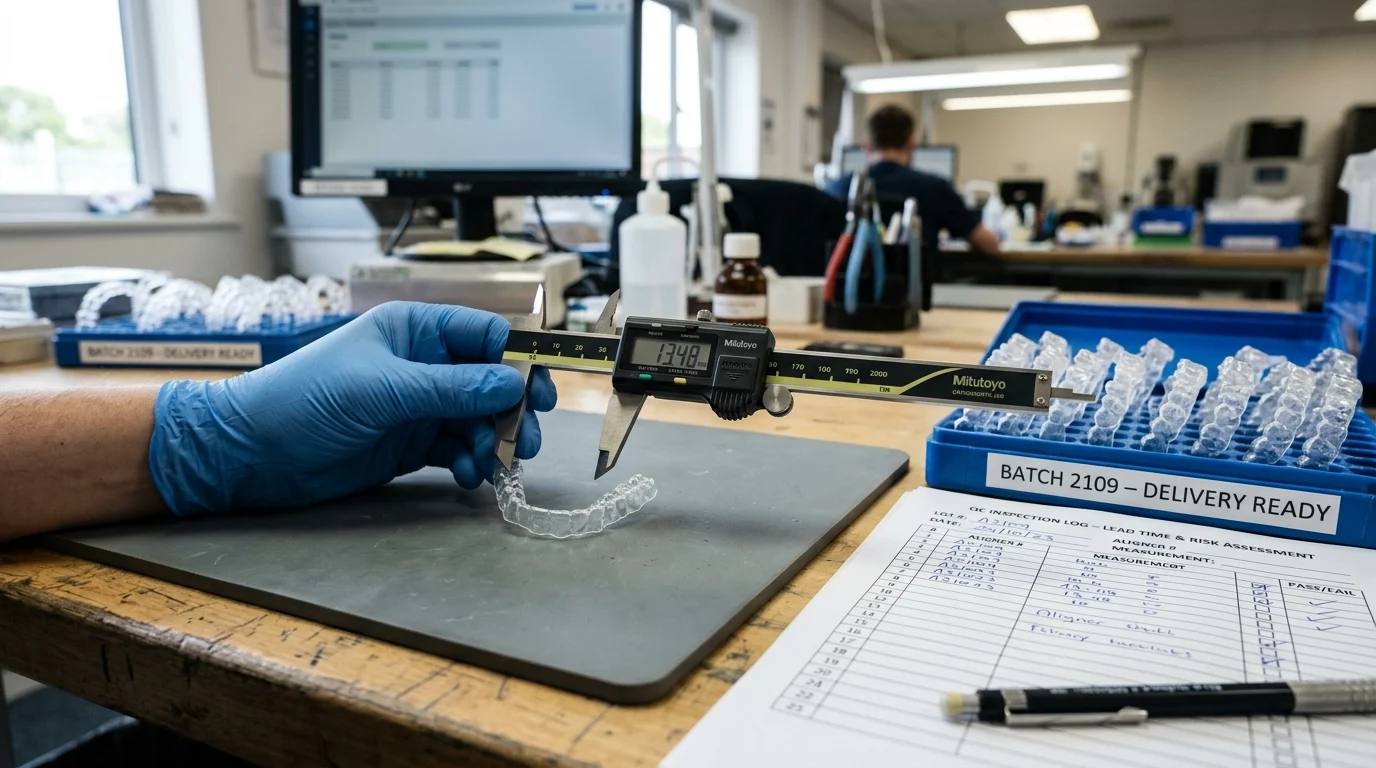
Lead time in orthodontic manufacturing is a composite metric, representing the cumulative duration of order processing, raw material acquisition, tooling, production, quality assurance, and transit. Dissecting these components is essential for identifying bottlenecks and mitigating delivery risks.
A comprehensive lead-time analysis protects clinical workflows from disruption. By understanding the geopolitical, logistical, and operational variables that influence delivery speeds, procurement teams can build highly resilient supply networks.
Which lead-time components should be evaluated
To accurately evaluate delivery risk, buyers must deconstruct the quoted lead time into its distinct phases. Tooling and setup often represent the most variable component. For example, tooling setup for custom self-ligating brackets frequently adds 14 to 21 days to an initial order, whereas repeat production runs of standard Roth or MBT prescriptions should stabilize at a 25- to 30-day production lead time.
Raw material procurement is another critical sub-component. Suppliers who do not maintain buffer stocks of medical-grade 17-4 PH stainless steel or nickel-titanium (NiTi) alloys may pass raw material lead times directly onto the buyer, easily adding 4 to 6 weeks to the production schedule during global commodity shortages.
How sourcing and factory location affect delivery speed
The geographic location of the manufacturing facility fundamentally dictates the baseline transit time and exposure to geopolitical disruptions. Offshoring to Asian manufacturing hubs typically offers lower unit costs but introduces extended sea freight transit times of 30 to 45 days, along with elevated risks of port congestion and customs delays.
Conversely, nearshoring strategies—such as utilizing manufacturing facilities in Mexico or Eastern Europe for North American and Western European markets, respectively—can reduce transit times to 3 to 7 days via ground transportation. While nearshoring may carry a 10% to 15% premium on unit manufacturing costs, the dramatic reduction in transit lead time often offsets the expense by lowering safety stock requirements.
What hidden delay risks to test through OTIF performance
The most rigorous method for testing hidden delay risks is through historical On-Time In-Full (OTIF) performance data. A supplier may boast short production lead times but consistently fail to deliver the full requested quantity, forcing partial shipments and administrative overhead.
Enterprise buyers should mandate an OTIF performance threshold exceeding 95% over a trailing 12-month period. Any variance below this threshold indicates underlying systemic issues—such as poor machinery maintenance leading to unplanned downtime, or inadequate quality control that results in high scrap rates and delayed lot releases.
Review Quality, Compliance, and Documentation
Scaling production volume must never compromise the clinical efficacy, biocompatibility, or regulatory standing of orthodontic appliances. As production velocity increases, the statistical probability of defects also rises, making rigorous quality management systems (QMS) non-negotiable.
Procurement professionals must treat compliance and documentation not as a final checklist, but as a continuous operational requirement. Evaluating a supplier’s quality infrastructure ensures that mass-produced brackets and wires perform predictably in the patient’s mouth.
Which quality systems and process controls indicate reliability
A reliable orthodontic supplier must operate under strict, internationally recognized quality frameworks, predominantly ISO 13485:2016 and FDA 21 CFR Part 820. However, merely holding a certificate is insufficient; the maturity of the supplier’s Statistical Process Control (SPC) dictates their actual reliability.
World-class orthodontic manufacturers maintain an outgoing defect rate of less than 500 Parts Per Million (PPM). Furthermore, they must demonstrate a process capability index (Cpk) exceeding 1.33 for critical dimensions, such as bracket slot torque and angulation. A Cpk of 1.33 or higher mathematically proves that the manufacturing process is stable and that out-of-tolerance parts are statistically highly improbable.
How to review certifications, traceability, and biocompatibility records
Orthodontic appliances reside in the oral cavity for extended periods, necessitating flawless biocompatibility records. Buyers must review the supplier’s ISO 10993 testing documentation, specifically ensuring that materials pass stringent tests for cytotoxicity, sensitization, and irritation.
Traceability is equally vital for regulatory compliance and risk management. Suppliers must implement robust Unique Device Identification (UDI) protocols, allowing any individual bracket or archwire lot to be traced back to the exact batch of raw metal or polymer. This documentation must be readily accessible during a recall scenario, ensuring that clinical partners can isolate affected products within 24 to 48 hours.
What audit checks procurement teams should follow
When auditing an orthodontic manufacturer, procurement teams should prioritize First Article Inspection (FAI) reports and corrective and preventive action (CAPA) logs. FAI reports validate that the supplier’s tooling and initial processes meet all engineering specifications before mass production begins.
Additionally, buyers should conduct unannounced audits to verify that standard operating procedures (SOPs) are followed during routine shifts, not just during scheduled inspections. Reviewing the CAPA logs provides deep insight into the supplier’s culture of continuous improvement; a healthy QMS will show thoroughly investigated root causes and permanently implemented solutions for any internal quality deviations.
Evaluate Logistics and Supply Continuity
Ensuring a continuous flow of orthodontic appliances requires logistics capabilities that extend beyond simple freight forwarding. A supplier’s ability to integrate with a buyer’s inventory management system directly impacts the total cost of ownership and the resilience of the clinical supply chain.
Evaluating logistics involves analyzing how a manufacturer handles warehousing, fulfillment, and contingency planning. Suppliers with sophisticated logistics infrastructure act as strategic partners, buffering the buyer against macroeconomic volatility.
Which logistics and fulfillment capabilities matter most
The most valuable logistics capabilities in modern orthodontic procurement include Vendor Managed Inventory (VMI), automated 3PL (Third-Party Logistics) integration, and direct-to-clinic dropshipping. VMI shifts the burden of inventory monitoring to the supplier, ensuring that stock levels are automatically replenished based on predefined minimum and maximum thresholds.
For DSOs managing hundreds of clinic locations, a supplier’s ability to pick, pack, and dropship directly to individual clinics bypasses the need for a centralized buyer-owned distribution center, significantly streamlining the fulfillment cycle and reducing internal handling errors.
How suppliers affect cost control and service continuity
Supplier logistics directly influence a buyer’s cost control. Inventory carrying costs for orthodontic supplies typically represent 15% to 25% of the total inventory value annually. This includes warehousing space, insurance, obsolescence, and the opportunity cost of capital.
| Logistics Strategy | Typical Carrying Cost Burden | Lead Time to Clinic | Best Suited For |
|---|---|---|---|
| Traditional Bulk Purchasing | 20% – 25% annually | 3 – 5 days (from internal DC) | Highly predictable, high-volume SKUs |
| Vendor Managed Inventory (VMI) | 5% – 10% annually | 1 – 2 days | DSOs with centralized purchasing |
| Direct Dropshipping | Near 0% | 3 – 7 days (from supplier) | Custom appliances, clear aligners |
Suppliers offering VMI or regional warehousing can reduce the buyer’s overhead by holding 30 to 60 days of safety stock at their own facilities. This service continuity ensures that clinics never experience a stockout of critical Class II correctors or elastomeric ligatures, even during transit disruptions.
What production redundancy signals long-term supply stability
Supply stability over a multi-year contract requires demonstrable production redundancy. Procurement teams must evaluate whether a supplier operates multi-site manufacturing facilities or relies on a single, highly vulnerable location. A catastrophic event at a single-site factory can instantly halt the global supply of a specific bracket line.
Redundancy must also extend to the supplier’s own raw material sourcing. A reliable manufacturer will maintain dual-sourcing agreements for critical inputs, such as medical-grade polyurethane for aligners or ceramic powders for aesthetic brackets. Evidence of backup machinery and cross-trained labor pools further signals that the supplier can maintain uninterrupted production despite localized operational challenges.
Choose the Right Sourcing Strategy

Synthesizing production capacity, lead-time data, compliance records, and logistics capabilities culminates in the selection of an optimal sourcing strategy. The decision-making process must align with the broader financial and clinical objectives of the purchasing organization.
Selecting an orthodontic supplier is rarely a simple pursuit of the lowest unit cost. Strategic procurement requires balancing price against the tangible risks of stockouts, quality failures, and supply chain rigidity.
How to weigh trade-offs among price, capacity, and support
Procurement teams must evaluate suppliers based on Total Cost of Ownership (TCO) rather than isolated unit prices. A supplier offering a metal bracket for $0.50 with a 90-day lead time and a 3% defect rate will ultimately cost the organization more than a supplier charging $0.65 with a 30-day lead time and a 0.1% defect rate.
Trade-offs between price and capacity are inevitable. High-volume suppliers may offer aggressive pricing but demand rigid minimum order quantities that stifle a buyer’s cash flow. Conversely, specialized boutique manufacturers may offer exceptional clinical support and flexible capacities, but at a premium price point that challenges profit margins.
Which sourcing model fits best: single, dual, or regional
The choice between single, dual, or regional sourcing models defines the supply chain’s risk profile. Single sourcing consolidates purchasing power, often yielding volume discounts of 10% to 15% on MOQs exceeding 10,000 units. However, it creates a single point of failure.
Implementing a dual-sourcing strategy with a 70/30 volume split is generally the most effective model for enterprise orthodontic buyers.
Key Takeaways
- The most important conclusions and rationale for Orthodontic Suppliers
- Specs, compliance, and risk checks worth validating before you commit
- Practical next steps and caveats readers can apply immediately
Frequently Asked Questions
How can buyers verify an orthodontic supplier’s real mass-production capacity?
Request monthly output by SKU, utilization rate, shift schedule, and recent surge-order records. A factory audit should confirm equipment, automation, and inspection systems.
What lead-time details should be broken down before placing a large orthodontic order?
Ask for separate timings for tooling, raw materials, production, QC, packing, and shipping. This shows where delays are most likely.
What Denrotary indicators help evaluate production reliability?
Check Denrotary’s 3 automatic bracket lines, 10,000-piece weekly output, modern workshops, and CE, FDA, ISO13485 certifications as practical reliability signals.
Why does capacity utilization matter when comparing orthodontic suppliers?
A supplier already near full utilization has little room for urgent orders. Lower utilization usually means better scalability and more stable lead times.
How can buyers reduce delivery risk for brackets, arch wires, and power chains?
Prioritize suppliers with buffer stock of key materials, repeat-order lead-time data, and clear surge-capacity commitments for high-volume SKUs.

Post time: May-21-2026