

Introduction
Choosing orthodontic wire brands is less about sticker price than about treatment consistency, inventory reliability, and patient outcomes. For dental clinics, the right supplier can reduce force variability between cases, support predictable tooth movement, and limit hidden costs tied to breakage, replacement, or prolonged chair time. This article explains what makes certain wire brands more trusted than others, from material quality and manufacturing control to performance across common treatment stages. It also helps readers evaluate brands with a clinical and operational lens, creating a practical foundation for comparing options in the sections that follow.
Why Orthodontic Wire Brands Matter Beyond Unit Price
Procuring orthodontic consumables requires balancing clinical efficacy with operational budgets. While orthodontic wires typically represent only 5% to 10% of a dental clinic’s total consumable spend, they serve as the primary active components driving tooth movement. The biomechanical forces exerted by these archwires dictate the efficiency of the entire treatment plan.
Selecting the right orthodontic wire brands extends far beyond finding the lowest unit price. Clinics that prioritize upfront savings over material predictability often encounter hidden costs later in the treatment cycle. By partnering with established manufacturers, orthodontic practices ensure that the biomechanical properties of their inventory remain stable, ultimately protecting both profit margins and patient outcomes.
How trusted brands affect treatment consistency
The hallmark of a reputable orthodontic wire brand is the predictability of its force delivery. Established manufacturers utilize advanced metallurgical processes to ensure that a 0.016-inch nickel-titanium (NiTi) wire behaves identically across different production lots. This consistency is crucial because orthodontists calculate treatment timelines based on expected force degradation over a standard four- to six-week appointment interval.
Premium wires typically maintain up to 90% of their target force profile over a standard adjustment period, whereas inferior alternatives may suffer from rapid force decay, dropping below the biological threshold required for optimal osteoclast and osteoblast activity. When clinics utilize trusted brands, clinicians can confidently schedule longer intervals between visits, optimizing chair time and increasing the practice’s overall patient capacity.
What risks clinics face with low-cost wire choices
Opting for economy wires from unverified suppliers introduces significant operational risks. The most immediate threat is an elevated breakage rate. While premium wires generally exhibit failure rates below 1.5%, low-cost alternatives can experience breakage rates of 5% to 8% under masticatory stress.
Wire fractures necessitate emergency appointments. Industry data suggests that an unscheduled emergency visit costs a clinic between $100 and $150 in lost chair time, disposable materials, and staffing overhead. Furthermore, inconsistent springback properties in budget wires can lead to unintended tooth movements or “round-tripping,” which extends the total treatment duration by several months and drastically reduces the profitability of fixed-fee orthodontic contracts. To mitigate these risks, clinics should source from vetted orthodontic wire product portfolios that guarantee metallurgical stability.
How to Compare Orthodontic Wire Brands by Material
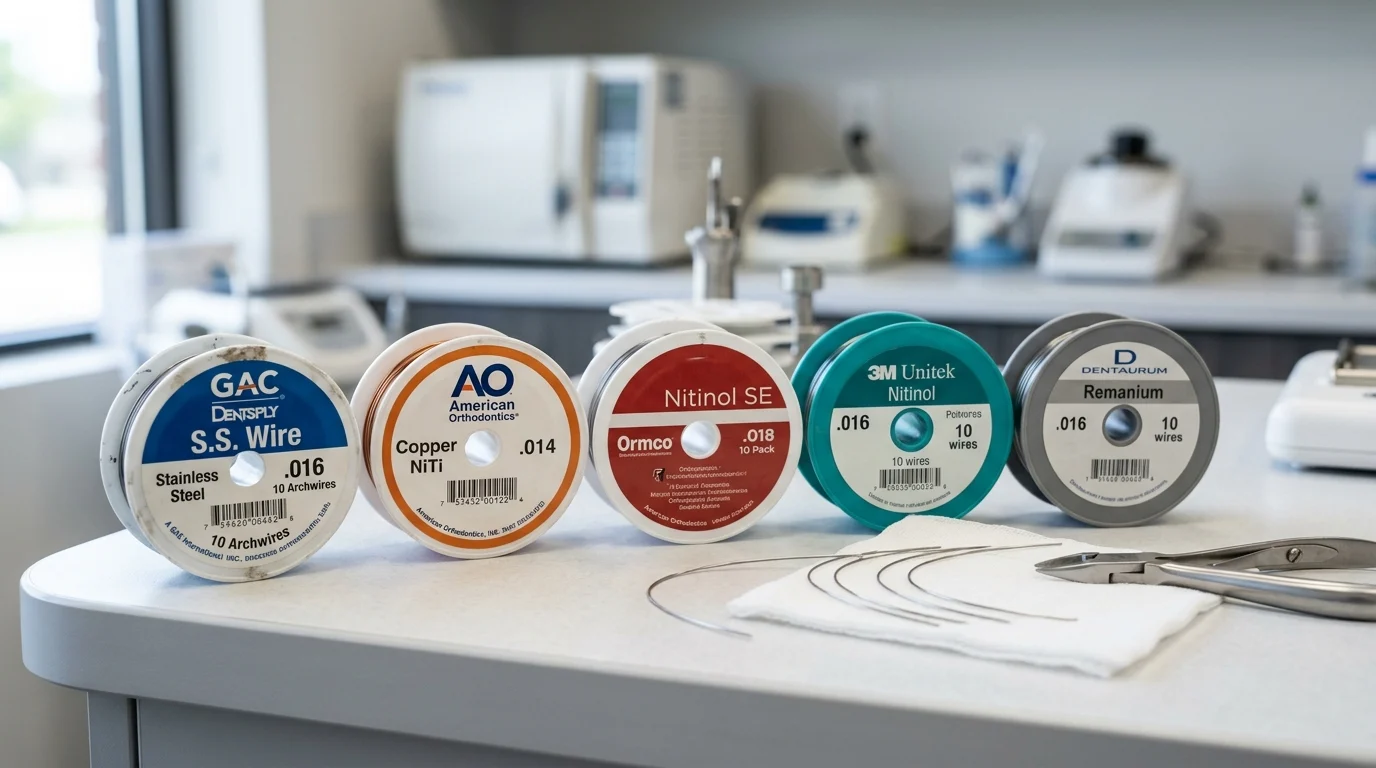
Evaluating wire brands requires a deep understanding of the core alloys used in modern orthodontics. A clinic’s inventory must encompass a strategic mix of materials to address the distinct mechanical phases of treatment: initial leveling and aligning, the working phase (space closure), and final detailing. Comparing brands based on how their specific alloys perform under clinical conditions is essential for building an effective supply chain.
How nickel-titanium, stainless steel, and beta-titanium differ
The three foundational alloys in orthodontics—nickel-titanium (NiTi), stainless steel (SS), and beta-titanium (TMA)—serve distinct biomechanical functions. NiTi is prized for its superelasticity and shape memory, making it ideal for early treatment phases where large deflections are required. Stainless steel offers high stiffness and low friction, which is necessary for sliding mechanics and maintaining arch form. Beta-titanium provides an intermediate modulus of elasticity, offering better formability than NiTi and lower force delivery than stainless steel.
| Material Type | Primary Clinical Phase | Yield Strength (MPa) | Modulus of Elasticity (GPa) | Typical Cost per Unit ($) |
|---|---|---|---|---|
| Nickel-Titanium (NiTi) | Leveling & Aligning | 100 – 300 | 30 – 40 | $2.50 – $5.50 |
| Stainless Steel (SS) | Working & Finishing | 1,000 – 1,500 | 160 – 200 | $0.50 – $1.50 |
| Beta-Titanium (TMA) | Detailing & Torque | 700 – 1,000 | 60 – 80 | $4.00 – $8.50 |
Top-tier brands distinguish themselves by optimizing the transition temperatures of their heat-activated NiTi wires, typically engineering them to become fully austenitic between 27°C and 35°C. This ensures the wire remains pliable during ligation but exerts continuous, gentle force once warmed by the oral environment.
Which criteria best compare wire performance
When comparing wire performance across different manufacturers, procurement managers should evaluate load-deflection curves rather than relying solely on subjective clinician feedback. The unloading plateau of a NiTi wire dictates the continuous force applied to the periodontal ligament. Superior brands provide flat, extended unloading plateaus, ensuring that the force remains relatively constant even as the teeth align and the wire deforms less.
Another critical criterion is the alloy’s resistance to permanent deformation (springback). Stainless steel wires from premium brands undergo specialized cold-working and stress-relieving processes to maximize their proportional limit. This allows clinicians to place intricate bends without the wire becoming brittle or snapping.
How arch form range and dimensional tolerance affect selection
Dimensional tolerance is a paramount factor in brand selection, particularly during the finishing stages of treatment where torque control is critical. A standard 0.019 x 0.025-inch rectangular wire in a 0.022-inch bracket slot inherently has about 10 degrees of torsional play. If a manufacturer’s dimensional tolerance is poor, the wire may be undersized by just 0.001 inches, which can inadvertently add an extra 5 to 7 degrees of play, making precise root torque nearly impossible.
Trusted brands maintain strict manufacturing tolerances of ±0.0005 inches. Furthermore, they offer a diverse range of arch forms—such as true, ovoid, and tapered—to accommodate varying patient anatomies. This minimizes the need for manual wire contouring, which saves valuable chair time and reduces the risk of introducing asymmetrical forces.
Quality and Compliance Signals to Review
In the medical device sector, stringent quality assurance separates reliable clinical partners from opportunistic vendors. Orthodontic wires are classified as medical devices, meaning their manufacturing, packaging, and distribution must adhere to strict regulatory frameworks. Clinics must prioritize brands that transparently demonstrate their compliance and quality control metrics.
Which certifications and traceability practices matter
Procurement teams should verify that a manufacturer holds an active ISO 13485:2016 certification, which dictates the quality management systems specifically required for medical devices. Depending on the clinic’s location, wires must also carry FDA 510(k) clearance in the United States or a CE mark under the stringent Medical Device Regulation (MDR) in Europe.
Traceability is equally critical. Premium orthodontic wire brands implement robust lot-tracking systems. In the event of a product recall or an adverse clinical event, a clinic should be able to trace a specific wire back to its exact metallurgical batch. Reputable manufacturers guarantee a traceability window of 24 to 48 hours, providing clinics with the documentation necessary to maintain their own compliance and liability protection. Learning about us and the specific manufacturing standards of a supplier is a critical step in due diligence.
How surface treatment and manufacturing quality affect reliability
The surface finish of an orthodontic wire dramatically impacts its clinical efficacy. Microscopic surface roughness increases friction between the wire and the bracket slot, which can stall tooth movement during sliding mechanics. High-quality brands utilize advanced electropolishing techniques to reduce surface roughness (Ra) to below 0.1 micrometers.
This level of smoothness can reduce frictional resistance by up to 30% compared to standard mechanical polishing. Additionally, a highly polished surface minimizes bacterial adhesion and plaque accumulation, lowering the patient’s risk of enamel decalcification (white spot lesions) during their 18-to-24-month treatment journey. Poor manufacturing quality often manifests as burrs or micro-fissures, which not only increase friction but serve as initiation points for structural fatigue and eventual wire fracture.
Sourcing, Logistics, and Total Cost Factors
A clinic’s profitability relies heavily on the efficiency of its supply chain. Procurement managers must evaluate orthodontic wire brands not just on their clinical merits, but on how effectively those products can be sourced, stocked, and replenished. Disruptions in consumable availability can force clinicians to alter treatment plans on the fly, compromising both efficiency and patient care.
How lead times, minimum orders, and distributor support affect supply
Supplier reliability is dictated by lead times and Minimum Order Quantities (MOQs). Direct-from-manufacturer arrangements often present lower unit costs but may impose high MOQs, sometimes requiring clinics to purchase 50 to 100 packs (500 to 1,000 wires) per order. Conversely, localized dental distributors might offer single-pack purchasing but at a 20% to 30% markup.
Lead times for imported premium wires can range from 4 to 6 weeks. To prevent stockouts without over-leveraging capital, clinics must calculate their reorder points accurately, often maintaining a safety stock equivalent to 1.5 times their average monthly usage. Evaluating a supplier’s contact protocols and customer service responsiveness is vital for navigating backorders or urgent inventory requests.
Which costs beyond unit price clinics should evaluate
Evaluating the Total Cost of Ownership (TCO) is essential when comparing budget wires to premium brands. While the unit price of an economy wire might be enticing, the hidden costs of clinical failures quickly erode those savings.
| Cost Metric | Premium Wire Brand | Economy Wire Brand |
|---|---|---|
| Average Unit Price | $3.50 | $1.00 |
| Estimated Breakage/Failure Rate | < 1.5% | 7.0% |
| Overhead Cost per Unscheduled Visit | $0.00 (Baseline) | $125.00 |
| Cost of Replacing Broken Wire | $3.50 | $1.00 |
| Effective Cost per 100 Patients | $355.25 | $976.00 |
As demonstrated, the elevated failure rate of cheaper materials drives up the effective cost significantly due to the overhead associated with unscheduled chair time. Clinics must also factor in the cost of inventory obsolescence; premium brands often offer favorable return or exchange policies for unopened packs of less frequently used arch sizes, which protects the clinic’s initial capital investment.
How Clinics Can Build a Practical Selection Process
Transitioning to a new orthodontic wire brand or consolidating an existing inventory requires a methodical approach. Haphazard purchasing decisions lead to cluttered stockrooms, frustrated clinicians, and inconsistent patient outcomes. A structured selection process aligns the clinical needs of the orthodontist with the financial constraints of the procurement department.
What step-by-step process to use for shortlisting brands
The first step in shortlisting brands is conducting a comprehensive audit of current wire usage over a 12-month period. Most clinics find their consumption follows a predictable ratio, such as 60% NiTi, 30% stainless steel, and 10% beta-titanium. Once high-volume SKUs are identified, the clinic should request samples from three to four top-tier manufacturers.
The clinical team should then execute a 30-day blind or semi-blind trial on a controlled subset of patients (e.g., 40 to 50 active cases). During this trial, orthodontists and dental assistants must log specific metrics: ease of ligation, frequency of wire breakage, patient reports of discomfort, and visible progression of leveling and aligning. Objective data collection prevents procurement decisions from being driven solely by brand familiarity or aggressive marketing.
How to balance clinical preference, procurement, and budget
Balancing clinician preferences with budget realities is the final hurdle. Orthodontists often develop strong tactile preferences for specific proprietary alloys. However, procurement teams can offset the higher costs of these preferred premium wires by standardizing the clinic’s archwire progression protocol.
By reducing the total number of wire sizes and cross-sections used in standard cases, a clinic can decrease its unique SKU count by 15% to 20%. This consolidation allows the practice to hit higher volume tiers with their chosen brand, often unlocking bulk purchasing discounts of 10% to 15% on annual contracts exceeding $10,000. Ultimately, establishing a collaborative dialogue between the clinical staff and the purchasing manager ensures that the selected wire brands deliver maximum biomechanical value without exceeding operational budgets.
Further reading:
Key Takeaways
- The most important conclusions and rationale for Orthodontic Wire Brands
- Specs, compliance, and risk checks worth validating before you commit
- Practical next steps and caveats readers can apply immediately
Frequently Asked Questions
Why should clinics prioritize trusted orthodontic wire brands over lower unit prices?
Trusted brands deliver more consistent force, lower breakage rates, and fewer emergency visits. That usually reduces hidden costs and helps keep treatment timelines predictable.
Which wire material is best for each treatment phase?
NiTi is best for leveling and aligning, stainless steel for working and finishing, and beta-titanium for detailing and torque control.
How can a clinic compare orthodontic wire brands objectively?
Review load-deflection curves, force retention, lot-to-lot consistency, and breakage rates. Ask suppliers for technical specifications and quality documentation.
What problems can low-cost orthodontic wires cause in daily practice?
They can fracture more often, lose force faster, and create unintended tooth movement. This may lead to extra visits, longer cases, and lower profitability.
Where can clinics source vetted orthodontic wire options online?
Clinics can review DenRotary’s orthodontic wire and dental product portfolio at denrotary.com/products to compare available options and request supply details.

Post time: Jun-13-2026