

Introduction
Choosing between conventional NiTi and Cu-NiTi archwires is not simply a material preference; it directly affects force delivery, patient comfort, and the predictability of early alignment. Although both wires are valued for superelastic behavior, Cu-NiTi adds temperature-sensitive control that can make force expression more precise in specific clinical situations. Understanding how these alloys differ in unloading characteristics, activation range, and biologic response helps clinicians match wire selection to crowding severity, bracket system, and treatment goals. The discussion below outlines where Cu-NiTi offers a meaningful advantage, where standard NiTi remains practical, and how to decide which option best fits a given case.
Why NiTi vs. Cu-NiTi Archwire Choice Matters
The advent of shape memory alloys revolutionized orthodontic biomechanics, shifting the paradigm from high-load stainless steel to continuous, light-force mechanics. The choice between conventional nickel-titanium (NiTi) and copper-nickel-titanium (Cu-NiTi) archwires represents a critical branch point in treatment planning.
While both alloys exhibit superelasticity, their differing thermodynamic behaviors dictate how mechanical stress is transferred to the periodontal ligament (PDL). Understanding these metallurgical nuances enables clinicians to optimize tooth movement while minimizing iatrogenic risks.
Impact on early-stage alignment
Early-stage leveling and aligning require forces that initiate cellular remodeling without inducing hyalinization or root resorption. Optimal orthodontic tooth movement typically demands continuous light forces in the range of 50g to 150g, depending on the specific tooth’s root surface area.
Conventional NiTi provides a relatively constant force over large deflections, but its unloading curve can fluctuate based on manufacturing tolerances. Cu-NiTi, conversely, offers a highly precise loading and unloading profile, ensuring the applied force remains strictly within the optimal biological threshold even when engaging severely malposed teeth.
How selection affects force delivery and planning
Archwire selection dictates the efficiency and predictability of the entire wire sequence. Because Cu-NiTi alloys can be engineered to activate at specific temperatures, clinicians can plan force delivery based on the oral environment rather than relying solely on mechanical deflection.
This thermal responsiveness allows for the insertion of larger rectangular wires (e.g., 0.016″ x 0.022″) earlier in the treatment sequence. The wire remains malleable at room temperature for easy engagement and gradually expresses its programmed force as it acclimates to the patient’s body heat, thereby streamlining the overall treatment plan.
NiTi vs. Cu-NiTi Material Differences
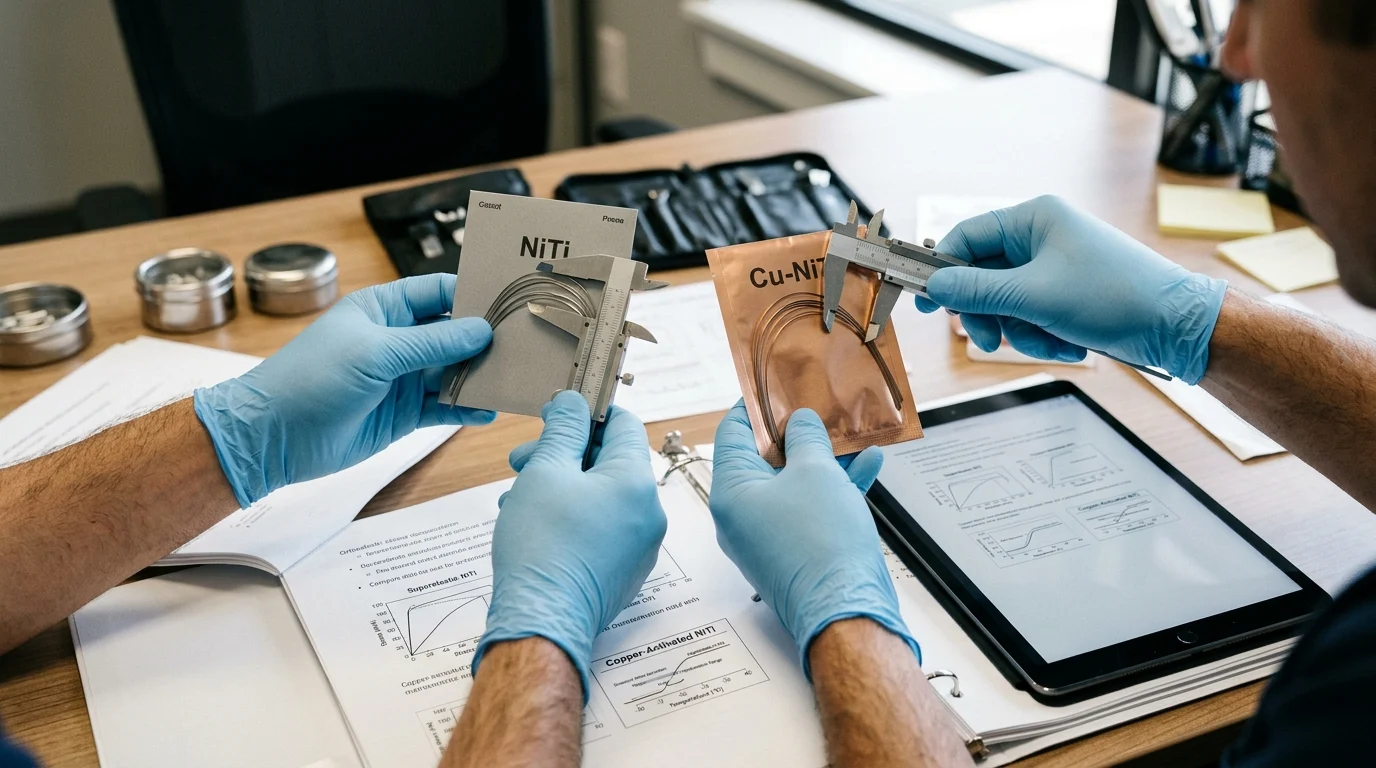
The fundamental performance variations between these archwires stem directly from their metallurgical composition. Conventional superelastic NiTi is a near-equiatomic binary alloy of nickel and titanium.
Cu-NiTi introduces copper into the matrix—typically constituting 5% to 6% of the alloy’s total weight—along with minor adjustments to the nickel and titanium ratios, and occasionally the addition of chromium to fine-tune transformation temperatures.
Superelasticity, shape memory, and thermal activation
Both alloys undergo a reversible phase transformation between a rigid, high-temperature austenitic state and a pliable, low-temperature martensitic state. However, the addition of copper significantly narrows the hysteresis loop—the gap between the loading (activation) and unloading (deactivation) force curves.
A narrower hysteresis means the force required to engage the wire into the bracket is much closer to the force the wire exerts as it returns to its original shape. This thermodynamic efficiency results in more consistent energy delivery and reduced trauma to the periodontal structures during the initial phases of treatment.
Force levels and working range comparison
Force levels and working ranges diverge sharply when analyzing the unloading plateaus of both materials. Standard superelastic NiTi unloading forces can experience a drop of 30% to 40% over a 2mm deflection, leading to uneven tooth movement as the wire recovers.
Cu-NiTi maintains a remarkably flat unloading plateau, often keeping force variance within a tight 10% to 15% margin across the same deflection range. This consistency is critical for maintaining the uninterrupted biological signaling required for efficient osteoclastic and osteoblastic activity.
| Property | Conventional Superelastic NiTi | Cu-NiTi (35°C Variant) |
|---|---|---|
| Alloy Composition | Binary (Ni, Ti) | Ternary (Ni, Ti, 5-6% Cu) |
| Hysteresis Loop | Wide | Narrow |
| Force Plateau Variance | 30% – 40% (over 2mm) | 10% – 15% (over 2mm) |
| Thermal Responsiveness | Low/Moderate | Highly Sensitive |
Clinical Factors That Guide Archwire Selection
Moving beyond material science, the clinical application of NiTi and Cu-NiTi requires a nuanced understanding of patient-specific variables. Orthodontists must weigh the severity of the malocclusion, the patient’s pain tolerance, and the mechanical demands of the chosen bracket system.
Matching wire type to case needs
Matching the wire type to the specific needs of the case is paramount for efficient leveling. In cases of severe crowding or ectopic eruptions, engaging a rigid wire risks bracket debonding or excessive patient discomfort.
A thermally activated Cu-NiTi wire (such as a 0.014″ or 0.016″ dimension) can be easily engaged in a chilled, martensitic state. As it warms to the oral temperature of approximately 37°C, it transitions to austenite, applying a gentle, continuous force. For mild alignment issues where profound deflection is not required, conventional NiTi often suffices and provides a highly efficient solution.
Temperature sensitivity and patient comfort
Patient comfort is directly influenced by the temperature sensitivity of the archwire. Cu-NiTi’s pronounced thermal reactivity acts as a built-in relief mechanism for the patient.
If a patient experiences localized pain spikes following an adjustment, consuming cold fluids (typically ranging from 5°C to 15°C) temporarily cools the oral cavity, shifting the archwire back into its softer martensitic phase. This instantly halts force delivery, providing temporary analgesia without requiring pharmacological intervention.
Limitations, handling, and cost trade-offs
Despite its biomechanical advantages, Cu-NiTi presents specific clinical and operational limitations. The inclusion of copper increases the alloy’s susceptibility to fracture under extreme, sharp bends, making it less suitable for intricate chairside detailing compared to stainless steel or even standard NiTi.
Additionally, procurement costs must be factored into practice overhead. Cu-NiTi archwires generally carry a price premium of 20% to 40% over conventional superelastic NiTi. This necessitates a strategic approach to inventory management to ensure premium wires are reserved for cases that truly benefit from their properties.
How to Evaluate Cu-NiTi Beyond Performance Claims
Evaluating Cu-NiTi requires looking past basic marketing claims and scrutinizing the exact thermodynamic specifications and quality assurance protocols of the manufacturer.
For high-volume practices and Dental Service Organizations (DSOs), standardizing procurement based on quantifiable metrics ensures consistent clinical outcomes and minimizes unexpected wire failures.
Specifications and transformation temperature ranges
The most critical specification for Cu-NiTi is its Austenite Finish (Af) temperature, which dictates when the wire is fully active. Manufacturers typically offer Cu-NiTi in specific Af variants to suit different clinical scenarios.
A 27°C wire remains active in almost all environmental conditions, functioning similarly to standard superelastic NiTi but with lower hysteresis. A 35°C wire activates just below normal body temperature, making it the standard choice for most orthodontic applications. A 40°C wire requires temperatures above baseline body heat to fully activate, making it ideal for patients with severe periodontal compromise where only intermittent, ultra-light forces are tolerable.
| Af Temperature Variant | Activation State at 37°C (Body Temp) | Primary Clinical Indication |
|---|---|---|
| 27°C | Fully Austenitic (Active) | Mild crowding, rapid alignment, mouth-breathers |
| 35°C | Near Fully Austenitic (Active) | Standard leveling and aligning, moderate crowding |
| 40°C | Partially Martensitic (Soft) | Severe crowding, periodontally compromised patients |
Sterilization, packaging, and regulatory checks
Regulatory compliance and sterilization protocols are vital evaluation criteria. High-quality Cu-NiTi archwires must comply with ISO 15841 standards for orthodontic wires, ensuring biocompatibility and reliable force expression.
While single-use protocols are the industry standard to prevent cross-contamination and material fatigue, some clinical settings may validate sterilization processes. It is crucial to note that standard autoclave cycles (e.g., 134°C for 3 to 5 minutes) can alter the crystalline structure of shape memory alloys over repeated cycles, potentially shifting the Af temperature and degrading the superelastic properties. Therefore, evaluating a manufacturer’s specific guidelines on thermal exposure during packaging and sterilization is mandatory.
How to Make the Right Archwire Choice
Deciding between conventional NiTi and Cu-NiTi is not a binary choice of one being universally superior; rather, it is about deploying the correct metallurgical properties at the appropriate stage of biomechanical intervention.
Establishing a standardized wire sequencing protocol allows practitioners to leverage the strengths of both alloys effectively.
A step-by-step decision framework
A systematic decision framework begins with assessing the degree of malocclusion and periodontal health. First, evaluate the interbracket distance and the severity of tooth deflection required; high deflection demands the thermal malleability of Cu-NiTi.
Second, assess root surface area and bone levels; compromised bone requires the ultra-light, consistent unloading forces of a 35°C or 40°C Cu-NiTi wire. Finally, consider the bracket prescription (e.g., self-ligating vs. conventional), as the lower friction of self-ligating systems pairs synergistically with the flat unloading plateau of copper-enriched alloys.
When to choose NiTi vs. Cu-NiTi
Conventional NiTi remains the highly efficient, cost-effective workhorse for routine, uncomplicated leveling phases where extreme deflection is absent and thermal control is unnecessary.
Conversely, Cu-NiTi should be the material of choice for complex initial alignments, severely rotated teeth, and thermally sensitive patients. From a practice management perspective, utilizing Cu-NiTi in complex cases can reduce the number of early-stage wire changes by one to two visits. This reduction in chair time and patient discomfort frequently offsets the 20% to 40% higher initial component cost, optimizing both clinical efficacy and operational workflow.
Key Takeaways
- The most important conclusions and rationale for Cu-NiTi Archwires
- Specs, compliance, and risk checks worth validating before you commit
- Practical next steps and caveats readers can apply immediately
Frequently Asked Questions
When is Cu-NiTi archwire the better choice?
Choose Cu-NiTi for severe crowding, ectopic teeth, or when you want lighter, more consistent force with easier engagement at room temperature.
When should I use conventional NiTi instead of Cu-NiTi?
Use NiTi for routine early alignment when thermal activation is not essential and you want a dependable, cost-effective superelastic wire.
Can Cu-NiTi reduce patient discomfort during initial alignment?
Yes. Its flatter unloading plateau helps deliver gentler, more controlled force, which can reduce soreness in the early treatment phase.
Does Cu-NiTi work well with self-ligating brackets?
Yes. Cu-NiTi pairs well with low-friction self-ligating systems, helping express light continuous forces efficiently during leveling and aligning.
Where can clinics source certified Cu-NiTi archwires and matching orthodontic products?
Clinics can source Cu-NiTi archwires, brackets, buccal tubes, and accessories from Denrotary, which highlights CE, FDA, and ISO13485 manufacturing standards.

Post time: May-21-2026