

Introduction
For high-volume dental clinics, an orthodontic wire supplier affects more than purchasing costs—it shapes treatment consistency, chair time, and daily workflow. When dozens of adjustments are scheduled each day, small differences in force accuracy, material quality, or delivery reliability can quickly disrupt patient throughput. This article explains what to look for in a supplier, from wire performance and manufacturing standards to inventory support and fulfillment dependability. It will help readers assess how supplier choice influences clinical outcomes, emergency visit rates, and operational efficiency, providing a practical foundation for comparing vendors and making more reliable sourcing decisions.
Why the right orthodontic wire supplier matters
High-volume dental clinics require precision and predictability in every component of patient care. Selecting the appropriate orthodontic wire supplier is a strategic decision that directly influences both clinical outcomes and operational efficiency. When practices handle upward of 50 to 100 orthodontic adjustments per day, even minor variations in arch wire performance or supply chain stability can compound into significant bottlenecks.
Impact on chair time and patient throughput
Arch wires that fail to deliver consistent force profiles or suffer from premature deformation increase the frequency of emergency visits. A reliable orthodontic wire supplier ensures that materials like Nickel-Titanium (NiTi) retain their shape memory and superelasticity, reducing unexpected breakages. Clinics that source high-grade wires often see emergency appointment rates drop by 15% to 20%, directly conserving valuable chair time for scheduled, revenue-generating treatments.
How supply reliability affects clinic operations
Operational continuity relies heavily on robust inventory management. A disruption in the supply of essential wire gauges can halt a clinic’s workflow, leading to rescheduled appointments and patient dissatisfaction. By partnering with a dependable orthodontic wire supplier, clinics mitigate the risk of stockouts. High-volume practices typically require a supplier capable of maintaining a 98% or higher on-time delivery rate, ensuring that the right arch wires are always accessible in the sterilization room or operatory.
Product specifications high-volume clinics should compare
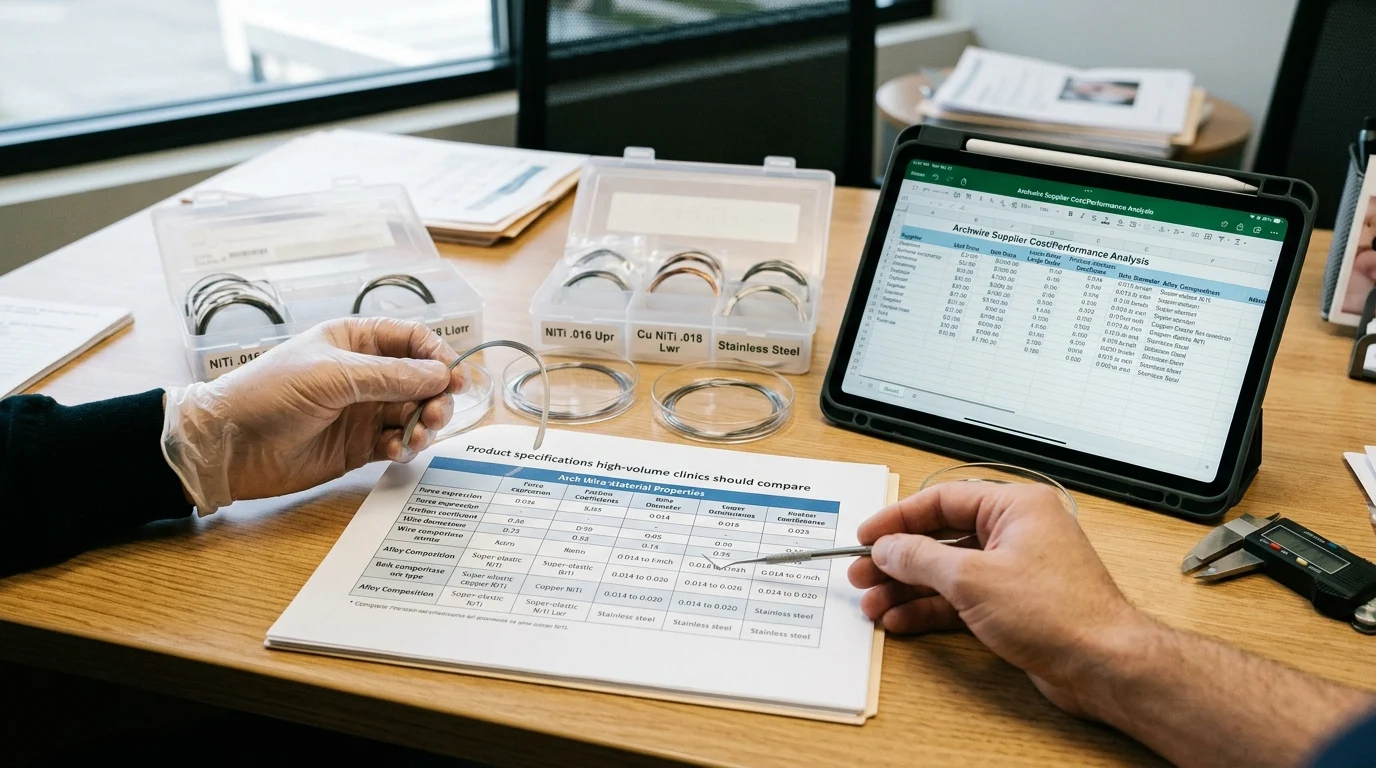
Evaluating an orthodontic wire supplier requires a deep dive into the technical specifications of their product catalog. High-volume practices must ensure that the wires they procure meet exact dimensional tolerances and force requirements to support diverse treatment phases.
Wire materials and clinical use cases
The foundational materials in orthodontic arch wires dictate their clinical application. Stainless steel provides high stiffness and low friction for the finishing stages, while NiTi is favored for initial leveling and aligning due to its superelasticity. Beta-Titanium (TMA) offers a middle ground, providing formability with moderate force. Suppliers should offer a comprehensive portfolio covering these three primary alloys, manufactured to strict metallurgical standards to prevent brittle fractures during ligation.
Dimensions, force profiles, and packaging options
Wires are typically available in round, square, and rectangular cross-sections, ranging from 0.012 inches to 0.021 x 0.025 inches. Force profiles must remain consistent across batches to ensure predictable tooth movement. Furthermore, packaging plays a crucial role in clinic efficiency; individually sealed, pre-sterilized single-use packages reduce cross-contamination risks and save staff up to 10 minutes per hour in sterilization prep time compared to bulk spools.
Key specification criteria for side-by-side comparison
A side-by-side comparison of specifications helps procurement managers make informed decisions. Key metrics include tensile strength, dimensional tolerance (ideally within ±0.0005 inches), and surface finish roughness.
| Material Type | Primary Clinical Phase | Typical Force Level | Dimensional Tolerance Requirement |
|---|---|---|---|
| Nickel-Titanium (NiTi) | Initial Leveling | Light, Continuous | ±0.0005 inches |
| Beta-Titanium (TMA) | Intermediate/Detailing | Moderate | ±0.0005 inches |
| Stainless Steel | Finishing/Space Closure | Heavy, Rigid | ±0.0002 inches |
How to assess quality, compliance, and risk
Quality assurance is non-negotiable when sourcing class II medical devices like arch wires. A thorough vetting of an orthodontic wire supplier’s compliance framework protects the clinic from regulatory liabilities and safeguards patient health.
Manufacturing controls, traceability, and certifications
Reputable manufacturers operate under stringent quality management systems, typically certified to ISO 13485 standards. This certification guarantees that the supplier maintains rigorous controls over raw material procurement, extrusion processes, and final polishing. Traceability is equally vital; every wire should be linked to a specific lot number, allowing the clinic to identify and isolate products instantly in the rare event of a recall.
Batch consistency and sterilization status
Variations in the alloy mix or heat treatment can drastically alter a wire’s transition temperature and force delivery. High-volume clinics should request lot-to-lot consistency data, looking for variance rates below 2%. Additionally, verifying the sterilization status is critical. Wires sold as pre-sterilized must adhere to validated gamma irradiation or ethylene oxide processes, supported by certificates of sterility for each shipment.
Sample testing and defect tracking
Before committing to a high-volume contract, clinics must conduct empirical sample testing. This involves deploying a trial batch of 100 to 200 wires in controlled clinical scenarios to monitor for premature breakage, surface friction, and bracket engagement ease. Tracking the defect rate during this trial phase is essential; a viable orthodontic wire supplier should demonstrate a clinical defect rate of less than 0.5% during rigorous application.
Sourcing, pricing, and logistics factors
Beyond clinical performance, the commercial terms offered by an orthodontic wire supplier dictate the financial viability of the partnership. High-volume clinics must balance unit costs with logistics reliability and inventory holding expenses.
MOQ, lead times, and inventory availability
Minimum Order Quantities (MOQs) and lead times directly impact cash flow and storage space. While overseas manufacturers might offer lower unit costs, they often require MOQs exceeding 5,000 units and lead times of 6 to 8 weeks. Domestic or regionally warehoused suppliers might offer lower MOQs of 500 units with 3-day lead times, allowing clinics to operate on a just-in-time inventory model and reducing holding costs by up to 15% annually.
Pricing factors beyond unit cost
Evaluating the true cost of arch wires requires looking past the invoice price per unit. Hidden costs such as expedited shipping fees for delayed orders, import duties, and the financial impact of defective wires must be factored into the Total Cost of Ownership (TCO). Clinics should negotiate volume-based rebates or fixed pricing agreements that lock in costs for 12 to 24 months, protecting the practice against raw material price volatility.
Manufacturer vs distributor comparison points
Clinics must choose between sourcing directly from a manufacturer or utilizing a dental distributor. Manufacturers offer deep customization and lower baseline costs but demand higher logistical oversight. Distributors provide consolidated purchasing and dedicated customer support but add a markup of 20% to 40%.
| Sourcing Model | Typical Unit Cost | Minimum Order Quantity (MOQ) | Average Lead Time | Best For |
|---|---|---|---|---|
| Direct Manufacturer | $0.80 – $1.50 | 5,000+ units | 4 – 8 weeks | Multi-location DSOs |
| Specialized Distributor | $1.50 – $3.00 | 100 – 500 units | 2 – 5 days | Single high-volume clinics |
Clinics can review specific products to determine which sourcing model aligns best with their operational scale.
Building a practical supplier selection framework
Transitioning from ad-hoc purchasing to a structured procurement strategy requires a standardized evaluation framework. High-volume clinics benefit significantly from implementing objective metrics to assess and manage their orthodontic wire suppliers over time.
Creating a clinic-focused supplier scorecard
A clinic-focused supplier scorecard quantifies performance across critical dimensions. Procurement managers should weight criteria such as product quality (40%), delivery reliability (30%), cost competitiveness (20%), and customer service responsiveness (10%). By scoring suppliers on a 100-point scale quarterly, clinics can identify degrading service levels before they impact patient care. A score dropping below 85 should trigger a formal review or corrective action plan with the supplier.
Standardization vs multi-sourcing
Relying on a single vendor simplifies ordering and maximizes volume discounts, but it introduces single-point-of-failure risks. Conversely, multi-sourcing ensures supply continuity but can complicate inventory management and reduce purchasing power. A hybrid approach—allocating 80% of volume to a primary supplier and 20% to a secondary, pre-vetted supplier—provides an optimal balance of cost efficiency and risk mitigation.
When and how to switch suppliers
Changing suppliers is a resource-intensive process that requires careful change management. Clinics should initiate a switch only when the current supplier consistently fails to meet scorecard benchmarks or when a competitor offers a demonstrable TCO reduction of at least 15%. The transition should be phased over 60 to 90 days, beginning with non-critical wire sizes, to ensure the new products meet clinical expectations without disrupting the daily treatment schedule. Engaging the new supplier’s contact us channels early in the process ensures seamless onboarding and alignment on delivery expectations.
Further reading:
Key Takeaways
- The most important conclusions and rationale for orthodontic wire supplier
- Specs, compliance, and risk checks worth validating before you commit
- Practical next steps and caveats readers can apply immediately
Frequently Asked Questions
What should high-volume clinics check first in an orthodontic wire supplier?
Prioritize lot consistency, on-time delivery, and material range. Ask for ISO 13485 certification, traceability by lot number, and availability of NiTi, TMA, and stainless steel arch wires.
Which arch wire materials should a supplier offer for full-case support?
A dependable supplier should stock NiTi for initial alignment, TMA for intermediate detailing, and stainless steel for finishing and space closure.
How can Denrotary help reduce stockout risk for busy orthodontic clinics?
Use Denrotary to confirm product availability, gauge options, and reorder planning. For high-volume clinics, request delivery schedules and backup supply details before placing recurring orders.
Why does wire packaging matter in a busy dental clinic?
Individually sealed, pre-sterilized wires speed setup, lower contamination risk, and reduce sterilization workload compared with bulk packaging.
How should a clinic verify arch wire quality before a bulk purchase?
Request samples, review dimensional tolerance and force data, and check lot-to-lot variance records. Track any breakage or deformation during trial use before signing a supply contract.

Post time: Jun-20-2026