

Introduction
Global dental importers are increasingly turning to orthodontic bracket OEM services to gain more control over pricing, branding, and product positioning in a crowded market. Rather than relying solely on third-party labels, OEM partnerships let importers develop private-brand bracket lines tailored to regional demand, clinical preferences, and margin targets. This article explains why that model is becoming more strategic, how OEM programs typically work, and which factors matter most when evaluating manufacturing partners. It also sets out the practical benefits and trade-offs importers should understand before adding orthodontic brackets to a private-label portfolio.
Why Orthodontic Brackets OEM Services Are Strategic
For global dental importers, navigating the competitive orthodontics landscape requires more than simply distributing established brands. Engaging with original equipment manufacturer (OEM) services provides a distinct advantage by allowing distributors to build proprietary brand equity while significantly improving operational margins. Industry data indicates that shifting from a standard distributorship to a private label model can yield a 25% to 40% increase in gross margins, depending on the scale of procurement and regional market positioning.
Market Shifts Driving OEM Demand
The global orthodontic supplies market is expanding continuously, driven by increasing awareness of dental aesthetics and rising disposable incomes. While clear aligners have gained substantial popularity, traditional fixed appliances remain the standard of care for complex malocclusions. This sustained demand for reliable Orthodontic Brackets drives importers to seek direct manufacturing relationships. By bypassing intermediaries, importers can adapt quickly to regional pricing pressures and specific clinical preferences, ensuring their product portfolios remain competitive and highly profitable.
How Private Label and OEM Programs Work
OEM and private label programs operate by connecting a distributor’s brand vision with a manufacturer’s production floor. In a private label arrangement, importers select pre-existing bracket designs and apply their branding to the packaging and labeling. Conversely, a true OEM program involves the manufacturer producing brackets based on the importer’s unique specifications or proprietary clinical prescriptions. This collaborative process requires careful alignment on materials, physical tolerances, and clinical performance expectations before mass production begins.
Key Product and Manufacturing Specifications
Critical Bracket Design Variables
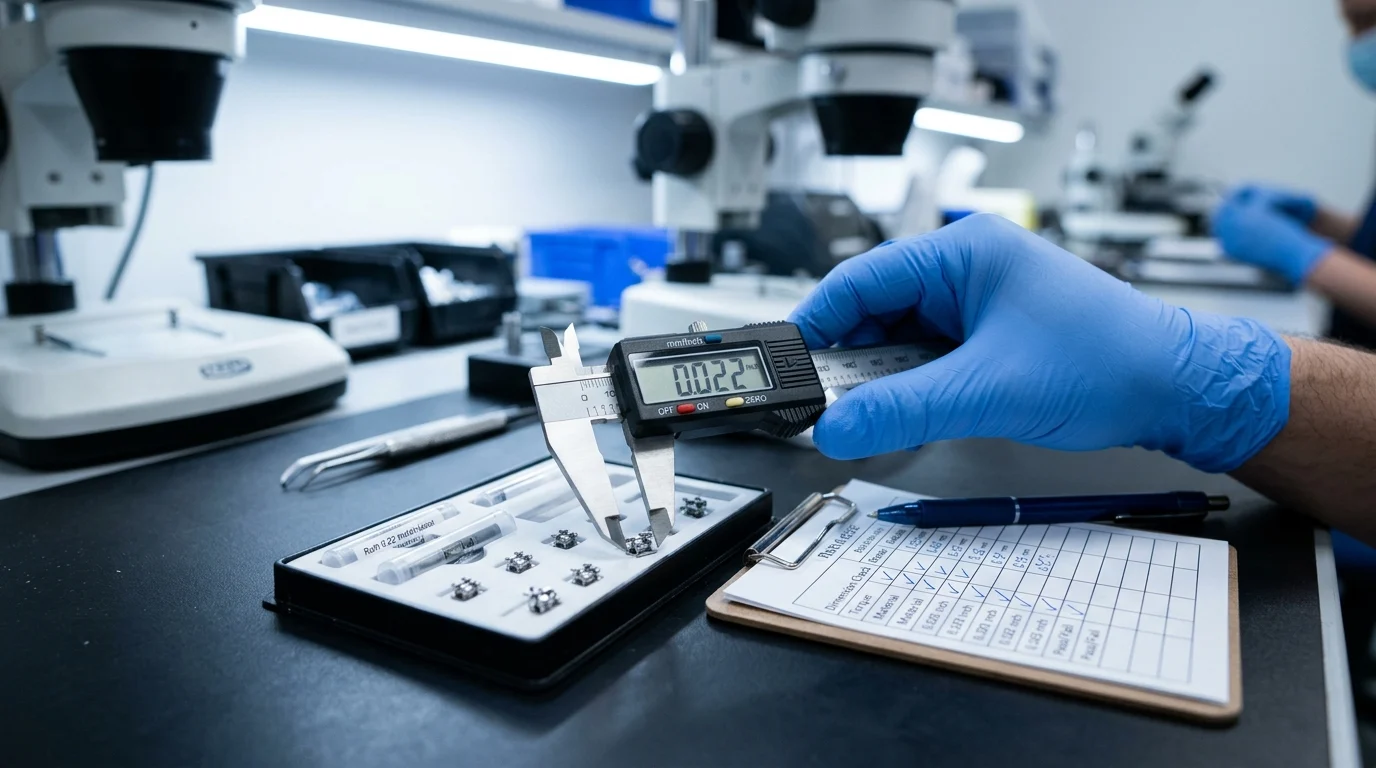
The foundational variables in bracket design dictate clinical outcomes and practitioner preferences. Importers must specify the prescription system (such as Roth or MBT), the slot size (typically standard 0.018-inch or 0.022-inch), and the material composition, which generally ranges from 17-4 PH stainless steel to advanced polycrystalline ceramics. Additionally, the base design is critical for clinical adhesion; an 80-gauge mesh base is an industry standard that maximizes the surface area for bonding adhesives, reducing bracket failure rates.
How to Evaluate Manufacturing Capabilities
Evaluating a factory’s capabilities involves analyzing its primary production methods. Metal Injection Molding (MIM) has become the gold standard for producing Orthodontic Brackets, offering superior surface smoothness, rounded contours for patient comfort, and high structural integrity without internal voids. Older or cheaper alternatives might rely on traditional casting or basic CNC machining, which often struggle to efficiently achieve the complex, undercut geometries required for modern self-ligating bracket systems.
Using Comparison Tables to Clarify Sourcing Options
To clarify sourcing strategies, importers should weigh the differences between manufacturing technologies. The following table highlights the operational distinctions between MIM and traditional CNC machining for bracket production.
| Feature | Metal Injection Molding (MIM) | CNC Machining |
|---|---|---|
| Unit Cost (High Volume) | Low | High |
| Design Complexity | Excellent for intricate undercuts | Limited by tool access |
| Surface Finish | Highly smooth, patient-friendly | May show microscopic tool marks |
| Tooling Investment | High ($3,000 – $8,000+ per mold) | Low (Programming and fixtures only) |
| Lead Time (Initial) | 45 – 60 days (Mold creation) | 15 – 20 days |
Quality, Compliance, and Risk Assessment
Entering the medical device supply chain mandates strict adherence to international quality and safety standards. A reputable OEM partner should consistently demonstrate a defect rate of less than 0.5% across production batches, ensuring that every bracket performs safely and reliably in the patient’s mouth.
Quality Control Checkpoints
Robust quality control (QC) protocols must be integrated at every stage of production. Key checkpoints include metallurgical analysis of raw materials, dimensional inspections of the archwire slots using optical comparators, and surface roughness testing. Furthermore, shear bond strength testing is critical; high-quality brackets typically require a bond strength exceeding 15 Newtons to prevent detachment during mastication or routine wire adjustments.
Regulatory and Documentation Requirements
Regulatory documentation forms the backbone of global distribution. Depending on the target market, importers must verify that the OEM holds valid ISO 13485 certification, which governs quality management systems for medical devices. For the European market, compliance with the Medical Device Regulation (MDR) and a valid CE mark are mandatory. In the United States, brackets are classified as Class II medical devices, requiring FDA 510(k) clearance. Importers must ensure the manufacturer can supply a comprehensive Technical File to support local Ministry of Health registrations.
Sourcing, Pricing, and Logistics
Optimizing the procurement process requires a deep understanding of manufacturing economics and international logistics. Minimum Order Quantities (MOQs) for custom orthodontic components typically range from 500 to 5,000 sets per SKU, heavily influencing the initial capital required for a new product launch and subsequent inventory cycles.
MOQ, Tooling, Lead Time, and Sampling
Sourcing economics are driven by tooling, sampling, and production timelines. Developing a custom MIM mold incurs significant upfront tooling costs, generally falling between $3,000 and $8,000 depending on complexity. Once tooling is finalized, initial sampling usually takes 3 to 4 weeks. After sample approval, importers should anticipate a mass production lead time of 45 to 60 days. Planning inventory cycles around these timelines is vital to prevent costly stockouts.
Supplier Qualification and Audit Steps
Supplier qualification should never be based solely on piece price. Importers must conduct rigorous audits, either in-person or via reputable third-party inspection agencies. These audits should evaluate factory capacity, worker conditions, equipment maintenance logs, and the traceability of raw materials from ingot to finished bracket. Utilizing a structured audit scorecard helps objectively compare potential manufacturing partners and mitigate supply chain risks.
Packaging, Shipping, and Inventory Planning
Proper packaging and shipping protocols safeguard the integrity of the medical devices. Brackets are typically packaged in color-coded blister packs to assist clinicians with quick identification and maintain cleanliness. While cold-chain logistics are unnecessary, moisture-controlled shipping environments prevent the oxidation of metallic components. Importers can often streamline these logistics by reaching out to specialized freight forwarders or utilizing manufacturer contact us pages to inquire about optimized routing.
| Shipping Method | Transit Time | Cost Profile | Best Use Case |
|---|---|---|---|
| Air Express (DHL/FedEx) | 3 – 7 Days | Highest | Urgent stock replenishment, samples |
| Standard Air Freight | 7 – 14 Days | Moderate | Medium volume, high-value shipments |
| Sea Freight (LCL/FCL) | 25 – 45 Days | Lowest | High volume, routine inventory restocking |
Choosing the Right OEM Partner
The culmination of the sourcing process is selecting a partner capable of scaling seamlessly with your business. An ideal OEM should possess scalable production capacity, outputting upwards of 100,000 sets per month to ensure they can accommodate future market growth without compromising quality or extending lead times.
White Label vs Semi-Custom vs Fully Custom
Importers must decide on the level of customization required for their market strategy. White-label solutions offer off-the-shelf brackets with generic designs, allowing for rapid market entry with minimal investment. Semi-custom models allow importers to apply bespoke branding and customized packaging to existing product lines, offering a balance of speed and brand identity. Fully custom OEM services involve engineering proprietary prescriptions and unique bracket geometries, requiring heavier investment but delivering a highly differentiated, defensible market offering.
Final Supplier Selection Criteria
Finalizing the supplier selection involves evaluating communication transparency, financial stability, and intellectual property (IP) protection. Importers must execute robust Non-Disclosure, Non-Use, and Non-Circumvention (NNN) agreements to protect proprietary designs and marketing strategies. Ultimately, the right manufacturing partner acts as a direct extension of the importer’s business, combining technical manufacturing expertise with a shared commitment to clinical excellence and long-term market success.
Further reading:
Key Takeaways
- The most important conclusions and rationale for Orthodontic Brackets
- Specs, compliance, and risk checks worth validating before you commit
- Practical next steps and caveats readers can apply immediately
Frequently Asked Questions
What OEM options are available for orthodontic brackets?
Importers can choose private label for existing bracket designs or full OEM for custom prescriptions, slot sizes, materials, and packaging based on market needs.
Which bracket specifications should importers confirm before ordering?
Confirm prescription system, slot size, material, base mesh design, and tolerance requirements. These directly affect wire fit, bonding strength, and clinical acceptance.
Why is MIM preferred for orthodontic bracket manufacturing?
MIM offers smoother surfaces, better complex geometry, and lower unit cost at volume. It is especially suitable for modern self-ligating and precision bracket designs.
What quality checks should a reliable bracket OEM provide?
Ask for raw material verification, slot dimension inspection, surface roughness testing, bond strength data, and batch defect rates below 0.5%.
How can importers start an orthodontic brackets OEM project with DenRotary?
Prepare your target prescription, slot size, material, branding, and quantity, then contact DenRotary through denrotary.com to discuss samples, lead times, and documentation.

Post time: Jun-08-2026