


In practice, the choice depends on the case design, anchorage demand, and clinician preference. This article explains the functional difference, selection logic, and where each component fits within a complete fixed appliance system.
Orthodontic Buccal Tubes vs Orthodontic Bands: Core Difference
Orthodontic buccal tubes are direct-bond posterior attachments, while orthodontic bands are circumferential metal rings placed around a tooth. The key difference is that tubes prioritize streamlined archwire guidance, whereas bands prioritize retention and accessory support.
For fixed appliances, both components work with brackets, archwires, and elastomeric auxiliaries to control tooth movement. The American Association of Orthodontists notes that braces rely on brackets and wires, and that wires are held by ties, rubber rings, or self-ligating doors.
How Orthodontic Buccal Tubes Work
Orthodontic buccal tubes are designed to receive and guide the archwire on molars. They are commonly used on first molars and second molars, depending on the treatment plan and appliance prescription.
Because they are bonded directly to enamel, they simplify posterior setup and reduce bulk compared with full bands. This makes them useful when the clinician wants efficient placement, easier hygiene access, and a more compact molar attachment.
In a complete system, buccal tubes are part of the posterior control chain that helps transmit force from the archwire to the molars. That role is especially important during alignment, leveling, and finishing, when wire control must remain stable.
How Orthodontic Bands Work
Orthodontic bands are stainless steel rings that fit around a tooth, usually a molar, and are cemented in place. They offer broad circumferential retention and can support auxiliary attachments such as hooks, tubes, or other appliance components.
Bands are often selected when stronger mechanical retention is needed or when the tooth anatomy makes direct bonding less reliable. They are also useful in cases that require additional anchorage or more complex posterior mechanics.
Compared with bonded tubes, bands are typically more visible and can be more technique-sensitive to fit. However, they remain valuable in many fixed appliance protocols because they provide a durable foundation for posterior control.
Comparison Table: Orthodontic Buccal Tubes vs Orthodontic Bands
| Feature | Orthodontic Buccal Tubes | Orthodontic Bands |
|---|---|---|
| Placement | Bonded directly to the tooth | Cemented around the tooth |
| Main function | Archwire guidance and posterior control | Strong retention and accessory support |
| Bulk | Lower profile | More circumferential coverage |
| Clinical use | Common in streamlined fixed setups | Common in higher-retention or auxiliary cases |
| Hygiene access | Usually easier | Can be more demanding |
When to Choose One Over the Other
The best choice depends on the clinical objective, not on one component being universally superior. Buccal tubes are often preferred when the goal is efficient molar attachment with a lower-profile design, while bands are preferred when retention and auxiliary support matter more.
- Choose buccal tubes when you want direct bonding, simpler placement, and compact posterior hardware.
- Choose bands when you need stronger circumferential retention or extra appliance attachments.
- Choose bands when molar anatomy or moisture control makes bonding less predictable.
- Choose tubes when patient comfort and easier cleaning are higher priorities.
For product selection, clinicians often evaluate the full appliance chain rather than a single part. That means considering brackets, archwires, elastics, and posterior attachments together, because each element affects force delivery and treatment efficiency.
Standards and Compliance for Orthodontic Accessories
Orthodontic accessories should be evaluated against recognized standards for dimensions, labeling, and material performance. ISO 27020:2019 applies to brackets and tubes for fixed orthodontic appliances and addresses functional dimensions, chemical ion release, packaging, and labeling.
In the United States, ANSI/ADA Standard No. 100 covers orthodontic brackets and tubes, and ADA also lists standards for orthodontic wires and elastomeric auxiliaries. These references help procurement teams compare products on a common technical basis.
FDA guidance resources are also relevant for medical device manufacturers and importers, especially when documentation, quality systems, or regulatory pathways are being reviewed.
Comparison Table: Clinical Selection Factors for Posterior Orthodontic Attachments
| Selection factor | Buccal tubes | Orthodontic bands |
|---|---|---|
| Retention demand | Moderate | High |
| Profile | Low profile | Higher profile |
| Accessory compatibility | Limited to tube-based designs | Broader accessory support |
| Placement efficiency | Often faster | Often more technique-dependent |
| Typical use case | Standard fixed treatment | Complex posterior mechanics |
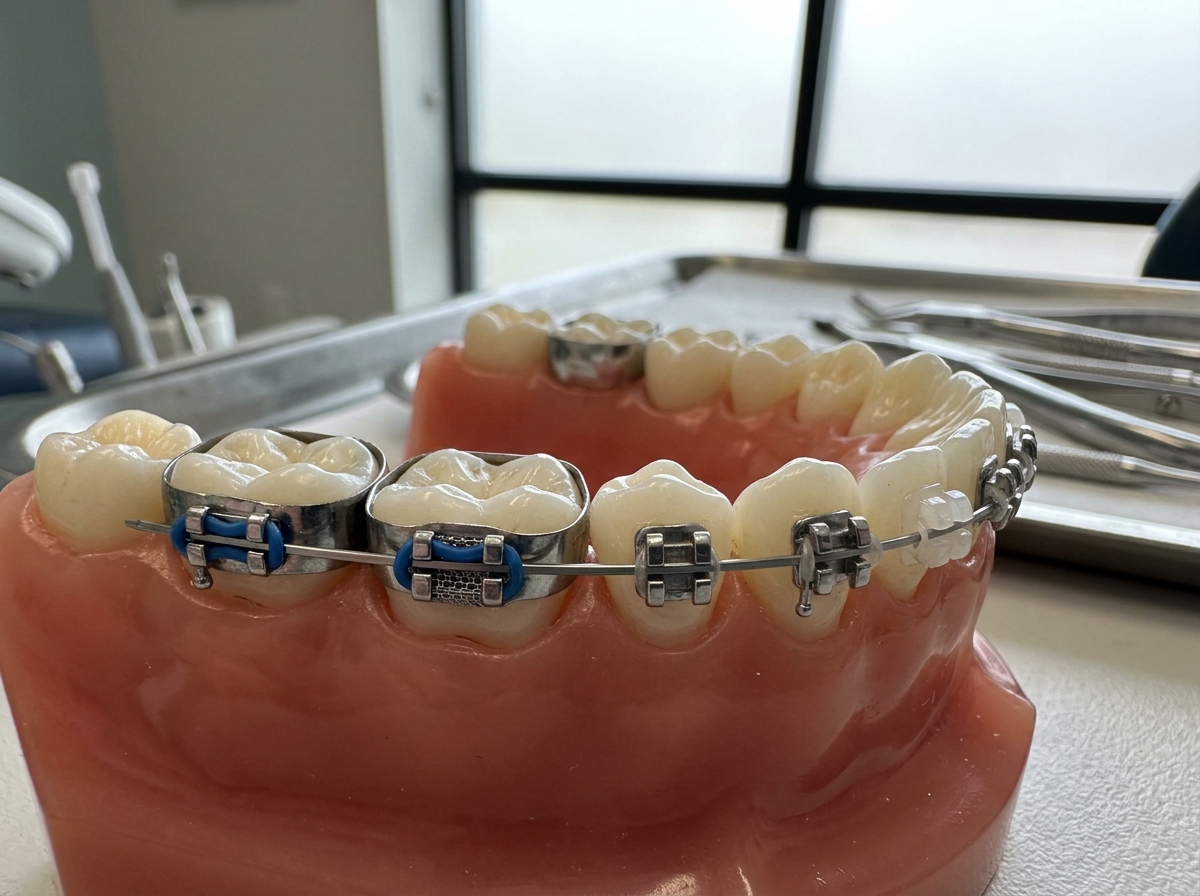
Where These Components Fit in a Complete Orthodontic System
A complete fixed appliance system combines brackets, posterior attachments, archwires, elastics, and clinical instruments. That system approach matters because posterior control is not isolated; it affects alignment, space closure, and finishing.
For example, a clinician may start with NiTi archwires for initial alignment, then move to stainless steel wires for control and detailing. The AAO explains that archwires are the main force-delivery component inside braces, which is why posterior attachments must match the wire stage.
In this context, a supplier with a broad product matrix can simplify procurement. The main product families on Denrotary include orthodontic bracket systems, buccal tube and band systems, orthodontic archwire systems, elastic accessories, and orthodontic tools.
That breadth matters for distributors and clinics because it supports one-source purchasing across the treatment workflow. It also reduces the risk of mismatched components when different cases require different posterior mechanics.
Supplier Directory: Product Categories to Review
For buyers comparing complete orthodontic accessory lines, the most relevant categories are the bracket system, posterior attachment system, archwire system, elastic accessory line, and clinical tool line. These categories reflect the actual treatment sequence rather than isolated products.
- Orthodontic bracket systems
- Orthodontic buccal tube and band systems
- Orthodontic archwire systems
- Orthodontic elastic accessories
- Orthodontic tools and pliers
When evaluating suppliers, procurement teams should confirm certification claims, lot traceability, packaging consistency, and compatibility across the full appliance set. Those checks are especially important for export-oriented purchasing and standardized clinic networks.
Practical Buying and Clinical Checklist
The safest selection process is to match the attachment to the treatment objective, not to the product catalog alone. A simple checklist can reduce errors and improve consistency across cases.
- Confirm whether the molar needs direct bonding or circumferential retention.
- Check archwire size, slot compatibility, and posterior tube orientation.
- Review whether auxiliary hooks or extra attachments are required.
- Verify material finish, bonding surface, and patient comfort considerations.
- Ask for compliance documentation and batch traceability before purchase.
This approach is useful for clinics, distributors, and cross-border buyers alike. It also aligns with evidence-based procurement, where product selection is tied to function, standards, and workflow efficiency.
Conclusion
Orthodontic buccal tubes and orthodontic bands are not interchangeable, because they solve different posterior problems. Tubes are best for compact archwire guidance, while bands are best for stronger retention and auxiliary support.
For most fixed appliance systems, the right answer is the one that matches the case mechanics, the patient’s needs, and the clinic’s workflow. A well-structured product line makes that decision easier by keeping brackets, wires, posterior attachments, and tools technically compatible.
FAQ
Are orthodontic buccal tubes better than orthodontic bands?
Neither is universally better. Buccal tubes are usually preferred for compact direct bonding and efficient archwire guidance, while bands are preferred when stronger retention or extra attachments are needed. The right choice depends on the clinical objective, tooth anatomy, and appliance design.
Can orthodontic bands replace buccal tubes in every case?
No, they cannot replace them in every case. Bands provide strong retention, but they are bulkier and more technique-sensitive. Some treatment plans benefit more from bonded buccal tubes, especially when a lower-profile posterior attachment is desired.
Why do some molars use bands instead of tubes?
Molars may use bands when direct bonding is less reliable or when the case requires additional anchorage support. Bands can also accommodate more auxiliary components. Clinicians choose them when posterior mechanics demand a more robust circumferential fit.
What standards apply to orthodontic tubes and brackets?
ISO 27020:2019 covers brackets and tubes for fixed orthodontic appliances, including functional dimensions, chemical ion release, packaging, and labeling. In the United States, ANSI/ADA Standard No. 100 is also relevant for orthodontic brackets and tubes.
How should buyers evaluate orthodontic accessory suppliers?
Buyers should review product compatibility, certification documents, batch traceability, manufacturing consistency, and the completeness of the product range. A supplier that covers brackets, buccal tubes, archwires, elastics, and tools can simplify procurement and reduce mismatch risk.

Post time: Jul-21-2026