


Introduction
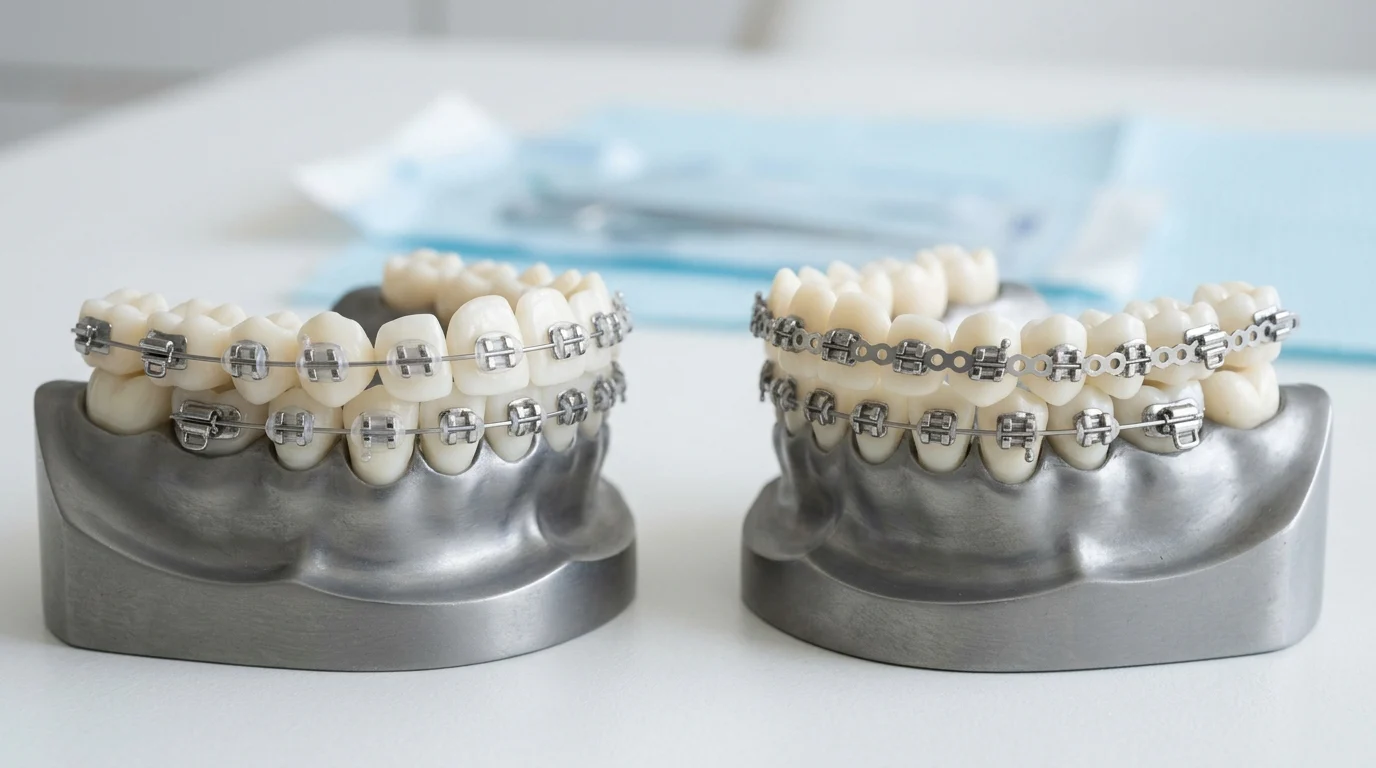
Although both are elastic components used with braces, power chains and elastomeric ligatures are designed for different jobs and produce different treatment effects. One acts as a continuous connector that can help close spaces and apply broader force across multiple teeth, while the other secures the archwire to individual brackets with more localized control. Understanding that distinction helps clarify why orthodontists choose one over the other at different stages of treatment. This article explains how each material is structured, how it functions clinically, and what those differences mean for tooth movement, friction, appointment timing, and overall treatment efficiency.
Why Power Chains vs Elastomeric Ligatures Matter
The selection of ligation methods directly influences the efficiency of archwire seating, space closure mechanics, and overall treatment duration (typically spanning 18 to 24 months) in contemporary orthodontics. While both orthodontic power chains and elastomeric ligatures serve the fundamental purpose of securing the archwire to the bracket slot, their distinct structural designs dictate entirely different biomechanical roles. Understanding these differences is essential for optimizing clinical outcomes and managing inventory efficiently in high-volume dental practices.
Clinical directors and procurement managers must weigh the specific force delivery profiles of these products against their material costs. Making the correct choice between continuous elastic chains and individual ligatures ensures that tooth movement progresses predictably, avoiding unnecessary treatment delays or the need for frequent emergency appointments.
Clinical and operational impact
The choice between continuous chains and individual ligatures has a measurable impact on both clinical efficacy and operational workflow. From a clinical perspective, selecting the appropriate elastomeric product ensures predictable tooth movement during standard 4-to-6-week appointment intervals. Incorrect application—such as using a power chain when individual ligation is required—can introduce unwanted friction (often increasing resistance by 50 to 100 grams), potentially slowing down the leveling and aligning phase by several weeks.
Operationally, standardizing the use of these materials can reduce chair time by an estimated 10% to 15% (roughly 3 to 5 minutes per 30-minute routine adjustment visit). When dental assistants and orthodontists have clear protocols for when to deploy specific Orthodontic Power Chains, inventory turnover becomes more predictable, reducing waste and preventing stockouts of critical supplies.
Key use cases in orthodontic treatment
Orthodontic treatment is broadly divided into distinct phases, each demanding specific ligation strategies. During the initial leveling and aligning phase, where light, continuous forces are required to correct severe crowding, individual elastomeric ligatures are the standard. They secure the highly flexible nickel-titanium (NiTi) archwires (typically 0.012 to 0.016-inch in diameter) into the bracket slots while allowing a necessary degree of sliding mechanics.
Conversely, the space closure phase relies heavily on the continuous force delivery of power chains. When orthodontists need to consolidate spaces following extractions (often managing 5mm to 7mm gaps) or close generalized diastemas, chains provide the necessary reciprocal forces across multiple teeth to achieve average space closure rates of 0.5mm to 1.0mm per month. The continuous nature of the elastomer acts as an active force system rather than just a passive retaining mechanism, making it indispensable for the intermediate and final detailing stages of treatment.
What Power Chains and Elastomeric Ligatures Are
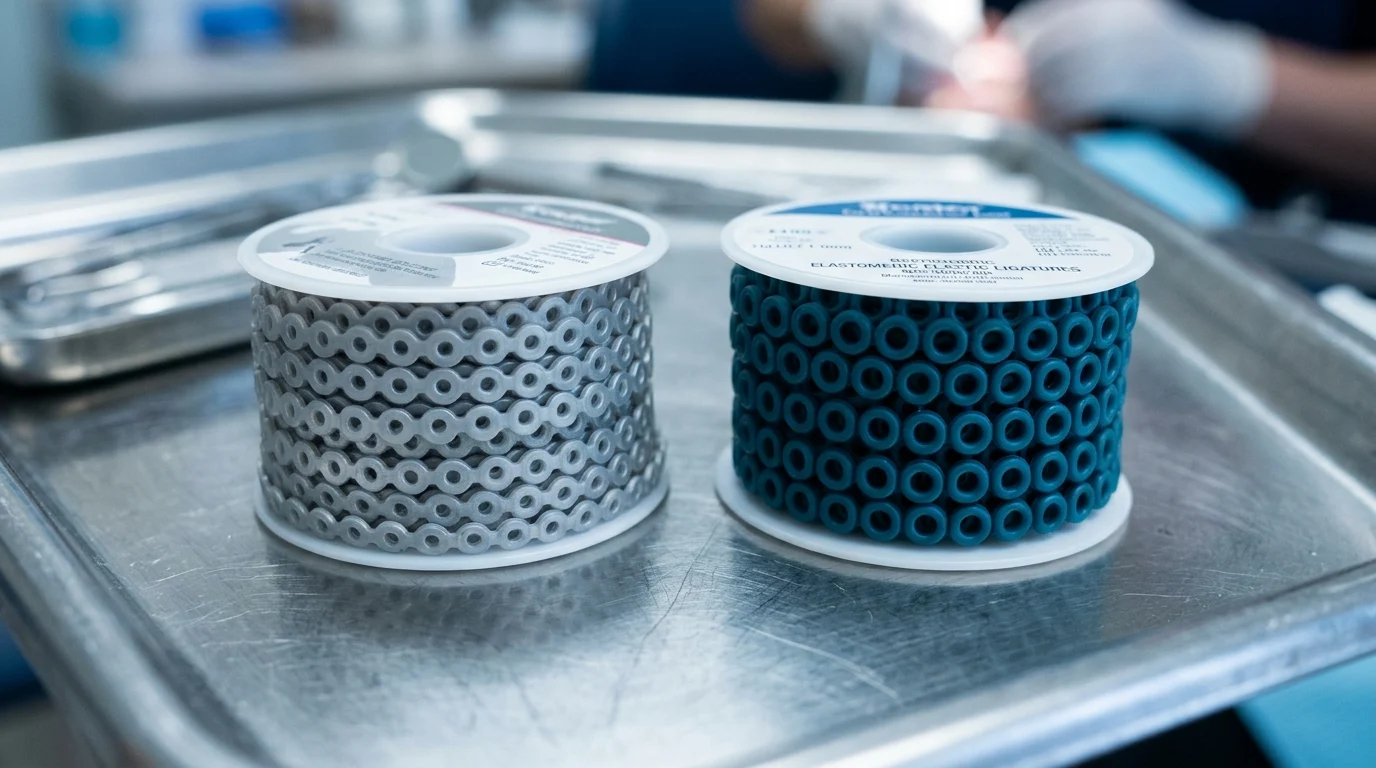
Both power chains and individual ligatures belong to the same family of polyurethane-based elastomers, yet their structural configurations are engineered to serve distinct biomechanical purposes. Their manufacturing processes involve injection molding or continuous extrusion to create products capable of sustaining tension in the harsh, moisture-rich environment of the oral cavity (typically 37°C and near 100% humidity).
Understanding the physical specifications of these materials allows clinicians to predict how they will perform over the duration of an adjustment interval. The physical geometry of the elastomer dictates not only how it is applied but also the magnitude of the force it will exert upon activation.
Design and typical applications
Elastomeric ligatures are manufactured as single, discrete O-rings. They typically feature an outer diameter ranging from 0.110 to 0.120 inches, an inner diameter of approximately 0.040 to 0.050 inches, and a thickness of 0.030 to 0.035 inches. Their primary application is to snap over the four tie-wings of a standard twin bracket, holding the archwire firmly in place. They are generally provided on molded sticks or canes, holding 10 to 24 modules each, which facilitates quick application using a hemostat or a specialized ligature director.
Power chains, on the other hand, consist of a continuous row of linked elastomeric modules. They are typically dispensed from a 15-foot spool. The design allows the clinician to cut the exact length required to span across multiple teeth. By stretching the chain from one bracket to another, the elastomer stores potential energy, which is gradually released to pull the teeth together.
Material and force characteristics
The base material for both products is typically a medical-grade thermoplastic polyurethane, chosen for its high elasticity, tear resistance, and a typical Shore A hardness of 80 to 90. However, the force characteristics depend heavily on the material formulation and the specific geometry of the product. Information regarding material specifications can often be found by reviewing documentation from manufacturers of Elastomeric Ligatures.
A critical characteristic of any orthodontic elastomer is its force decay profile. When stretched, polyurethane bonds begin to relax. Depending on the thickness and the proprietary curing process of the material, a standard power chain might deliver an initial force of 300 to 400 grams when stretched to twice its resting length. Individual ligatures exert a much lower seating force, typically between 100 and 200 grams, which is sufficient to hold the wire without completely binding it.
Main differences at a glance
The most prominent difference lies in the spacing of the modules. Individual ligatures have no spacing, as they are unlinked. Power chains are manufactured in three standard filament intervals: closed (no space between rings, approximately 2.8mm from center to center), short (a small connecting filament, about 3.5mm), and long (a longer connecting filament, roughly 4.0mm).
| Configuration | Spacing (Center-to-Center) | Typical Application | Force Delivery Profile |
|---|---|---|---|
| Individual Ligature | N/A (Discrete) | Initial leveling/aligning | Low (100-200g), passive |
| Closed Chain | ~2.8mm | Small brackets, lower incisors | High initial force, rapid decay |
| Short Chain | ~3.5mm | Standard twin brackets | Moderate force, steady decay |
| Long Chain | ~4.0mm | Large brackets, ceramic brackets | Lighter force, continuous |
Clinicians select the spacing based on the distance between the brackets and the amount of force desired. A closed chain on large brackets will stretch significantly, delivering high forces, whereas a long chain on the same teeth will deliver a much lighter, more continuous force. Individual ligatures, lacking inter-bracket connections, exert zero interproximal force.
How Power Chains vs Elastomeric Ligatures Compare
Evaluating the performance of these two ligation methods requires an analysis of force degradation over time, handling characteristics in the clinic, and procurement economics. Because orthodontic appointments are typically spaced 4 to 8 weeks apart, the chosen material must perform adequately throughout the entire interval without requiring premature replacement.
While both products suffer from the inherent limitations of polyurethane in a wet environment, their differing applications mean that these limitations manifest differently in clinical practice. A comprehensive comparison highlights the trade-offs between force retention, patient compliance, and supply chain management.
Force retention and performance
Both power chains and elastomeric ligatures exhibit rapid initial force decay. Clinical studies consistently show that polyurethane elastomers lose between 50% and 70% of their initial force within the first 24 hours of application in the oral cavity. After this initial drop, the force level plateaus, retaining approximately 30% to 40% (roughly 100 to 150 grams) of its original strength for the remaining 3 to 4 weeks.
Because power chains are actively moving teeth, this force decay must be carefully managed. If a chain is overstretched initially to compensate for decay, it can cause hyalinization of the periodontal ligament, halting tooth movement. Individual ligatures, serving primarily as passive retaining devices, are less affected by this decay, provided they retain enough strength to keep the archwire fully engaged in the bracket slot.
Handling, durability, and patient considerations
Handling and durability are heavily influenced by the patient’s diet and oral hygiene. Both materials are susceptible to staining from coffee, tea, turmeric, and smoking. However, because power chains cover a larger surface area and span interproximal spaces, they are significantly more prone to trapping plaque and food debris compared to discrete ligatures.
Durability is also a factor, with clinical breakage rates typically under 2% to 3% per month for high-quality elastomers. A broken individual ligature affects only one tooth, perhaps allowing the wire to slip out of a single bracket. A snapped power chain, however, completely compromises the space-closure mechanics for an entire quadrant, necessitating an immediate emergency visit to prevent relapse.
Cost and supply considerations
From a procurement standpoint, the cost structures differ notably. With standard supplier lead times of 2 to 4 weeks, a standard 15-foot spool of orthodontic power chain typically costs between $10 and $18, depending on the manufacturer and material grade. A single spool can service dozens of patients. In contrast, individual elastomeric ligatures are generally sold in packs of 1,000 (often 100 sticks of 10), ranging from $5 to $12 per pack.
| Feature | Orthodontic Power Chains | Elastomeric Ligatures |
|---|---|---|
| Primary Function | Active space closure and consolidation | Passive archwire engagement |
| Initial Force Delivery | 300 – 400 grams (variable by stretch) | 100 – 200 grams |
| Force Decay (24 hours) | 50% – 70% | 50% – 70% |
| Typical Cost Basis | $10 – $18 per 15-foot spool | $5 – $12 per 1,000 count pack |
| Hygiene Challenge | High (spans interproximal spaces) | Low (discrete placement) |
While the per-patient cost for both materials is relatively low (often less than $0.50 per arch), high-volume clinics must consider the aggregate cost, as elastomers can account for 5% to 8% of total consumable spend. Standardizing inventory to a few reliable brands and colors can significantly reduce overhead and simplify supply chain logistics.
What Buyers and Clinicians Should Evaluate
Procurement managers and clinical directors must balance biomechanical efficacy with inventory standardization and regulatory compliance. Sourcing orthodontic elastomers is not merely a matter of finding the lowest price; it requires rigorous evaluation of product specifications, material safety, and vendor reliability.
Establishing standard operating procedures for purchasing ensures that clinical staff always have access to materials that perform predictably. This requires a systematic approach to evaluating new products before committing to bulk institutional purchases.
Product specifications and packaging
When evaluating product specifications, buyers must scrutinize the dimensional consistency of the elastomers. For individual ligatures, the elasticity must allow stretching over large twin brackets without snapping, while returning to a tight diameter to ensure full wire seating. Buyers should verify the exact inner and outer diameters to ensure compatibility with their preferred bracket systems.
For power chains, the accuracy of the filament spacing (closed, short, long) is critical. Inconsistent spacing along a single spool leads to unpredictable force delivery, complicating treatment planning. Packaging is equally important; spools must be housed in light-resistant dispensers to prevent premature degradation (polyurethane can degrade by up to 20% in elasticity if exposed to direct UV light for over 48 hours), while ligatures should be packaged in sealed, moisture-proof bags.
Quality, biocompatibility, and traceability
Quality assurance and biocompatibility are non-negotiable in orthodontic procurement. All elastomeric products must comply with ISO 10993-1 and ISO 10993-5 (cytotoxicity) standards for the biological evaluation of medical devices. Furthermore, latex-free formulations are now the industry standard and are strictly required in most jurisdictions. With an estimated 1% to 6% of the general population exhibiting latex sensitivities, utilizing latex-free polyurethanes eliminates the risk of severe allergic reactions.
Traceability is another critical factor. Reputable manufacturers provide lot numbers and expiration dates (indicating a typical shelf life of 24 to 36 months) on all packaging. This allows clinics to track inventory lifecycles and manage recalls if necessary. Clinics looking to verify supplier certifications and quality control processes should direct inquiries through formal channels, such as contacting suppliers via Orthodontic Power Chains portals to request compliance documentation.
Trial and standardization steps
Before standardizing a new brand of power chain or ligature across a multi-chair clinic, a 60-to-90-day limited clinical trial is highly recommended.
Further reading:
How to Choose Between Power Chains and Elastomeric Ligatures
Key Takeaways
- The most important conclusions and rationale for Orthodontic Power Chains vs Elastomeric Ligatures
- Specs, compliance, and risk checks worth validating before you commit
- Practical next steps and caveats readers can apply immediately
Frequently Asked Questions
What is the main difference between orthodontic power chains and elastomeric ligatures?
Power chains are connected elastic modules that actively close spaces across multiple teeth. Elastomeric ligatures are single O-rings mainly used to tie the archwire into each bracket during leveling and alignment.
When should an orthodontist use power chains instead of ligatures?
Use power chains during space closure, such as after extractions or for diastema reduction. Use individual ligatures in early alignment when light wire engagement and controlled sliding are needed.
Do power chains create more force than elastomeric ligatures?
Yes. Power chains are stretched across several brackets, so they deliver continuous closing force. Ligatures mostly provide passive wire retention and generally do not generate the same level of tooth-moving force.
How can clinics choose the right elastic products from DenRotary?
Match the product to treatment phase: ligatures for routine archwire tie-in, power chains for space closure. DenRotary’s orthodontic product range helps clinics standardize supplies and reduce stock shortages.
Can using the wrong ligation method slow orthodontic treatment?
Yes. Using a power chain when individual ligation is needed can increase friction and hinder alignment. Choosing the correct elastic for each appointment helps keep treatment on schedule.

Post time: May-29-2026