

Introduction
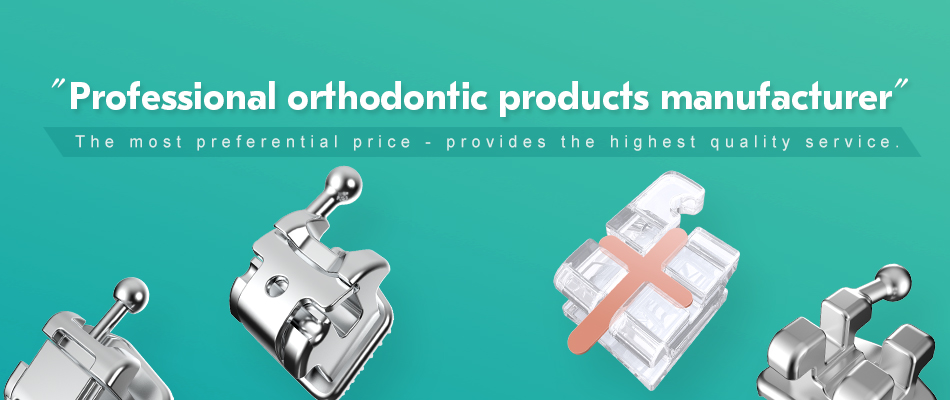
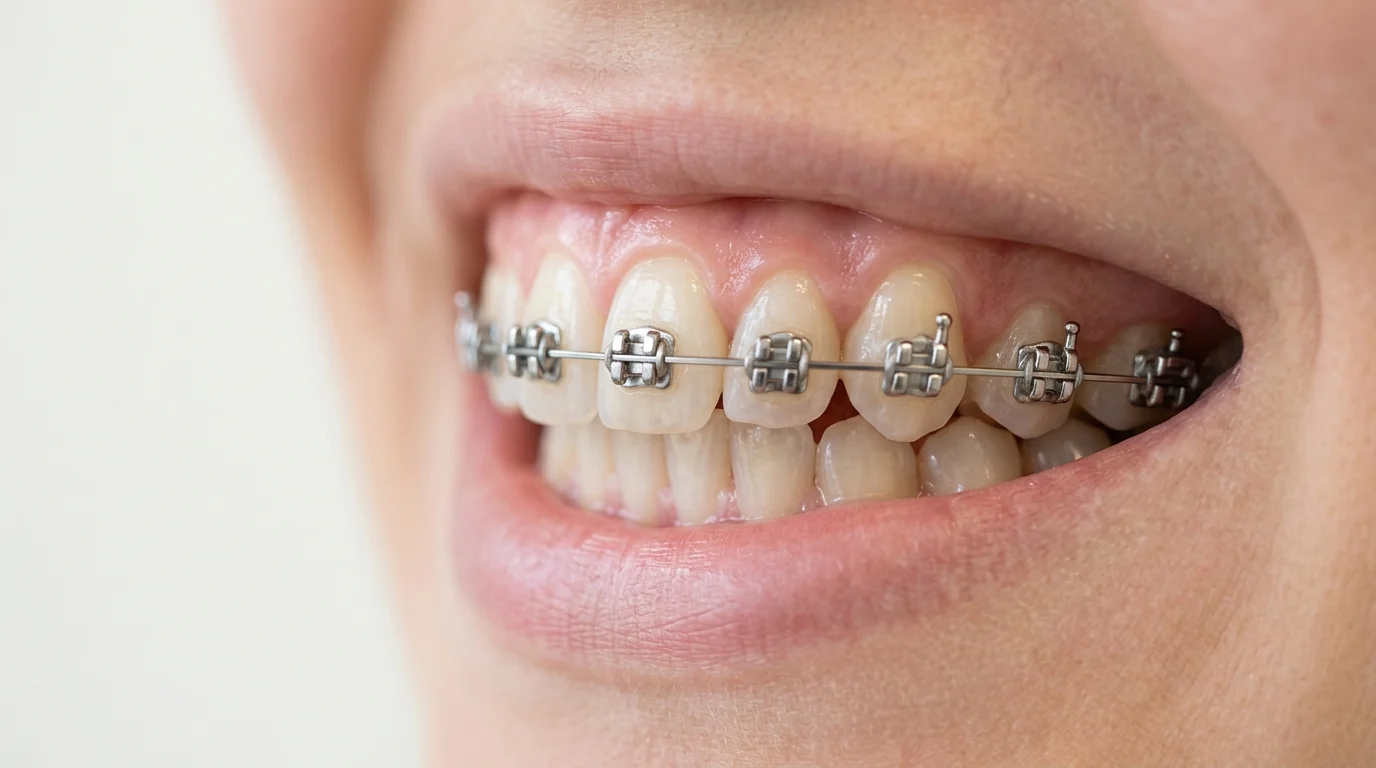
Orthodontic treatment has increasingly moved toward bracket systems that secure the archwire without elastomeric or steel ties, changing both mechanics and daily workflow. Self-ligating brackets are often promoted for lower friction, faster wire changes, and improved comfort, but their real clinical value depends on how those claims hold up in practice. This article explains how these brackets work, where they may improve efficiency or tooth movement, and which limitations remain important for treatment planning, cost, hygiene, and long-term outcomes. The discussion sets up a practical comparison with conventional brackets so the benefits and trade-offs can be judged in a clinical context.
Why self-ligating brackets matter in modern orthodontics
The evolution of orthodontic mechanotherapy has driven a consistent transition away from traditional elastomeric and steel ligatures toward built-in mechanical closures. Self-ligating brackets (SLBs) represent a significant biomechanical shift in how archwires are engaged within the bracket slot, altering the frictional dynamics of tooth movement. By integrating a mobile fourth wall—typically a sliding door or a spring clip—these systems eliminate the need for external ligation materials, directly influencing both clinical efficiency and the biological response of the periodontal ligament.
For the orthodontic specialist, the adoption of self-ligating systems is not merely a material upgrade but a fundamental change in treatment protocols. The integration of SLBs impacts practice overhead, appointment scheduling, and the predictability of early-phase tooth movement, necessitating a thorough understanding of their operational mechanics and market positioning.
Impact on chair time and workflow
The most immediate operational advantage of self-ligating brackets is the measurable reduction in clinical chair time. Studies consistently demonstrate that archwire removal and insertion in SLB systems save an average of 1.5 to 3 minutes per arch compared to conventional elastomeric ligation, and significantly more when compared to steel tie ligation. Over an average treatment span of 24 months requiring 12 to 15 wire changes, this translates to a substantial reduction in active chairside manipulation.
Furthermore, the workflow is streamlined by reducing the frequency of appointments required for ligature replacement. Because elastomeric ties suffer from force decay—losing up to 50% of their initial force within the first 24 hours and degrading further in the oral environment—conventional systems often require appointments every 4 to 6 weeks. SLB systems, particularly passive variants combined with copper-nickel-titanium (CuNiTi) wires, allow for extended intervals of 8 to 12 weeks during the initial alignment phase, optimizing the clinician’s daily schedule and increasing practice capacity.
Clinical and market trends driving adoption
The global orthodontic bracket market has seen a rapid pivot toward self-ligation, with the SLB segment expanding at a Compound Annual Growth Rate (CAGR) of approximately 7.5%, projected to exceed $1.2 billion globally by the end of the decade. This growth is driven by a dual demand: clinicians seeking operational efficiency and patients demanding improved aesthetics and hygiene.
Additionally, the integration of digital orthodontics and customized bracket positioning systems has accelerated SLB adoption. Many modern intraoral scanning and indirect bonding workflows are optimized for self-ligating systems, as the absence of elastomeric wings allows for smaller bracket profiles and more precise digital template fabrication. Manufacturers are responding by heavily investing in the research and development of aesthetic ceramic SLBs, pushing the market further away from conventional twin brackets.
What self-ligating brackets are and how they work
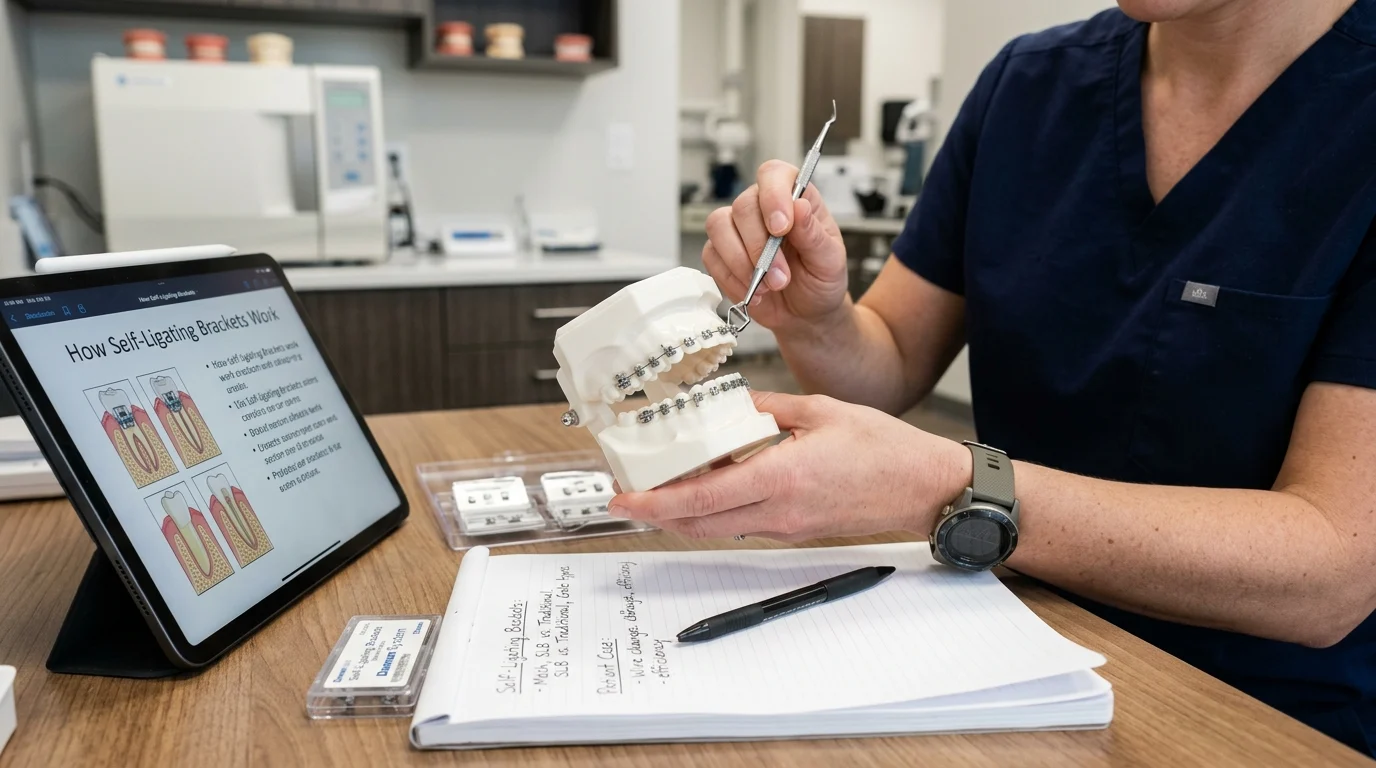
Understanding the functionality of self-ligating brackets requires analyzing the interaction between the bracket slot, the ligating mechanism, and the archwire. Unlike conventional twin brackets that rely on the elastic deformation of a polyurethane tie to seat the wire, SLBs utilize a rigid or semi-rigid mechanical barrier. This fundamental design difference dictates the resistance to sliding (friction) and the degree of control the clinician has over torque and rotation during different phases of treatment.
Passive vs active bracket systems
Self-ligating systems are broadly categorized into two distinct biomechanical classifications: passive and active. Passive SLBs feature a rigid sliding door or clip that converts the bracket slot into a simple tube. When closed, the clip does not exert active pressure on the archwire, even when full-size wires (e.g., 0.019 × 0.025-inch in a 0.022-inch slot) are engaged. This design minimizes classical friction, often keeping resistance below 50 grams during the initial leveling and aligning phases, allowing the archwire to slide freely and express its superelastic properties.
Active SLBs, conversely, utilize a flexible spring clip (typically made of nickel-titanium or cobalt-chromium) that encroaches into the slot space. While passive with small round wires, the clip actively presses against larger rectangular wires (e.g., beyond 0.016 × 0.022-inch). This continuous seating force increases friction—often exceeding 150 grams of resistance—but provides superior three-dimensional control, particularly in expressing torque and finalizing rotational corrections during the finishing phases of treatment.
Design features, slot mechanics, and materials
The precise manufacturing of the bracket slot and the durability of the clip are critical to SLB performance. Most systems are available in 0.018-inch or 0.022-inch slot dimensions, though the 0.022-inch slot is predominantly favored in passive systems to maximize the sliding mechanics of smaller initial wires. The clips themselves must withstand significant cyclic fatigue; high-quality cobalt-chromium clips are engineered to resist permanent deformation even when subjected to opening and closing forces of up to 1.5 kilograms over a 24-month treatment period.
Material selection for the bracket body also dictates clinical efficacy. While 17-4 PH stainless steel remains the gold standard for durability and minimal slot distortion, patient demand has driven the development of polycrystalline alumina (ceramic) SLBs. To prevent the fracturing of ceramic during clip manipulation, modern aesthetic SLBs often feature a hybrid design, incorporating a metal slot insert or a specialized rhodium-coated metal clip that blends visually with the ceramic body while maintaining structural integrity.
Comparison with conventional brackets
To clearly delineate the biomechanical and operational differences, the following table compares conventional brackets with both passive and active self-ligating systems across critical clinical parameters.
| Feature / Parameter | Conventional Twin Brackets | Passive Self-Ligating (SLB) | Active Self-Ligating (SLB) |
|---|---|---|---|
| Ligation Mechanism | Elastomeric or steel ties | Rigid sliding door/clip | Flexible spring clip |
| Friction (Early Phase) | High (due to tie pressure) | Very Low (< 50g resistance) | Low (passive on small wires) |
| Torque Expression | Moderate to High | Lower (requires larger wires) | High (clip presses on wire) |
| Wire Seating Force | Degrades over 4-6 weeks | Constant (rigid boundary) | Constant (active pressure) |
| Appointment Intervals | 4 to 6 weeks | 8 to 12 weeks | 6 to 8 weeks |
This comparison highlights that no single system is universally superior; rather, the choice depends on whether the treatment plan prioritizes early alignment speed (favoring passive SLBs) or late-stage finishing control (favoring active SLBs or conventional systems).
Clinical benefits and limitations of self-ligating brackets
The shift toward self-ligation is largely justified by specific clinical outcomes, yet the literature and clinical experience reveal a nuanced reality. While SLBs excel in certain biomechanical domains, they present inherent limitations that orthodontists must manage, particularly regarding precise tooth positioning in the final stages of mechanotherapy.
Benefits in alignment efficiency and hygiene
The primary clinical benefit of SLBs lies in alignment efficiency, particularly in cases of severe crowding. By reducing resistance to sliding by up to 60% compared to elastomeric-tied brackets in a dry state, passive SLBs allow light, continuous forces to dissipate across multiple teeth. This facilitates transverse arch expansion and alignment with less reciprocal anchorage loss. Clinically, this often results in a faster resolution of initial crowding within the first 6 to 9 months of treatment.
Hygiene is another significant advantage. Elastomeric ligatures are highly susceptible to plaque accumulation and bacterial colonization. Clinical studies indicate that elastomeric ties retain approximately 38% more plaque biofilm than the smooth metallic surfaces of SLB clips. By eliminating the porous polyurethane ties, self-ligating systems reduce the microbial load around the bracket base, consequently lowering the risk of white spot lesions (enamel demineralization) and gingival hypertrophy during prolonged treatment.
Limits in rotational control and finishing
Despite their efficiency in early leveling, passive SLBs frequently struggle with rotational control and torque expression during the finishing phases. Because the rigid door does not actively press the archwire into the base of the slot, there is an inherent “play” between the wire and the bracket. For instance, a 0.019 × 0.025-inch rectangular wire in a 0.022-inch passive slot exhibits approximately 10.5 degrees of torque play. If the clinician requires maximum torque expression for incisor retraction, this play necessitates the use of auxiliary torquing springs or the premature progression to full-size wires, which can be clinically challenging.
Active SLBs mitigate this torque loss through the spring clip, but they introduce their own limitations. The active clips are susceptible to mechanical fatigue; over an 18 to 24-month treatment period, the continuous stress can reduce the clip’s seating force by 15% to 20%, compromising final control. Furthermore, calculus buildup or dietary debris can occasionally jam the intricate sliding mechanisms of both passive and active systems, requiring time-consuming interventions to unblock the clip or, in severe cases, requiring bracket replacement.
How to evaluate self-ligating brackets for case selection
Transitioning to or selecting a new self-ligating bracket system requires a rigorous evaluation process. Orthodontic practices must weigh biomechanical specifications against logistical realities, ensuring that the chosen hardware aligns with the clinician’s treatment philosophy and the practice’s operational infrastructure.
Key criteria for system comparison
When evaluating SLB systems, clinicians must look beyond marketing claims and analyze specific engineering criteria. Base surface area and retention mechanisms are paramount; a reliable SLB should feature an 80-gauge mesh base or laser-etched micro-retention to ensure a shear bond strength exceeding 10 MPa, thereby minimizing bond failure rates. The profile thickness of the bracket (measured in millimeters from the tooth surface to the labial face of the clip) is also critical, as lower profiles (e.g., under 2.5 mm) significantly reduce occlusal interference and patient soft-tissue irritation.
| Evaluation Criterion | Ideal Specification | Clinical Rationale |
|---|---|---|
| Base Retention | > 10 MPa shear bond strength | Prevents debonding during mastication and wire engagement. |
| Profile Thickness | < 2.5 mm | Enhances patient comfort and reduces lip bumper effect. |
| Opening Mechanism | Explorer or simple dual-action tool | Reduces chairside frustration and prevents clip distortion. |
| Slot Precision | Tolerances within ±0.001 inches | Ensures predictable torque expression and minimizes wire play. |
| Clip Material | Cobalt-Chromium or NiTi | Provides high resistance to cyclic fatigue and deformation. |
The opening and closing mechanism is a particularly vital criterion. Systems that require proprietary, highly complex tools can disrupt workflow if the tool is misplaced or sterilized improperly. Systems that allow for opening with a standard dental explorer or a straightforward rotational tool tend to integrate more seamlessly into existing clinical routines.
Selection, staff training, and implementation
Successful implementation of an SLB system extends beyond the orthodontist to the entire clinical staff. The training curve for dental assistants transitioning from elastomeric ties to mechanical clips typically spans 1 to 2 months before baseline efficiency is restored. Staff must be trained on the specific directional forces required to open the clips without causing bracket debonding or patient discomfort, as well as the protocols for ensuring clips are fully seated and locked before the patient is dismissed.
Inventory management and procurement also play a role in selection. Manufacturers typically enforce a Minimum Order Quantity (MOQ) of 10 to 20 patient kits for initial orders, with bulk pricing tiers available for larger volume commitments. Practices must evaluate the supply chain reliability of the manufacturer, ensuring that replacement brackets, specific archwire sequences tailored to the SLB system, and proprietary opening tools are readily available without extended lead times.
Decision framework for choosing self-ligating brackets
The decision to integrate self-ligating brackets into an orthodontic practice requires a strategic framework that balances clinical outcomes, patient demographic needs, and financial viability. While the biomechanical advantages in specific malocclusions are well-documented, the economic impact on the practice must be carefully calculated to justify the transition.
Balancing outcomes, patient needs, and cost
Cost is the most immediate barrier to SLB adoption.
Key Takeaways
- The most important conclusions and rationale for self-ligating brackets
- Specs, compliance, and risk checks worth validating before you commit
- Practical next steps and caveats readers can apply immediately
Frequently Asked Questions
How do self-ligating brackets reduce chair time?
They use a built-in clip or door instead of elastomeric ties, so wire changes are faster. In practice, this can save a few minutes per arch and support longer intervals between early alignment visits.
What is the difference between passive and active self-ligating brackets?
Passive systems let small wires slide with less friction, which helps early alignment. Active systems press more on larger wires, giving better torque and rotational control during finishing.
Are self-ligating brackets always faster than conventional brackets?
Not always. They often improve workflow and early-stage efficiency, but total treatment time still depends on case complexity, wire sequence, patient cooperation, and clinical technique.
What product features matter most when choosing self-ligating brackets?
Look for accurate slot dimensions, reliable clip performance, low-friction design, and durable materials. Denrotary highlights MIM 17-4 stainless steel and medical-grade manufacturing with CE, FDA, and ISO13485 standards.
Can self-ligating brackets improve hygiene for patients?
They can help because there are no elastomeric ties to trap as much plaque or stain. Patients still need careful brushing, interdental cleaning, and regular orthodontic checkups for good oral hygiene.

Post time: May-18-2026