


Introduction
Choosing between stainless steel and nickel-titanium arch wires affects more than wire preference; it shapes force delivery, sliding efficiency, treatment sequencing, and cost control. While NiTi is known for flexibility and superelastic behavior during early alignment, stainless steel arch wire is often selected when greater stiffness, form stability, and lower friction are needed. This comparison outlines the mechanical and clinical differences that matter most in practice, including springback, rigidity, and handling characteristics, so readers can better judge where each material fits in fixed orthodontic treatment and why stainless steel remains important beyond the initial stages.
Stainless steel arch wire vs NiTi wires: key differences
The efficacy of fixed orthodontic appliances depends heavily on the metallurgical properties of the arch wires utilized throughout a patient’s treatment. Clinicians and procurement specialists must navigate the distinct biomechanical profiles of a stainless steel arch wire compared to nickel-titanium (NiTi) alloys to optimize tooth movement, minimize root resorption, and control supply chain costs.
Mechanical properties: stiffness, springback, friction
Mechanical performance in orthodontics is largely dictated by an alloy’s stiffness, springback, and surface friction. Stainless steel exhibits a high Young’s modulus of approximately 180 to 200 GPa. This delivers the rigidity necessary to maintain arch form and resist deformation during aggressive space closure. Furthermore, the coefficient of friction for stainless steel against standard metal brackets is notably low—typically ranging from 0.10 to 0.15—making it superior for sliding mechanics.
In contrast, NiTi alloys possess a significantly lower stiffness profile, usually ranging from 30 to 50 GPa. This translates to an exceptionally high springback capacity, allowing the wire to undergo substantial deflection without permanent deformation. This flexibility is critical during the initial alignment of severely malpositioned teeth.
Shape memory and superelasticity in NiTi
NiTi wires are distinguished by their unique crystallographic properties, specifically shape memory and superelasticity. These phenomena occur due to a reversible solid-state phase transformation between the austenitic and martensitic phases. Depending on the specific alloy composition, the austenite finish temperature (Af) is typically calibrated between 27°C and 35°C to ensure the wire remains superelastic within the oral cavity.
A stainless steel arch wire lacks these phase transformation capabilities. It delivers forces linearly proportional to its deflection, rather than maintaining a constant force over a wide range of deactivation. This linear force decay requires precise clinical monitoring to avoid overloading the periodontal ligament.
Specifications, dimensions, and formability
Formability is a critical operational metric for orthodontic detailing. Stainless steel arch wire is highly formable, allowing orthodontists to place intricate first-, second-, and third-order bends. It boasts a yield strength of 1,000 to 1,500 MPa, ensuring permanent deformation occurs only under intentional clinical manipulation. Standard dimensions span from round 0.012-inch wires to rectangular 0.021 x 0.025-inch cross-sections.
Conversely, NiTi is highly brittle when subjected to sharp bends. It cannot be easily soldered or welded in a standard clinical setting, limiting its use in custom detailing or when auxiliary attachments are required.
How to compare stainless steel arch wire and NiTi wires
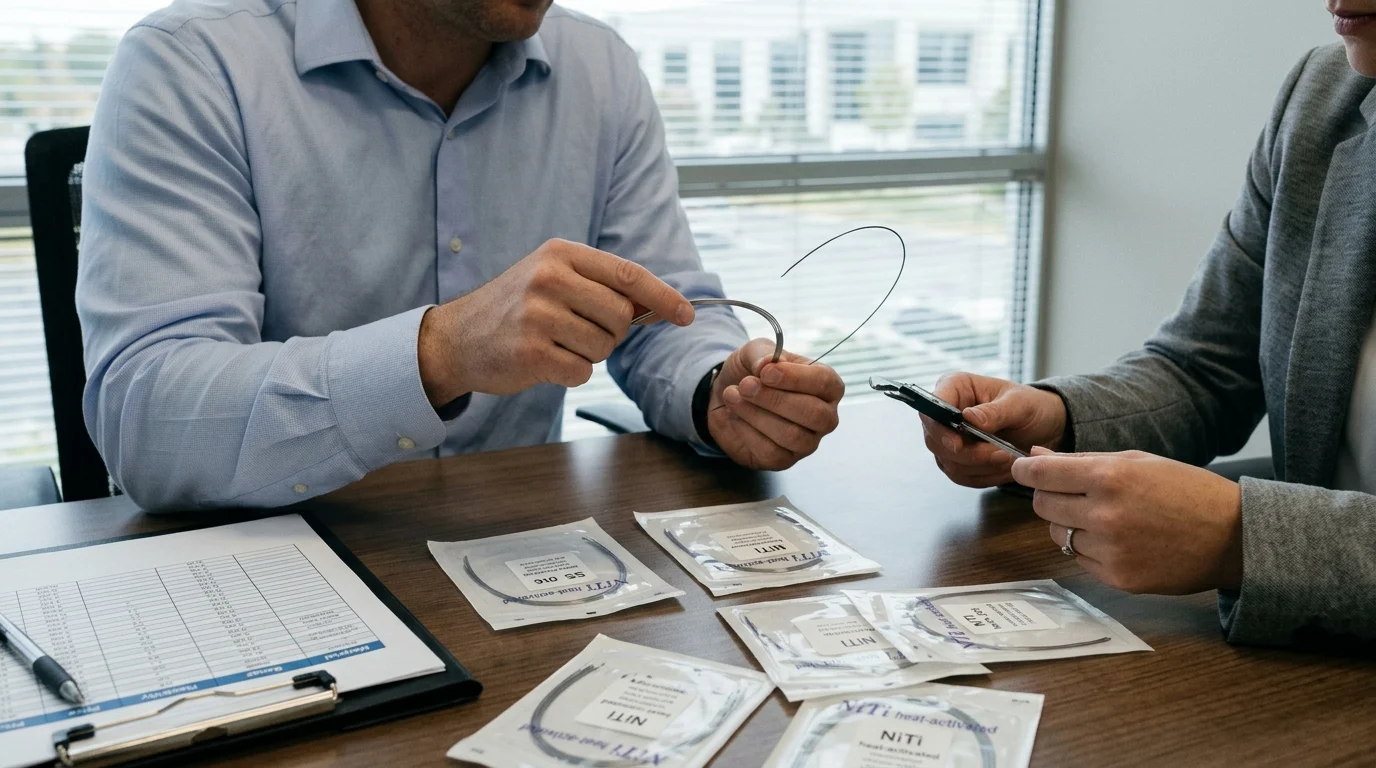
Selecting the optimal arch wire requires a rigorous comparison of metallurgical data, manufacturing tolerances, and quality control protocols. Distributors and clinicians must look beyond basic dimensions to evaluate the microstructural integrity and regulatory compliance of the wires.
Side-by-side evaluation criteria
To effectively evaluate an arch wire inventory, buyers must weigh several core metallurgical parameters side-by-side. The following comparison highlights the contrasting mechanical profiles of the two dominant alloys:
| Property | Stainless Steel (304V) | Superelastic NiTi |
|---|---|---|
| Young’s Modulus (GPa) | 180 – 200 | 30 – 50 |
| Yield Strength (MPa) | 1,000 – 1,500 | 200 – 400 (Austenitic) |
| Friction Coefficient | Low (~0.12) | High (~0.28) |
| Formability/Bending | Excellent | Poor (Brittle) |
| Force Delivery | Linear, Rapid Decay | Constant, Superelastic |
This data illustrates why neither material can unilaterally serve the entirety of a comprehensive orthodontic treatment plan.
Surface finish, weld integrity, and packaging control
Surface topography directly impacts both sliding mechanics and bacterial plaque retention. High-quality stainless steel wires undergo extensive electropolishing to achieve a surface roughness (Ra) of less than 0.1 µm. Weld integrity is equally critical, particularly when attaching stops or hooks; the heat-affected zone must not compromise the wire’s baseline tensile strength.
Packaging control in a cleanroom environment (Class 10,000 or better) is necessary to prevent cross-contamination and oxidation before the product reaches the clinic. Individual sealing processes must maintain a sterile or highly hygienic barrier against moisture ingress during international transit.
Standards, biocompatibility, and supplier validation
Compliance with international standards is non-negotiable for Class IIa medical devices. Wires must conform to ISO 15841 for orthodontic products and ISO 10993 for comprehensive biological evaluation. A critical metric is the nickel release rate, which must remain below 0.2 µg/cm²/week to comply with stringent European directives regarding patient sensitization.
Rigorous supplier validation ensures these metrics are met consistently. Distributors should review manufacturing credentials and compliance documentation via resources like supplier about us pages to verify ISO 13485 certifications, material traceability, and batch-testing protocols.
When to choose stainless steel arch wire or NiTi wires
The clinical application of an arch wire is governed by the specific biomechanical demands of the treatment phase. Strategic procurement hinges on understanding how material properties align with these shifting clinical requirements and inventory constraints.
Selection by treatment phase and malocclusion
NiTi wires are the established gold standard for the initial leveling and aligning phase of treatment. Their ability to deliver light, continuous forces—typically between 50 and 150 grams of force depending on the cross-sectional dimension—makes them ideal for resolving severe crowding without causing periodontal ischemia or root resorption.
Once the dental arch is leveled, a stainless steel arch wire is introduced for the working and finishing phases. The high rigidity of stainless steel is mandatory for expressing torque, closing extraction spaces via sliding mechanics, and maintaining transverse arch dimensions while heavy elastics are deployed.
Cost, shipping, and minimum order considerations
Financial and logistical factors play a significant role in inventory management. Stainless steel is highly cost-effective, with bulk wholesale prices often ranging from $0.10 to $0.30 per wire. In contrast, complex NiTi alloys command higher price points, typically between $0.50 and $1.50 per wire, due to advanced vacuum melting and shape-setting processes.
For distributors, minimum order quantities (MOQs) for custom or private-label wires usually start at 5,000 to 10,000 pieces per dimension. Exploring comprehensive product catalogs allows buyers to consolidate shipping volumes and negotiate better freight terms, which is critical given the dense, heavy nature of bulk steel shipments.
Procurement and clinical evaluation steps
Implementing a new wire brand requires a phased evaluation approach to mitigate clinical risk. Clinics and distributors should initially procure a sample batch of 100 to 200 pieces to conduct in vitro load-deflection testing and in vivo clinical trials.
This evaluation step verifies that the stated specifications translate to predictable clinical performance, ensuring the wire does not fracture under masticatory forces and that the arch form remains dimensionally stable during the critical finishing stages of treatment.
Decision framework for clinicians and distributors
Developing a comprehensive arch wire inventory requires a strategic framework that balances clinical efficacy, economic realities, and regulatory compliance. Both clinicians and global distributors must adapt to evolving orthodontic technologies while securing reliable, cost-effective supply chains.
Balancing performance, cost, and compliance
A successful procurement strategy relies on stocking the correct ratio of materials to match typical case progressions and minimize dead stock. The table below outlines a recommended inventory distribution for a standard orthodontic practice:
| Treatment Phase | Preferred Wire Material | Typical Dimensions (Inch) | Recommended Inventory Share |
|---|---|---|---|
| Initial Leveling | Superelastic NiTi | 0.012 to 0.016 Round | 35% |
| Transition / Torque | Rectangular NiTi | 0.016 x 0.022 | 25% |
| Working / Space Closure | Stainless Steel | 0.019 x 0.025 | 30% |
| Detailing / Finishing | TMA / Braided Steel | 0.0175 Braided | 10% |
Maintaining these proportions ensures practitioners have immediate access to the necessary mechanical profiles without tying up excess capital in low-turnover dimensions.
Market trends affecting wire selection
The orthodontic wire market is currently experiencing a compound annual growth rate (CAGR) of approximately 6.5%, driven by rising demand in emerging markets and an increase in adult orthodontics. Aesthetic demands have spurred the development of rhodium-coated and Teflon-coated wires, though these aesthetic coatings can inadvertently increase surface friction by 15% to 20%.
Despite the exponential growth of clear aligner therapy, complex malocclusions, impacted canines, and surgical cases still necessitate fixed appliances. This ensures a sustained baseline volume demand for traditional high-grade stainless steel and superelastic NiTi alloys.
Final recommendations
For long-term operational stability, distributors should partner with manufacturers capable of dual-sourcing raw materials to mitigate global supply chain disruptions. Clinicians should standardize their wire sequencing protocols to reduce variability in treatment times and inventory overhead.
Organizations looking to optimize their supply chain, audit manufacturing tolerances, or request customized alloy profiles should contact reputable manufacturers directly to establish robust, compliant, and cost-effective procurement agreements.
Further reading:
Key Takeaways
- The most important conclusions and rationale for stainless steel arch wire
- Specs, compliance, and risk checks worth validating before you commit
- Practical next steps and caveats readers can apply immediately
Frequently Asked Questions
When is a stainless steel arch wire preferred over NiTi?
Use stainless steel mainly in working and finishing stages, especially for space closure, sliding mechanics, and detailed bends where higher stiffness and lower friction are needed.
Why do orthodontists start many cases with NiTi wires?
NiTi is ideal for initial alignment because it offers high springback and gentle, more consistent force on crowded or severely displaced teeth.
Can stainless steel arch wire be bent and customized easily?
Yes. Stainless steel is highly formable, so clinicians can add first-, second-, and third-order bends, plus custom detailing that NiTi usually cannot handle well.
What should buyers check when sourcing stainless steel arch wire from suppliers like DenRotary?
Check dimensions, surface finish, weld quality, packaging cleanliness, and compliance documents to ensure consistent performance and safe international delivery.
How does friction differ between stainless steel and NiTi arch wires?
Stainless steel generally has lower friction against metal brackets, which helps sliding mechanics and controlled space closure more efficiently than NiTi.

Post time: May-30-2026