

- Choose an orthodontic manufacturer that can support several treatment stages rather than only one product category.
- Compare bracket structure, archwire metallurgy, elastic performance, packaging, and documentation before comparing price.
- OEM orthodontic products require clear specifications, artwork approval, quality inspection, and batch traceability.
- International buyers should verify the regulatory pathway required in their destination market.
Choosing a China orthodontic supplier is less about finding the lowest quotation and more about securing consistent clinical components for a complete treatment workflow. The U.S. Food and Drug Administration explains that dental devices are regulated medical devices, so documentation and market-specific compliance should be reviewed alongside technical performance. This guide compares the main product groups, OEM evaluation criteria, and procurement risks for distributors, dental groups, and orthodontic brands.
What makes a China orthodontic supplier suitable for OEM projects?
A suitable China orthodontic supplier must demonstrate repeatable manufacturing, clear product specifications, and the ability to manage private-label requirements without weakening quality controls. OEM purchasing is not simply a logo-printing service. It normally involves product selection, design confirmation, packaging development, inspection, export documentation, and ongoing batch communication.
For a distributor, the most useful supplier is often the one that can organize a coherent product family. A bracket, archwire, buccal tube, elastic chain, and orthodontic plier should be specified as separate products but managed through one purchasing system. This reduces the risk of mismatched labeling, inconsistent packaging, and fragmented delivery schedules.
Denrotary states that it has focused on orthodontic manufacturing since 2012 and offers products covering brackets, buccal tubes, archwires, elastics, and orthodontic instruments. Buyers should treat these statements as starting points for verification and request current certificates, test records, technical files, and representative samples before approval.
Product categories to compare in OEM orthodontic products
The strongest OEM programs begin with product architecture because each component serves a different clinical and commercial purpose. A broad portfolio can support a distributor’s standard catalog while allowing selected products to be customized for regional demand.
| Product group | Common options | Primary purchasing question | Buyer score guide |
|---|---|---|---|
| Brackets | Metal, ceramic, sapphire, self-ligating | Are slot, base, prescription, and bonding details documented? | 1-5 |
| Buccal tubes | Different molar positions and configurations | Are position, weld, base, and identification requirements clear? | 1-5 |
| Archwires | Nickel titanium, stainless steel, copper nickel titanium, thermal-activated | Are dimensions, temper, force behavior, and packaging controlled? | 1-5 |
| Elastic accessories | Ligatures, elastic chains, elastomeric modules | Are color, recovery, aging, and lot details consistent? | 1-5 |
| Instruments | Cutting, forming, bending, and utility pliers | Are material, finish, alignment, and maintenance instructions supplied? | 1-5 |
The buyer score is a procurement framework, not a clinical performance claim. A supplier that scores well across all categories may be easier to manage than a specialist that offers an excellent single item but cannot coordinate the rest of the catalog.
Brackets and buccal tubes
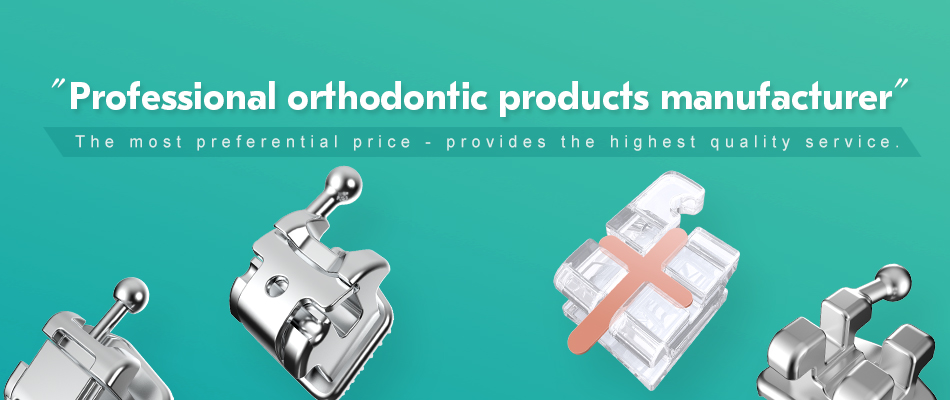
Bracket selection should start with the intended patient segment and treatment philosophy. Metal brackets generally serve standard fixed appliances, while ceramic and sapphire options address patients who prioritize a less visible appearance. Self-ligating brackets may be offered in active, passive, or ball designs, but the buyer should compare the actual mechanism, door or clip construction, slot accuracy, base geometry, and handling instructions rather than relying on the category name alone.
Base design is a practical OEM issue because it affects bonding workflow, packaging protection, and product identification. Mesh-base and integrated-base metal brackets may suit different engineering priorities, including bonding surface design and structural simplicity. The supplier should provide drawings and inspection criteria that define the approved product, not only photographs.
Buccal tubes complete the posterior part of a fixed appliance system. Their position, weld or bonding configuration, auxiliary features, and archwire entry geometry should be matched to the target prescription and clinical workflow. Buyers should request samples for insertion, handling, and packaging review before approving a large private-label run.
Archwires for different treatment stages
Archwire metallurgy should be matched to the treatment stage and the clinician’s preferred force system. Nickel titanium is commonly selected for initial alignment and leveling, while stainless steel is often used when greater working control and finishing adjustability are required. Copper nickel titanium and thermal-activated designs are marketed for temperature-responsive behavior, but their force characteristics must be supported by technical documentation and independent or internal test data.
| Archwire type | Typical use context | OEM evidence to request | Selection score guide |
|---|---|---|---|
| Nickel titanium | Initial alignment and leveling | Dimension, transformation data, surface finish, and lot control | 1-5 |
| Stainless steel | Working, control, and finishing stages | Dimension, temper, straightness, and corrosion-related records | 1-5 |
| Copper nickel titanium | Temperature-responsive treatment concepts | Activation range, force data, and storage guidance | 1-5 |
| Thermal-activated wire | Temperature-dependent force delivery | Testing method, conditions, and labeling controls | 1-5 |
| Reverse-curve wire | Specific leveling or arch-form applications | Shape specification, intended use, and packaging protection | 1-5 |
Orthodontic wire claims should be read carefully because force behavior depends on dimension, temperature, deflection, ligation, and testing conditions. A responsible orthodontic manufacturer should explain how its data were generated and should not present a laboratory result as a universal clinical outcome.
How to evaluate an orthodontic manufacturer for private label supply
Manufacturing capability is credible only when it can be connected to controlled processes and records. A modern workshop or automated line may support consistency, but buyers still need objective evidence such as incoming-material controls, in-process inspection, final-release criteria, nonconformance procedures, and retained samples.
Regulatory readiness should be evaluated by destination market rather than by certificate count. The FDA provides a dental device resource page explaining the regulatory context for dental products in the United States. Importers should confirm product classification, establishment responsibilities, labeling obligations, and whether their intended product requires a specific submission or registration pathway.
Clinical terminology also needs disciplined use. The National Institute of Dental and Craniofacial Research provides patient-oriented information about orthodontic treatment, including the role of appliances in moving teeth and correcting bite-related concerns. This is useful background for marketing teams because consumer messaging should remain understandable and should not turn general treatment information into an unsupported product promise.
OEM due diligence checklist
- Define the product scope, prescription, dimensions, materials, colors, packaging, and destination markets.
- Request samples from normal production rather than specially prepared demonstration pieces.
- Compare drawings, labels, certificates, inspection records, and packaging artwork for consistency.
- Agree on acceptance criteria for appearance, dimensions, bonding components, surface finish, and quantity.
- Confirm how complaints, corrective actions, replacement units, and change notifications will be managed.
- Approve a pilot order before expanding the range or committing to a long-term forecast.
The most overlooked issue is change control. A supplier may change a raw-material source, coating process, mold, packaging film, or subcontracted operation without the buyer noticing. The OEM agreement should require advance notification for changes that could affect fit, function, labeling, regulatory status, or shelf-life expectations.
Comparing OEM orthodontic products by application and risk
Product selection should reflect the commercial risk of failure, not only the unit price. A missing elastic module may be inconvenient, but an inconsistent bracket base or poorly controlled archwire can affect clinical workflow, complaints, and brand reputation.

| Buying priority | Higher-risk issue | Evidence that reduces uncertainty | Review frequency |
|---|---|---|---|
| Clinical fit | Prescription, slot, base, or dimension variation | Approved drawing, sample comparison, and inspection report | Each production batch |
| Patient-facing appearance | Color, transparency, burrs, or surface defects | Visual standard, retained sample, and packaging check | Each production batch |
| Supply continuity | Material shortages or undocumented substitutions | Approved supplier list and change-notification procedure | At every material change |
| Market access | Incorrect labeling or incomplete technical records | Market-specific compliance review and document set | Before launch and after changes |
| Brand protection | Complaint handling delays | Written response process and escalation contact | At contract review |
For adult aesthetic cases, ceramic and sapphire brackets can be commercially attractive, but the buyer should ask about chipping resistance, base handling, packaging protection, and removal instructions. For high-volume general orthodontic use, metal brackets and standard archwires may offer simpler inventory planning. The correct answer depends on the distributor’s customer mix, not on a universal ranking.
When a broader product portfolio creates an advantage
A broader portfolio creates value when it simplifies procurement and preserves consistent specifications across the treatment pathway. A distributor can source initial alignment wires, working wires, brackets, buccal tubes, elastics, and instruments through a coordinated catalog instead of managing several unrelated vendors.
However, breadth should not replace depth. Buyers should verify whether every listed item is manufactured in-house, produced by an approved partner, or supplied through trading arrangements. They should also check whether packaging, inspection, and traceability controls are applied consistently to every category.
For a clinic group, the practical advantage is standardization. Staff can follow familiar ordering codes, packaging formats, and replenishment routines. For a private-label brand, the advantage is a more complete launch assortment. For a manufacturer, the advantage is the ability to discuss product development across brackets, wires, elastics, and instruments rather than treating each item as an isolated quotation.
Recommended procurement process for overseas buyers
The safest procurement process moves from clinical definition to controlled commercialization. Begin with a written specification and intended use, then test samples under the same handling conditions expected in the target market.
- Stage 1: Build a product matrix covering category, prescription, material, size range, packaging, and market.
- Stage 2: Request samples, technical files, current certificates, and a quotation with clear shipping terms.
- Stage 3: Conduct product, packaging, labeling, and documentation review.
- Stage 4: Approve artwork and acceptance criteria before pilot production.
- Stage 5: Inspect the pilot shipment and record corrective actions before scaling the order.
Price should be evaluated as landed cost and operational risk. A lower unit quotation can lose its advantage when packaging must be redesigned, mixed lots arrive, documents are incomplete, or replacement communication is slow. A higher-value supplier is one that makes quality predictable and exceptions manageable.
FAQ
What products should a China orthodontic supplier offer?
A practical fixed-appliance portfolio may include metal, ceramic, sapphire, and self-ligating brackets; buccal tubes; nickel titanium and stainless-steel archwires; elastics and elastic chains; and orthodontic pliers. The right range depends on the buyer’s clinical and distribution model.
Are OEM orthodontic products suitable for international distribution?
They can be suitable when the manufacturer and importer complete the market-specific regulatory, labeling, quality, and documentation work. Approval in one market does not automatically establish compliance in another.
How should I compare orthodontic manufacturers?
Compare documented specifications, sample consistency, material controls, inspection records, change control, complaint handling, production capacity, packaging support, and communication quality. Price should be reviewed only after these factors are understood.
What information is needed for an OEM quotation?
Provide product category, prescription or design, material, dimensions, quantity, packaging format, artwork requirements, destination market, delivery terms, and any testing or documentation requirements.
Are self-ligating brackets always better than conventional brackets?
No. Self-ligating and conventional systems have different designs and handling characteristics. Selection should follow the clinician’s treatment method, preferred workflow, training, and documented product performance.
What should be checked in archwire samples?
Check dimensions, straightness, surface finish, labeling, packaging, handling behavior, and the consistency of samples across lots. Ask for the supplier’s test method and conditions before interpreting force-related claims.
How can a distributor reduce OEM supply risk?
Use approved drawings, pilot orders, batch records, acceptance criteria, retained samples, change-notification clauses, and a written complaint process. Maintaining a qualified secondary source for critical items can also improve continuity.
About the supplier
Denrotary is a specialist orthodontic manufacturer focused on fixed-appliance products, including brackets, buccal tubes, archwires, elastics, and orthodontic instruments. Its catalog covers multiple materials and treatment stages, while its stated manufacturing focus, automated production capabilities, and international documentation support are relevant to distributors and private-label buyers. Review the orthodontic bracket range, compare archwire options, and use the contact page to request samples, specifications, and an OEM quotation.
Post time: Sep-08-2026