

Introduction
Orthodontists often evaluate self-ligating bracket brands not only by marketing claims, but by how consistently a supplier delivers precise slot dimensions, reliable clip performance, and prescription accuracy across cases. With more manufacturers entering the market, comparing brands now requires attention to clinical efficiency, material quality, and supply stability. This article highlights the self-ligating bracket brands most often recommended by orthodontists and explains what makes a supplier worth trusting, from biomechanical compatibility to manufacturing standards. By the end, readers will have a clearer framework for choosing products that support smoother treatment workflows, predictable outcomes, and long-term practice value.
Why the right self-ligating brackets supplier matters
The global orthodontic supply chain has evolved significantly, shifting heavily toward low-friction biomechanics and advanced manufacturing. Selecting a reliable self ligating brackets supplier is no longer merely a procurement task; it is a strategic clinical decision that directly impacts chair time, treatment predictability, and overall practice profitability.
With the self-ligating bracket market experiencing an estimated compound annual growth rate (CAGR) of over 8.5%, the proliferation of manufacturers has created both opportunities and risks for orthodontic clinics and dental distributors. Identifying a supplier capable of maintaining stringent metallurgical standards while offering scalable production is critical for long-term operational stability.
Treatment philosophy and bracket selection
Orthodontic treatment philosophies heavily dictate bracket selection, requiring suppliers to offer systems that align with specific biomechanical approaches. Self-ligating brackets (SLBs) eliminate the need for elastomeric ligatures, fundamentally altering how archwires interact with the bracket slot. This transition reduces binding and friction by up to 40-50% during the initial leveling and aligning phases.
Clinicians relying on specific prescriptions, such as Roth, MBT, or high/low torque variations, must partner with manufacturers capable of delivering exact angular specifications. A deviation of even 1 to 2 degrees in base torque can lead to unintended tooth movement, necessitating compensatory wire bending and extending treatment duration.
Market forces shaping supplier demand
Macroeconomic factors and supply chain volatility are reshaping how distributors and large dental service organizations (DSOs) source orthodontic inventory. Historically, practices relied almost exclusively on premium domestic brands. However, rising overhead costs and inflation have driven a search for high-quality OEM (Original Equipment Manufacturer) alternatives that offer comparable clinical performance without the premium brand markup.
Furthermore, the demand for shorter chair times—saving an average of 10 to 15 minutes per adjustment appointment—has accelerated the adoption of SLBs. Suppliers must now balance high-volume demand with consistent quality control, as any bottleneck in the delivery of brackets or proprietary opening instruments can disrupt clinical schedules across entire DSO networks.
Top self-ligating bracket brands compared
Navigating the diverse landscape of self-ligating bracket brands requires a fundamental understanding of ligation mechanics and manufacturing tiers. Orthodontists evaluate brands not just on their marketing claims, but on the empirical performance of their slot systems and base retention technologies.
Passive vs active self-ligating systems
The primary mechanical distinction in the SLB market is between passive and active systems. Passive brackets utilize a rigid sliding door that creates a tube-like structure, allowing the archwire to slide freely with minimal friction. Active brackets feature a resilient spring clip that presses against the archwire, providing continuous seating force for enhanced rotational and torque control in the later stages of treatment.
| Feature | Passive Self-Ligating | Active Self-Ligating |
|---|---|---|
| Ligation Mechanism | Rigid sliding door or shield | Resilient spring clip pressing on wire |
| Initial Friction | Extremely low (ideal for leveling) | Moderate (increases with wire dimension) |
| Torque Expression | Relies strictly on wire-to-slot clearance | Enhanced by active clip pressure on the wire |
| Clinical Application | Maximum expansion and sliding mechanics | Precise finishing and root control |
Key criteria for comparing slot systems
When comparing slot systems across different brands, dimensional accuracy is paramount. Most suppliers offer both 0.018-inch and 0.022-inch slot variants, but the true test of a brand lies in its base retention and profile design. High-quality brands utilize 80-gauge mesh pads or laser-etched bases to achieve optimal mechanical interlock with orthodontic adhesives.
Clinical standards dictate that a premium self-ligating bracket should consistently achieve a shear bond strength of 10 to 15 MPa to prevent mid-treatment debonding while remaining safe for enamel during bracket removal. Additionally, ultra-low profile designs are heavily scrutinized, as reducing bracket depth by even 0.5 mm significantly improves patient comfort and reduces mucosal ulcerations.
Premium, mid-market, and value brands
The market is broadly segmented into premium, mid-market, and value tiers. Premium brands (such as Damon by Ormco or In-Ovation by Dentsply Sirona) command higher prices, typically ranging from $15 to $30 per bracket, backed by extensive clinical literature and proprietary alloys.
Conversely, mid-market and value brands, often sourced directly from specialized manufacturers, have closed the quality gap. Advanced CNC milling and metal injection molding (MIM) technologies allow these tier-two brands to offer brackets in the $4 to $9 range. For distributors, vetting these value brands involves ensuring that the lower cost does not correlate with compromised clip resilience or inaccurate torque values.
Technical and commercial evaluation criteria
A rigorous technical and commercial evaluation is essential before committing to a self ligating brackets supplier. Procurement teams must look beyond superficial product catalogs and interrogate the underlying engineering tolerances, regulatory frameworks, and hidden cost structures of potential manufacturing partners.
Manufacturing tolerances and bracket specifications
The foundation of bracket performance is its manufacturing tolerance. Industry-leading suppliers utilize Metal Injection Molding (MIM) combined with secondary CNC machining to ensure slot dimensions are exact. A strict tolerance threshold of +/- 0.0005 inches within the slot is mandatory; any variance beyond this results in “slop,” leading to an unacceptable loss of torque expression.
Furthermore, the metallurgical composition must be scrutinized. High-grade 17-4 PH stainless steel is the benchmark for strength and durability. The locking mechanism, whether a sliding door or a NiTi spring clip, must undergo stringent fatigue testing to guarantee it will not warp or jam over the 18 to 24 months of typical orthodontic treatment.
Regulatory compliance and sterilization standards
Regulatory compliance serves as a non-negotiable filter for supplier selection. Any reputable manufacturer must operate under an ISO 13485-certified quality management system. For global distribution, the brackets must carry FDA 510(k) clearance in the United States and CE MDR certification in the European Union.
Biocompatibility is an equally critical standard. With an estimated 10% to 15% of the global patient population exhibiting nickel hypersensitivity, suppliers must offer fully documented, low-nickel or nickel-free alternatives, such as advanced ceramic self-ligating brackets or specialized titanium alloys, backed by verifiable cytotoxicity and sensitization test reports.
Cost drivers beyond unit price
While unit price is the most visible metric, true commercial evaluation requires a total cost of ownership (TCO) approach. Hidden cost drivers include shipping logistics, import tariffs, and the financial impact of clinical failures. A supplier offering a bracket for $3.00 with a 3% clip failure rate is ultimately more expensive than a $5.00 bracket with a near-zero defect rate.
Acceptable defect rates in premium orthodontic manufacturing should not exceed 0.5%. Additionally, distributors must factor in the cost of proprietary opening tools, inventory carrying costs, and the availability of replacement parts when calculating the long-term viability of a supplier contract.
How clinics and distributors should source suppliers
Establishing a resilient supply chain requires a structured sourcing strategy. Clinics and distributors must navigate the complexities of international trade, minimum order quantities, and brand positioning to secure advantageous partnerships that support their specific business models.
Sample validation and vendor comparison
Before initiating bulk orders, rigorous sample validation is imperative. Distributors should request unbranded sample sets to conduct blind clinical trials on typodonts. This validation phase must test the tactile feedback of the locking mechanism, ensuring it withstands a minimum of 50 consecutive opening and closing cycles without loss of retention force.
Vendor comparison should also include an assessment of the supplier’s technical documentation. Legitimate manufacturers will readily provide scanning electron microscope (SEM) imagery of their bracket bases and independent lab reports verifying shear bond strength and dimensional accuracy.
MOQ, lead time, private labeling, and support
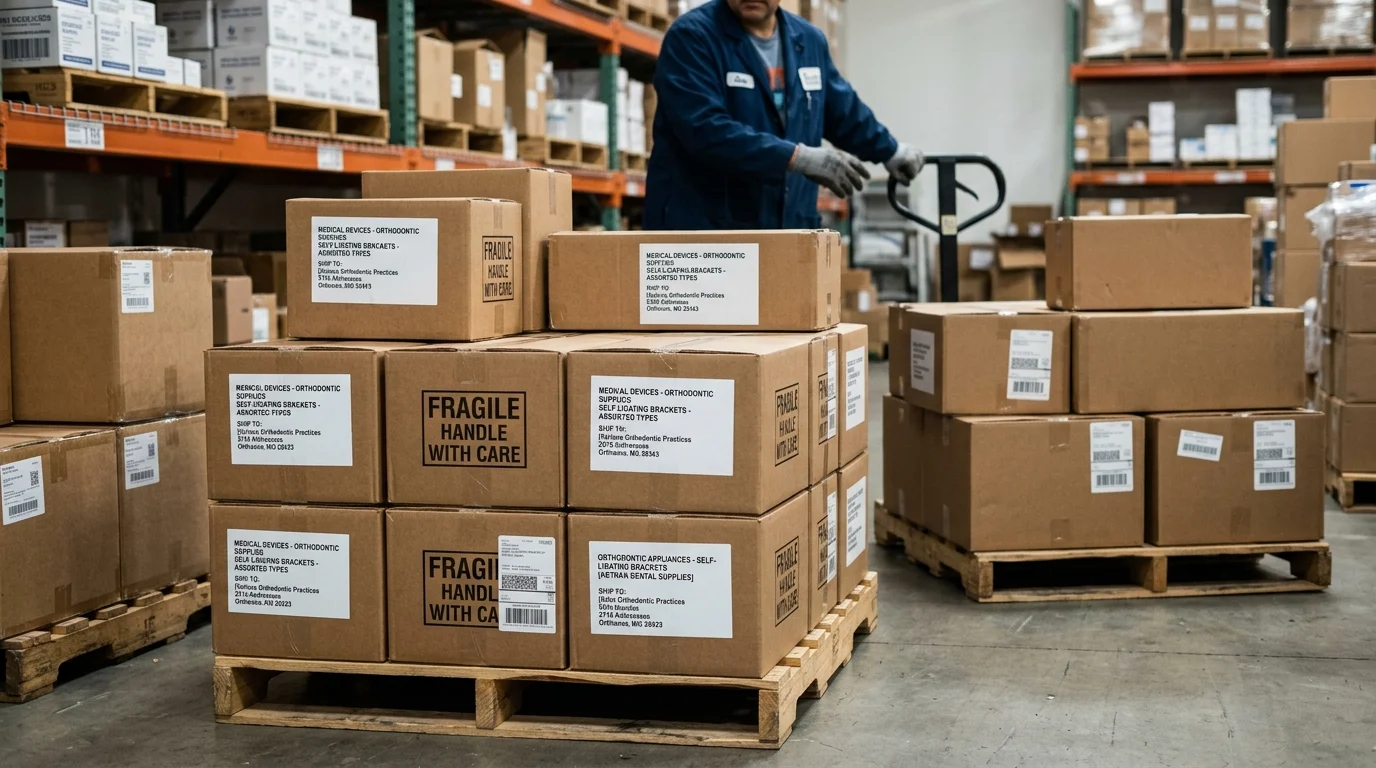
Commercial terms dictate the feasibility of a supplier relationship. Minimum Order Quantities (MOQs) vary wildly; standard catalog items may require an MOQ of 50 to 100 sets, while custom private-label manufacturing often demands MOQs exceeding 500 sets per prescription.
Lead time is another critical variable. While domestic warehousing can fulfill orders within 3 to 5 days, direct-from-factory sourcing typically involves lead times of 21 to 45 days. Distributors looking to build their own brand equity must negotiate private labeling terms, ensuring the supplier can provide custom packaging, laser-etched branding on the bracket base, and dedicated post-sales technical support.
Global brands vs OEM suppliers
The decision between distributing established global brands versus partnering with an OEM supplier hinges on market positioning. Global brands offer immediate clinical acceptance and robust marketing support, but strictly control distributor margins and territorial exclusivity.
OEM suppliers offer unparalleled flexibility and significantly higher profit margins, allowing DSOs and regional distributors to create proprietary bracket systems. However, this route places the burden of marketing, clinical education, and regulatory registration squarely on the sourcing entity, requiring a robust internal infrastructure to support the product rollout.
Decision framework for choosing a supplier
Synthesizing technical specifications, clinical needs, and commercial terms into a cohesive decision framework is the final step in the procurement process. A systematic approach ensures that the chosen supplier aligns with both immediate clinical demands and long-term strategic growth goals.
Matching brand choice to case mix
The optimal supplier choice must reflect the specific case mix of the end-user. High-volume, fast-turnaround clinics heavily prioritize passive self-ligating systems that maximize efficiency and reduce chair time, favoring suppliers with robust bulk-discount structures and rapid fulfillment capabilities.
Conversely, boutique orthodontic practices handling complex, multidisciplinary cases may prioritize active systems and ceramic aesthetics. For these environments, the supplier’s ability to provide a comprehensive ecosystem—including compatible archwires, specialized buccal tubes, and precise torque variations—outweighs pure cost considerations.
Final supplier selection matrix
To objectify the final decision, procurement teams should utilize a weighted supplier selection matrix. This tool prevents over-indexing on unit price and ensures critical factors like clinical reliability and supply chain stability are properly valued before reaching out to a self ligating brackets supplier to finalize contracts.
| Evaluation Criteria | Strategic Weight (%) | Minimum Acceptable Benchmark |
|---|---|---|
| Dimensional Accuracy & Quality | 30% | Slot tolerance strictly within +/- 0.0005″ |
| Clip Reliability & Mechanics | 25% | Zero failure under 50+ open/close cycles |
| Supply Chain & Delivery Stability | 25% | >95% on-time delivery rate; <30 day lead time |
| Commercial Terms & Pricing | 20% | Standard MOQ <200 sets; competitive TCO |
Further reading:
Key Takeaways
- The most important conclusions and rationale for self ligating brackets supplier
- Specs, compliance, and risk checks worth validating before you commit
- Practical next steps and caveats readers can apply immediately
Frequently Asked Questions
What should I verify in a self-ligating brackets supplier?
Check slot accuracy, prescription options like MBT or Roth, bond base design, consistent QC, and reliable delivery. A supplier should also provide opening instruments and clear product specifications.
How do passive and active self-ligating brackets differ?
Passive systems reduce friction for early leveling and sliding mechanics. Active systems add clip pressure for stronger torque and rotational control during finishing.
Why does slot precision matter when choosing bracket brands?
Even small torque or angulation deviations can affect tooth movement and prolong treatment. Precise slots help reduce wire bending and improve treatment predictability.
Are OEM self-ligating brackets a practical option for clinics?
Yes, if the OEM supplier maintains stable metallurgy, accurate prescriptions, and dependable QC. They can lower costs while supporting consistent clinical performance.
Can DenRotary support bulk orders for self-ligating brackets?
DenRotary focuses on scalable orthodontic supply and OEM support. For bulk quantities, confirm available prescriptions, packaging options, lead times, and shipping schedules directly with their team.

Post time: Jun-11-2026