

Introduction
Orthodontic elastomeric ligatures are routine but critical orthodontic consumables, so choosing the right online source affects cost, stock reliability, and clinical consistency. This article explains where practices, distributors, and bulk buyers can purchase them online, what differences to expect between marketplace vendors, dental supply sites, and direct manufacturers, and how to compare pricing, pack sizes, certifications, and shipping terms. By the end, readers will have a practical framework for identifying dependable suppliers, avoiding common purchasing risks, and selecting options that fit both treatment volume and procurement budgets.
Why Buy Orthodontic Elastomeric Ligatures Online
Orthodontic elastomeric ligatures are essential consumable medical devices used daily in dental practices to secure archwires to brackets. As supply chain digitization accelerates, procuring these materials online has transitioned from a supplementary option to a primary sourcing strategy for clinics and distributors worldwide.
Transitioning to digital procurement channels offers unprecedented transparency in pricing and inventory. By leveraging global B2B platforms and direct-to-buyer portals, dental professionals can optimize their consumable spend while maintaining the rigorous clinical standards required for orthodontic treatments.
Price pressure, chairside efficiency, and supply continuity
The cost of consumable materials exerts continuous pressure on the profitability of orthodontic practices. Traditional distribution channels typically price standard elastomeric ligatures between $3.00 and $6.00 per pack of 1,000 units. By shifting to online procurement, practices can often bypass regional intermediaries, achieving a 15% to 30% reduction in unit costs without compromising clinical efficacy.
Beyond direct cost savings, online platforms enhance chairside efficiency and supply continuity. Automated inventory tracking and subscription-based ordering models help prevent stockouts of high-demand colors and sizes. Consistent access to these materials ensures that orthodontists do not face operational bottlenecks, allowing for seamless patient turnover and predictable clinical workflows.
Buyer types comparing online options
The online marketplace serves a diverse spectrum of buyers, each with distinct procurement priorities. Large Dental Service Organizations (DSOs) operate at a massive scale, frequently consuming upwards of 15,000 to 20,000 ligature packs annually. These buyers utilize online B2B portals to negotiate bulk contracts, establish automated fulfillment schedules, and integrate purchasing data into their enterprise resource planning (ERP) systems.
Conversely, independent orthodontic clinics and regional distributors operate with different constraints. An independent practice might purchase 500 to 1,000 packs per year, placing a premium on vendor flexibility, broad color variety, and low minimum order quantities. Regardless of scale, astute buyers meticulously review supplier credentials, often examining a company’s about us page to verify their manufacturing legacy, regulatory standing, and market reputation before committing to a long-term purchasing agreement.
Key Specifications to Compare

Evaluating orthodontic elastomeric ligatures requires a stringent analysis of material science and manufacturing precision. Because these devices remain active in the oral cavity for weeks, their mechanical properties directly influence treatment timelines and patient comfort.
Buyers must look beyond superficial attributes like color and packaging to assess the underlying polymer chemistry. High-quality ligatures are predominantly manufactured from medical-grade, latex-free polyurethane, engineered to withstand the demanding biological environment of the mouth without degrading prematurely.
Material consistency and force retention
Material consistency is the cornerstone of effective orthodontic mechanics. The primary function of an elastomeric ligature is to maintain secure seating of the archwire within the bracket slot. However, all polyurethane elastomers undergo force decay when exposed to moisture, enzymes, and temperature fluctuations in the oral cavity. Clinical studies indicate that standard ligatures can lose 50% to 70% of their initial force within the first 24 hours of application.
Premium online suppliers mitigate this rapid degradation by utilizing advanced cross-linked polymers. When sourcing online, buyers should verify the inner diameter (ID) specifications, which typically range from 0.115 to 0.120 inches for standard applications. Precise dimensional consistency ensures that the ligature stretches uniformly over the bracket tie wings, providing a predictable, continuous force that drives optimal tooth movement over a typical 4-to-6-week adjustment interval.
Comparison criteria for product evaluation
When evaluating multiple online suppliers, procurement teams must utilize standardized criteria to separate premium medical devices from substandard alternatives. Key evaluation metrics include elasticity, tear resistance, and color stability. A high-quality ligature should be capable of stretching up to 300% of its original diameter without rupturing or suffering permanent plastic deformation.
Color stability is another critical factor, particularly for adult patients who demand aesthetic discretion. Substandard materials are highly susceptible to staining from coffee, tea, and heavily pigmented foods, leading to patient dissatisfaction.
| Evaluation Metric | Premium Specification | Indicator of Substandard Quality |
|---|---|---|
| Force Decay (24h) | < 50% loss of initial force | > 75% loss of initial force |
| Maximum Elongation | 300% without rupture | Snaps before 150% stretch |
| Water Absorption | < 1% over 30 days | Swelling and rapid degradation |
| Dimensional Tolerance | ± 0.005 inches | High variance between batches |
Essential product definitions and terminology
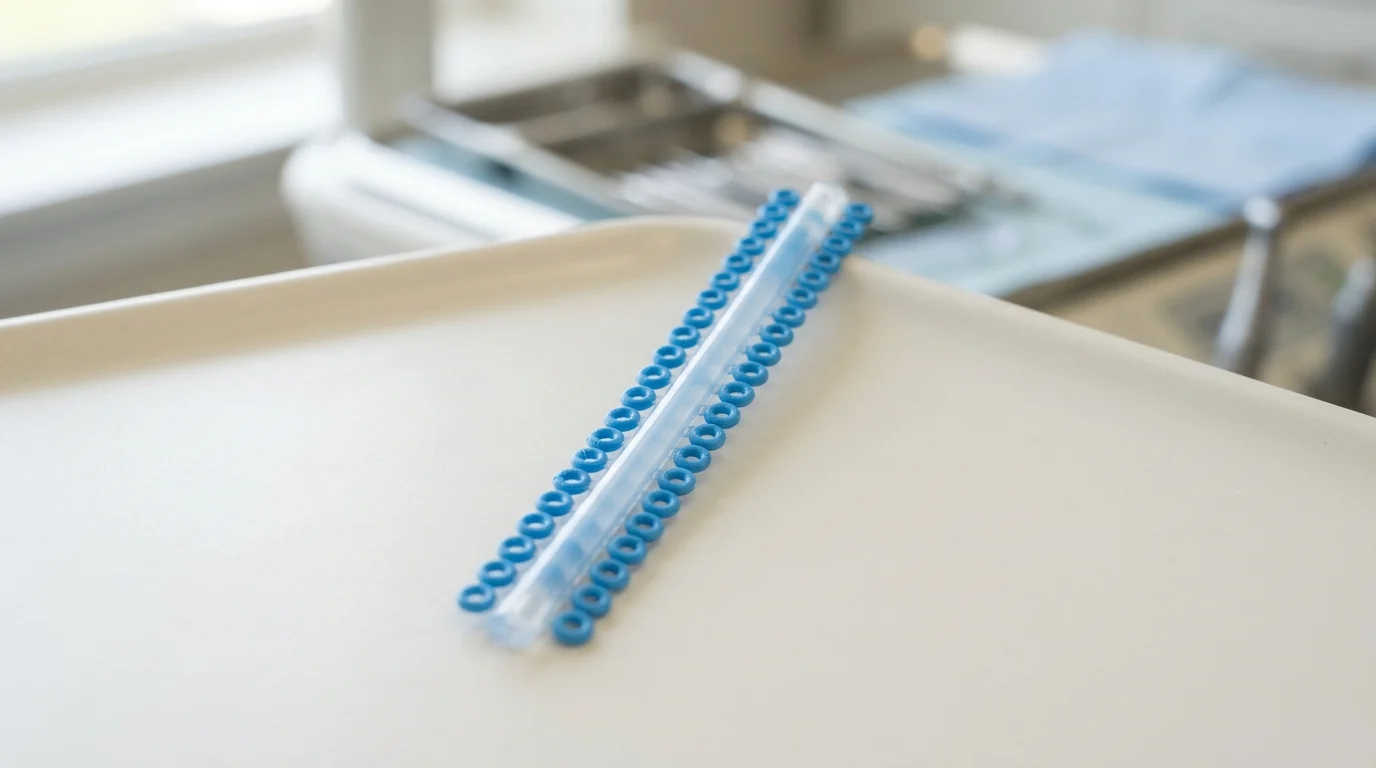
Navigating online catalogs requires a firm grasp of industry terminology to ensure accurate ordering. Elastomeric ligatures are generally categorized by their presentation and outer diameter. “Short ties” or “mini ties” are individually cut and typically dispensed from sticks or canes, which aids in cross-contamination control. “Continuous chains” or “power chains” are connected ligatures used to close spaces between multiple teeth.
Furthermore, understanding the difference between latex and latex-free formulations is critical for patient safety, given the high prevalence of latex allergies. Buyers can browse comprehensive catalogs of these specific configurations by exploring dedicated products pages on manufacturer websites, which detail the exact dimensions, packaging formats, and material compositions available.
Where to Source Online
The digital landscape offers multiple avenues for sourcing orthodontic consumables, primarily divided into direct-from-manufacturer platforms and authorized third-party dental dealers. Selecting the right channel depends heavily on the buyer’s volume requirements, warehousing capacity, and desired level of customer support.
Understanding the structural differences between these online sources enables procurement teams to align their purchasing strategy with their operational cash flow and inventory management capabilities.
Manufacturer-direct sites vs authorized dealers
Manufacturer-direct websites connect buyers straight to the production source, effectively eliminating distributor markups. This route is highly advantageous for securing the lowest possible unit cost and ensuring direct accountability for quality control. However, buying direct often involves navigating international trade logistics, customs clearance, and longer communication cycles if the manufacturer is based overseas.
Authorized online dealers and dental supply aggregators present a different value proposition. These platforms stock multiple brands, allowing clinics to consolidate their purchasing of brackets, wires, and ligatures into a single order. While the unit price of ligatures may be 10% to 20% higher compared to direct sourcing, authorized dealers typically provide localized warehousing, net-30 payment terms, and expedited domestic shipping, which can offset the higher upfront material costs.
Low unit cost, MOQ, and service trade-offs
The trade-off between unit cost and Minimum Order Quantity (MOQ) is the defining factor in online sourcing. Direct manufacturers may offer elastomeric ligatures at a highly competitive rate of $0.80 to $1.20 per pack, but they frequently enforce MOQs ranging from 2,000 to 5,000 packs per order. This requires significant upfront capital and climate-controlled storage space to prevent the polyurethane from degrading over time.
Conversely, online dental dealers cater to smaller operational footprints. They typically allow purchases with no MOQ, or minimums as low as 10 packs, albeit at a higher price point of $3.50 to $5.00 per pack. For independent clinics, paying this premium is often more cost-effective than risking material expiration. Larger institutions, however, readily absorb high MOQs to capture the long-term low unit costs, relying on robust inventory rotation protocols.
How to Verify Quality and Delivery
Procuring medical devices through online channels introduces inherent risks regarding product safety, regulatory compliance, and supply chain reliability. Mitigating these risks requires a structured verification process before any financial transaction takes place.
Buyers must rigorously vet potential suppliers by validating their quality assurance frameworks, requesting physical samples, and accurately calculating the total landed cost to ensure the anticipated savings are actually realized.
Required compliance and product documents
Because orthodontic elastomeric ligatures are inserted into the human body, they are subject to strict regulatory oversight globally. In the United States, they are classified as FDA Class I medical devices, requiring the manufacturer to maintain an active facility registration and device listing. In the European Union, compliance with the Medical Device Regulation (MDR 2017/745) and a valid CE mark are mandatory.
Before finalizing a supplier, procurement officers must request and independently verify these compliance documents. Additionally, the supplier should hold an active ISO 13485 certification, which is the internationally recognized standard for quality management systems specific to the medical device industry. Failure to provide verifiable, up-to-date certificates is an immediate disqualifier for any online vendor.
Supplier quality systems and sample evaluation
Documentary compliance must be validated by physical product performance. Buyers should insist on receiving evaluation samples from current production batches. During sample evaluation, clinicians should conduct visual inspections under magnification to check for “flash”—excess polymer left on the edges of the ligature due to poor injection molding. High-quality manufacturing processes typically maintain a physical defect rate of less than 1%.
Clinical staff should also test the tactile handling of the ligatures, ensuring they load smoothly onto dispensing instruments and seat securely around the bracket tie wings without premature snapping. Buyers interested in establishing a rigorous testing protocol can reach out to prospective manufacturing partners via their contact us portals to request technical data sheets and specific sample configurations.
Logistics factors affecting landed cost
The advertised online price of a product is rarely the final cost. Logistics factors heavily influence the total landed cost, especially when sourcing internationally. Buyers must account for freight charges, customs duties, insurance, and potential port handling fees. A supplier offering a ligature pack for $1.00 might ultimately cost the buyer $1.40 per pack once logistics are factored in.
Choosing the right shipping modality is critical to balancing cost and lead time.
| Shipping Modality | Average Transit Time | Est. Cost per 100kg | Best Application |
|---|---|---|---|
| Express Air Courier (DHL/FedEx) | 3 – 7 Days | $600 – $850 | Urgent restocks, small independent clinics |
| Standard Air Freight | 10 – 15 Days | $400 – $600 | Medium volume, predictable inventory cycles |
| Sea Freight (LCL) | 25 – 40 Days | $100 – $250 | High volume DSOs, bulk annual orders |
How to Choose the Best Supplier
Transitioning to a new online supplier for orthodontic elastomeric ligatures should be executed methodically to prevent clinical disruptions. A systematic approach ensures that the chosen vendor can consistently meet the clinic’s quality standards, volume demands, and delivery schedules.
By formalizing the procurement process, organizations can objectively compare multiple online vendors and establish a resilient, cost-effective supply chain for their essential orthodontic consumables.
Step-by-step procurement process
The procurement process begins with issuing a Request for Quotation (RFQ) to three to five shortlisted online suppliers. The RFQ should detail the required annual volume, preferred packaging types, color assortments, and target delivery schedules. Once initial pricing and compliance documents are reviewed, the buyer moves to the sample testing phase, which should include a 4-week clinical trial to monitor in-vivo force decay and stain resistance.
If the clinical trial is successful, the next step is to place a paid trial order—typically 10% of the anticipated annual volume (e.g., 100 to 500 packs). This trial order tests the supplier’s fulfillment accuracy, packaging integrity during transit, and adherence to promised lead times. Only after a successful trial order should a buyer commit to a long-term supply contract or large-scale bulk purchase.
Decision criteria for final supplier selection
Final supplier selection requires balancing multiple, sometimes competing, criteria. A robust decision matrix typically weights product quality and clinical performance at 50%, as substandard ligatures directly harm patient outcomes. Total landed price is usually weighted at 30%, while supply chain reliability and lead times account for the remaining 20%.
Furthermore, buyers should evaluate the vendor’s financial flexibility and communication responsiveness. Favorable payment terms, such as Net 30 for established accounts or a 30% advance / 70% pre-shipment structure for international direct orders, indicate a mature, financially stable supplier. Ultimately, the best online supplier acts as a strategic partner, providing high-performance materials that drive both clinical excellence and operational efficiency.
Further reading:
Key Takeaways
- The most important conclusions and rationale for Orthodontic Elastomeric Ligatures
- Specs, compliance, and risk checks worth validating before you commit
- Practical next steps and caveats readers can apply immediately
Frequently Asked Questions
What should I check before buying orthodontic elastomeric ligatures online?
Confirm latex-free medical-grade polyurethane, standard ID around 0.115–0.120 inches, force retention, tear resistance, and supplier credentials such as regulatory information and manufacturing background.
Are online orthodontic elastomeric ligatures cheaper than traditional distributors?
Often yes. Online sourcing can reduce unit costs by about 15%–30%, especially for clinics or distributors buying in bulk or ordering on a recurring schedule.
How can I verify a supplier on DenRotary before ordering?
Review DenRotary’s About Us page, product specifications, material details, and contact information, then request packaging, MOQ, and shipment details before placing a larger order.
Which product specifications matter most for daily orthodontic use?
Focus on elasticity, 24-hour force decay, dimensional consistency, tear resistance, and color stability. These factors affect wire seating, treatment efficiency, and patient satisfaction.
What order quantities work best for clinics buying elastomeric ligatures online?
Independent clinics usually benefit from low-MOQ mixed-color orders, while DSOs and distributors should negotiate bulk pricing, scheduled fulfillment, and inventory planning for continuity.

Post time: Jun-06-2026