

Introduction
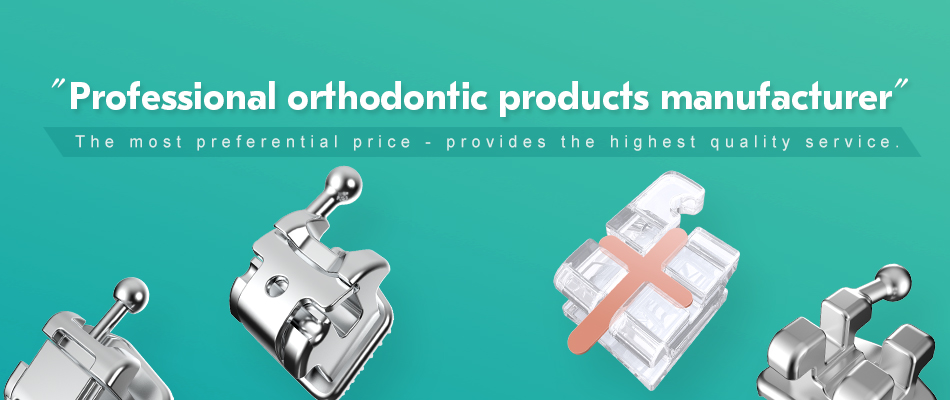
Orthodontic brackets must hold precise dimensions while enduring constant chewing pressure, wire torque, and long treatment cycles, so material choice directly affects performance and reliability. Among available alloys, 17-4 precipitation-hardening stainless steel stands out because it combines very high strength with strong corrosion resistance and accurate manufacturability. These properties help brackets resist deformation, preserve slot geometry, and maintain consistent expression of built-in torque and tooth movement. Understanding why this alloy performs so well gives readers a clearer view of how bracket design, patient comfort, and clinical predictability are connected, setting up the key material and treatment advantages explored in the rest of the article.
Why Choose 17-4 Stainless Steel
Orthodontic brackets are subjected to complex multidirectional forces during treatment, requiring materials that offer exceptional mechanical stability. Among the various alloys utilized in orthodontic manufacturing, 17-4 precipitation-hardening (PH) stainless steel has emerged as the industry standard. Known metallurgically as Type 630, this martensitic stainless steel delivers a highly desirable combination of high strength, excellent corrosion resistance, and precise manufacturability.
For orthodontic applications, the material must withstand masticatory forces and the sustained torque applied by archwires without undergoing plastic deformation. 17-4 stainless steel achieves a remarkable yield strength that can exceed 1,170 MPa (170 ksi) when properly heat-treated, ensuring that the critical dimensions of the bracket slot (typically standard 0.018-inch or 0.022-inch systems) remain entirely stable throughout the duration of clinical treatment. This structural resilience allows manufacturers to design lower-profile, highly comfortable brackets without compromising the mechanical integrity required for effective tooth movement.
Clinical reliability benefits
Clinical reliability in orthodontics hinges on the predictable expression of torque (often ranging from -7° to +22°), tip, and in-out movements built into the bracket prescription. When a bracket slot deforms under the load of a heavy rectangular archwire, the prescribed tooth movement is compromised, leading to extended treatment times and unpredictable outcomes. 17-4 stainless steel prevents this slot deformation, allowing manufacturers to maintain tight tolerances—often as stringent as +/- 0.001 inches—which translates to predictable clinical results.
Furthermore, the inherent rigidity of the material minimizes the risk of tie-wing fractures during ligation or when patients accidentally bite down on hard foods. By drastically reducing emergency visits and bracket failure rates, 17-4 stainless steel provides practitioners with a highly reliable appliance that supports uninterrupted biomechanical forces from the initial leveling phase through to final detailing.
Why it outperforms generic stainless steel
Generic austenitic stainless steels, such as 304, 316L, or standard 18-8 alloys, are widely used in general medical devices but fall short in high-stress orthodontic applications. The primary limitation of 300-series stainless steels is their inability to be hardened via heat treatment; they rely solely on cold working to achieve elevated strength, which is often insufficient for miniaturized components.
In contrast, 17-4 stainless steel undergoes a precipitation hardening process that creates a highly refined martensitic structure. This metallurgical transformation allows 17-4 to reach hardness levels up to 44 HRC (Rockwell Hardness Scale C), vastly outperforming the roughly 20-25 HRC typical of annealed 316L (which typically yields at just 170-310 MPa). Consequently, 17-4 provides superior structural integrity, allowing for the manufacturing of miniaturized, aesthetically pleasing bracket designs where generic alloys would yield or collapse under clinical loads.
Key Properties of 17-4 Stainless Steel
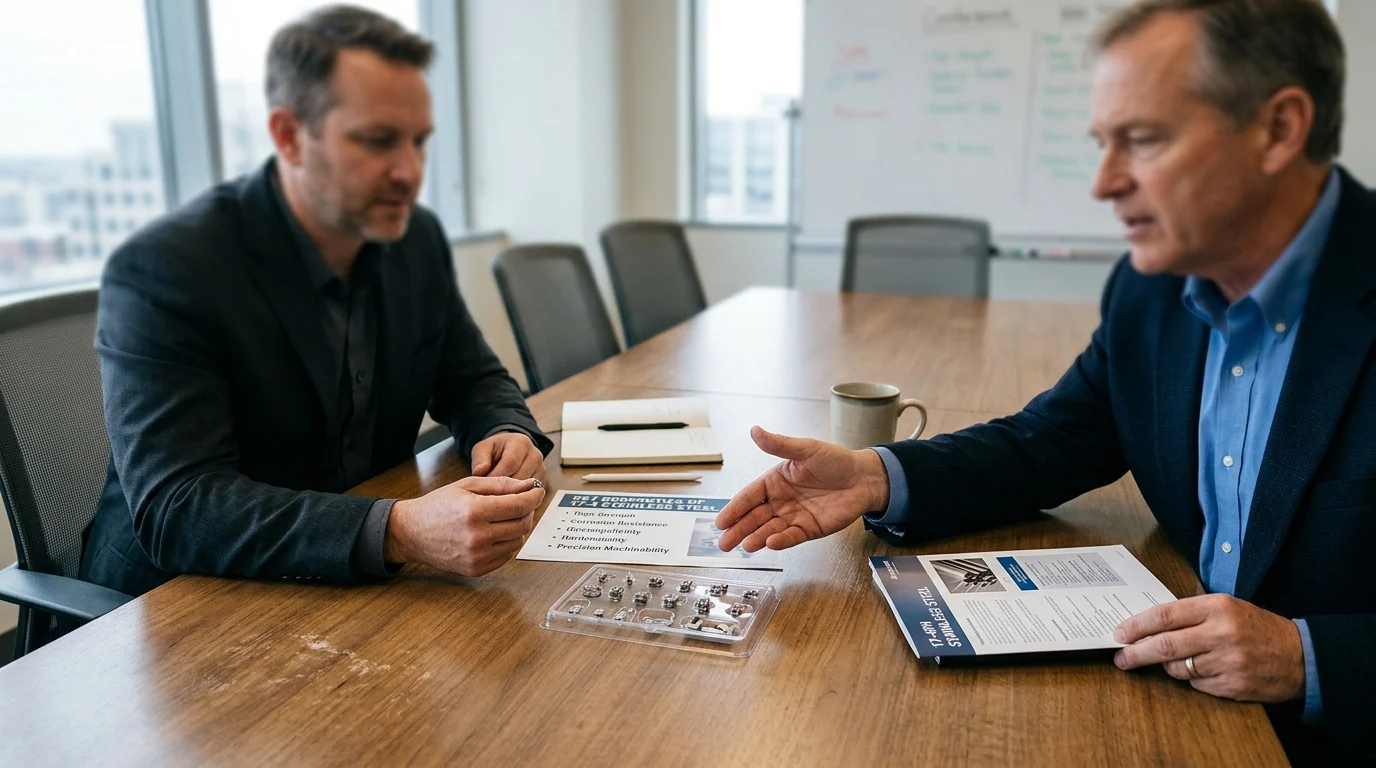
The exceptional performance of 17-4 stainless steel in orthodontics is directly attributed to its specific metallurgical composition and its response to thermal processing. The alloy typically consists of 15.0% to 17.5% chromium, 3.0% to 5.0% nickel, and 3.0% to 5.0% copper, alongside trace amounts of columbium (niobium) and tantalum. This precise blend creates a material that balances the mechanical robustness of martensitic steels with the environmental resilience of austenitic grades.
Understanding these properties is critical for Original Equipment Manufacturers (OEMs) and clinicians alike, as they dictate not only how the bracket performs in the oral cavity but also how it is manufactured, finished, and sterilized.
Strength, hardness, and wear resistance
The mechanical properties of 17-4 stainless steel can be tailored through specific heat treatments. In the H900 condition (aged at 482°C / 900°F for one hour), the material achieves an ultimate tensile strength of up to 1,310 MPa (190 ksi). This extreme strength is coupled with high hardness, which directly translates to exceptional wear resistance.
In the context of orthodontics, wear resistance is paramount. As stainless steel, titanium, or nickel-titanium archwires slide through the bracket slot, friction and mechanical wear can alter the slot dimensions over time. The high hardness of 17-4 minimizes this abrasive wear, preventing the archwire from binding or notching the slot, thereby ensuring low-friction sliding mechanics throughout the typical 18- to 24-month treatment lifecycle.
Corrosion resistance and polishability
The oral environment is highly corrosive, characterized by fluctuating pH levels (often dropping below pH 5.5 after meals), enzymatic activity, and constant moisture. The 15.0% to 17.5% chromium content in 17-4 stainless steel facilitates the formation of a robust, passive oxide layer that protects the underlying metal from oxidation and corrosive attack. While slightly less corrosion-resistant than 316L, 17-4 performs exceptionally well in the mouth, resisting tarnishing and degradation from acidic dietary intake.
Additionally, the density and uniform microstructure of 17-4 make it highly polishable. Manufacturers can utilize mass finishing, electropolishing, or mechanical tumbling to achieve a surface roughness (Ra) well below 0.2 micrometers. This mirror-like finish is crucial for minimizing plaque accumulation, improving patient hygiene, and reducing the coefficient of friction against the archwire.
Relevant standards and specifications
To ensure patient safety and product efficacy, 17-4 stainless steel used in orthodontics must comply with stringent international standards. The most relevant specification is ASTM F899, the Standard Specification for Wrought Stainless Steels for Surgical Instruments, which outlines the exact chemical composition and mechanical requirements for medical-grade 17-4.
Additionally, manufacturers often reference ASTM A564 for the general requirements of hot-rolled and cold-finished age-hardening stainless steel. Compliance with these standards guarantees that the raw material is free from harmful impurities (such as excessive sulfur or phosphorus, capped at 0.030% and 0.040% respectively) and possesses the necessary microstructural integrity to pass ISO 10993-5 (cytotoxicity) and ISO 10993-10 (sensitization) biocompatibility testing.
17-4 Stainless Steel vs Alternative Materials
While 17-4 stainless steel dominates the orthodontic bracket market, it is frequently evaluated against alternative materials such as 316L stainless steel, pure titanium, cobalt-chromium (Co-Cr) alloys, and polycrystalline alumina (ceramic). Each material presents a unique profile of mechanical properties, aesthetic qualities, and manufacturing costs.
Selecting the optimal material requires a careful balancing of clinical efficacy, patient comfort, and economic feasibility. A direct comparison highlights why 17-4 remains the preferred baseline for high-quality metal brackets.
Core comparison criteria
When comparing orthodontic materials, engineers and clinicians focus on yield strength, hardness, friction coefficient, and biocompatibility. Yield strength dictates the bracket’s resistance to deformation, while hardness influences wear and friction. Biocompatibility is assessed based on the material’s potential to trigger allergic reactions, primarily focusing on nickel release.
| Material | Yield Strength (MPa) | Hardness | Friction Coefficient | Nickel Content (%) |
|---|---|---|---|---|
| 17-4 PH Stainless | 1,000 – 1,170 | 40-44 HRC | Low | 3.0 – 5.0 |
| 316L Stainless | 170 – 310 | ~95 HRB | Low-Medium | 10.0 – 14.0 |
| Pure Titanium (Gr 4) | 480 – 650 | ~30 HRC | High | 0.0 |
| Polycrystalline Alumina | N/A (Brittle) | >2000 HV | Medium-High | 0.0 |
Performance advantages
Against 316L stainless steel, 17-4 offers more than triple the yield strength, allowing for significantly smaller bracket profiles (mini-twins) without sacrificing durability. When compared to titanium, 17-4 exhibits vastly superior hardness, which prevents the severe archwire binding and notching issues commonly associated with softer titanium brackets.
Furthermore, while ceramic brackets offer superior aesthetics, their inherent brittleness leads to frequent tie-wing fractures and complicated debonding procedures that can damage tooth enamel. 17-4 stainless steel avoids these catastrophic failures entirely, offering a ductile yet highly resilient alternative that guarantees clinical predictability.
Key trade-offs
The primary trade-off associated with 17-4 stainless steel is its nickel content. Although lower than 316L (which contains 10-14% nickel), the 3-5% nickel in 17-4 can still trigger hypersensitivity in susceptible patients. Epidemiological data suggests that approximately 10-15% of the general population has some form of nickel allergy.
For these specific patients, orthodontists must substitute 17-4 brackets with nickel-free alternatives, such as pure titanium or ceramic brackets, despite their mechanical compromises. Additionally, 17-4 brackets lack the highly demanded cosmetic invisibility of clear aligners or lingual ceramic appliances, positioning them strictly as traditional, highly functional biomechanical tools rather than aesthetic solutions.
Manufacturing and Quality Control Considerations
The intricate geometries of modern orthodontic brackets—featuring compound contours, precision torque-in-base angulations, and undercuts for ligation—make traditional subtractive machining highly inefficient. As a result, the industry has widely adopted Metal Injection Molding (MIM) as the standard manufacturing process for 17-4 stainless steel brackets.
MIM combines the design flexibility of plastic injection molding with the structural integrity of wrought metal, but it requires rigorous quality control protocols to ensure the final product meets exacting medical standards.
Forming and heat-treatment methods
The MIM process begins by mixing ultra-fine 17-4 stainless steel powder with a thermoplastic binder to create a feedstock. This feedstock is injected into custom molds to form a ‘green part’ that is approximately 15-20% larger than the final bracket. The binder is then removed chemically or thermally, creating a ‘brown part’, which is subsequently sintered in a high-temperature vacuum or hydrogen furnace at around 1,300°C.
During sintering, the bracket shrinks to its final dimensions, achieving a density exceeding 97% of wrought material (typically >7.5 g/cm³). Following sintering, the brackets undergo precipitation hardening. The most common treatment for orthodontics is Condition H900, where the parts are heated to 482°C for one hour and air-cooled, maximizing their strength and hardness for clinical use.
Inspection, traceability, and compliance
Because the bracket slot dimensions directly control tooth movement, dimensional inspection is a critical phase of quality control. Manufacturers utilize automated optical Coordinate Measuring Machines (CMMs) capable of verifying slot widths and depths with an accuracy down to 2 microns. The industry standard demands defect rates of less than 0.1% (<1,000 PPM) for slot dimension failures.
Traceability is mandated by medical device regulations such as ISO 13485 and FDA 21 CFR Part 820. Every batch of MIM 17-4 brackets must be traceable back to the specific lot of raw metal powder. Compliance documentation includes material test reports (MTRs) validating chemical composition, sintering furnace logs, and post-sintering density checks, which must routinely confirm a final density greater than 7.5 g/cm³.
Supplier qualification steps
For OEMs sourcing 17-4 brackets from contract manufacturers, rigorous supplier qualification is essential. The first step involves auditing the supplier’s MIM capabilities, specifically examining their tooling precision and sintering furnace controls, as temperature variations of even 10°C during sintering can cause unacceptable dimensional warpage.
Buyers must also validate the supplier’s post-processing capabilities. This includes reviewing their tumbling, electropolishing, and passivation processes to ensure the brackets meet the required Ra < 0.2 µm surface finish. Finally, the supplier must provide third-party validation that their finished 17-4 components pass ISO 10993-5 cytotoxicity and sensitization testing, confirming that residual MIM binders have been entirely eliminated.
Cost and Selection Guidance
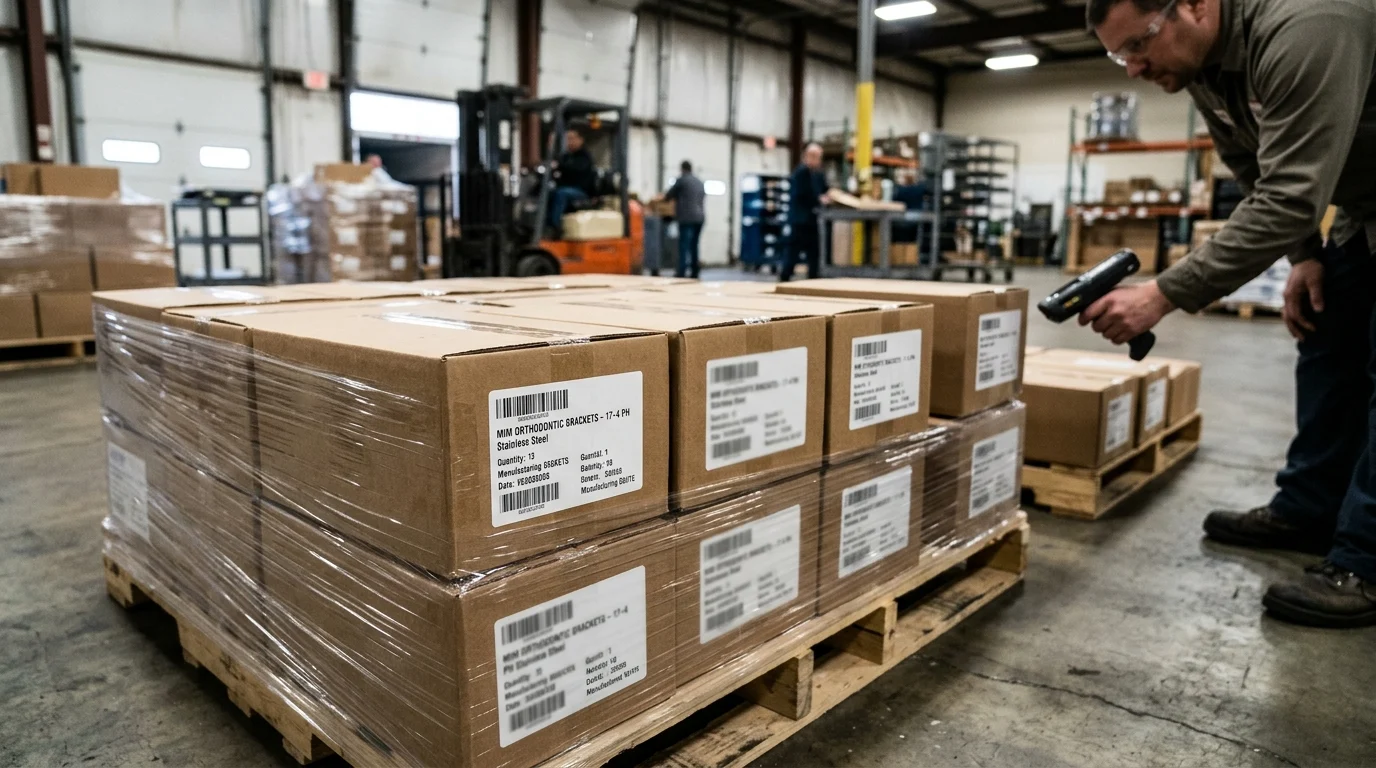
Strategic procurement of 17-4 stainless steel brackets requires an understanding of the cost drivers inherent to the MIM process and the long-term clinical value the material provides. While alternative materials might offer lower raw material costs or niche aesthetic benefits, 17-4 represents the optimal balance of manufacturability, durability, and unit economics.
For dental distributors, OEMs, and clinical buyers, navigating the supply chain for these brackets means evaluating upfront tooling investments against high-volume production savings.
Cost vs long-term value
The raw material cost for 17-4 MIM feedstock generally ranges from $15 to $25 per kilogram. Given that a single orthodontic bracket weighs only a fraction of a gram (typically 0.1 to 0.3 grams), the raw material cost per unit is negligible. The true cost drivers are the injection molding tooling, the energy-intensive sintering process, and the meticulous post-processing required for medical finishes.
| Procurement Metric | Typical Industry Range |
|---|---|
| Raw Material (MIM Feedstock) | $15 – $25 per kg |
| Initial Tooling Investment | $10,000 – $30,000 per mold |
| Typical Minimum Order Quantity (MOQ) | 10,000 – 50,000 units |
| Production Lead Time (Post-Tooling) | 4 – 8 weeks |
| Estimated Unit Cost (at volume) | $0.30 – $1.50 per bracket |
However, the clinical value generated by 17-4 brackets far outweighs their manufacturing costs.
Key Takeaways
- The most important conclusions and rationale for Why 17-4 Stainless Steel is the Best Material Choice for Orthodontic Brackets?
- Specs, compliance, and risk checks worth validating before you commit
- Practical next steps and caveats readers can apply immediately
Frequently Asked Questions
Why is 17-4 stainless steel preferred for orthodontic brackets?
It offers high strength, heat-treatable hardness, and corrosion resistance, helping bracket slots keep their shape and deliver more predictable tooth movement.
How does 17-4 stainless steel compare with 304 or 316L for brackets?
17-4 can be precipitation hardened, so it is much stronger and more wear resistant than common 300-series stainless steels used in lower-stress applications.
What clinical benefit comes from better slot stability?
Stable slot dimensions improve torque expression, reduce deformation with rectangular wires, and help shorten delays caused by inconsistent bracket performance.
Does 17-4 stainless steel help reduce bracket breakage?
Yes. Its rigidity and hardness lower the risk of tie-wing fracture and wear, which can reduce emergency rebonding visits during treatment.
Does Denrotary offer 17-4 stainless steel orthodontic brackets?
Yes. Denrotary features MIM 17-4 stainless steel brackets and manufactures orthodontic products under CE, FDA, and ISO13485 quality systems.

Post time: May-08-2026