

Introduction
By 2026, choosing an orthodontic products supplier is as much a compliance decision as a purchasing one. CE certification now signals more than basic market access: it reflects whether a manufacturer can meet current MDR requirements for safety, documentation, traceability, and ongoing quality control. For clinics, distributors, and procurement teams, that directly affects product availability, audit readiness, and exposure to regulatory risk. This article explains why a CE certified orthodontic products supplier matters in the new regulatory environment, what standards buyers should verify, and how the right partner helps protect both supply continuity and long-term business stability.
Why Choose a CE Certified Orthodontic Products Supplier
The orthodontic manufacturing landscape is undergoing a massive regulatory shift. As procurement teams prepare for 2026, partnering with a reliable CE Certified Orthodontic Products Supplier is no longer just a mark of quality—it is a legal and operational necessity. The transition from the Medical Device Directive (MDD) to the Medical Device Regulation (MDR) in Europe has fundamentally altered how dental products are evaluated, manufactured, and traced.
Suppliers who fail to meet these stringent standards risk having their products barred from major markets, leading to severe supply chain disruptions for clinics and distributors. Navigating this environment requires a deep understanding of what the CE mark represents today and why securing compliant partnerships is the foundation of long-term commercial success.
Regulatory Pressure and Procurement Expectations
The European Union’s MDR (2017/745) introduced a hard transition period that phases out legacy MDD certificates. By 2026, procurement managers face a critical deadline: any orthodontic product entering the European market—and many international markets that benchmark against EU standards—must be fully MDR compliant. This regulatory pressure has forced distributors to audit their supply chains aggressively.
Procurement expectations have shifted from basic cost-negotiation to rigorous compliance verification. Buyers now expect a CE Certified Orthodontic Products Supplier to provide comprehensive traceability for every batch of brackets, wires, and elastomers. Failure to secure compliant suppliers exposes distributors to a 100% risk of customs seizures and stockouts. Consequently, global procurement teams are consolidating their vendor lists, dropping manufacturers who cannot prove their readiness for the 2026 regulatory cliff.
Why CE Certification Matters
The CE mark is far more than a passport to the European market; it is a globally recognized indicator of clinical safety and consistent manufacturing quality. For orthodontic devices, which remain in a patient’s mouth for 18 to 24 months, material safety, biocompatibility, and biomechanical precision are non-negotiable. A valid CE certification confirms that a manufacturer adheres to these high standards through an audited Quality Management System (QMS).
Working with a certified manufacturer directly impacts the bottom line by reducing clinical failures. Facilities operating under CE-compliant QMS typically report product defect rates below 0.5%, compared to non-certified manufacturers where defect rates can easily exceed 3.0%. To understand the operational background of compliant manufacturers, buyers can review the corporate infrastructure and quality commitments detailed on a supplier’s about us page. Ultimately, the CE mark safeguards the patient’s health and the distributor’s reputation.
What Defines a CE Certified Orthodontic Products Supplier

Identifying a genuine CE Certified Orthodontic Products Supplier requires looking past marketing claims and examining the manufacturer’s regulatory documentation. Under the new regulatory regime, CE certification is an ongoing process of clinical evaluation and post-market surveillance, not a static achievement.
Procurement professionals must understand the specific classifications of orthodontic products and the corresponding technical files required to maintain compliance. A true certified supplier maintains a state of constant audit readiness.
Required Documents and Product Classification
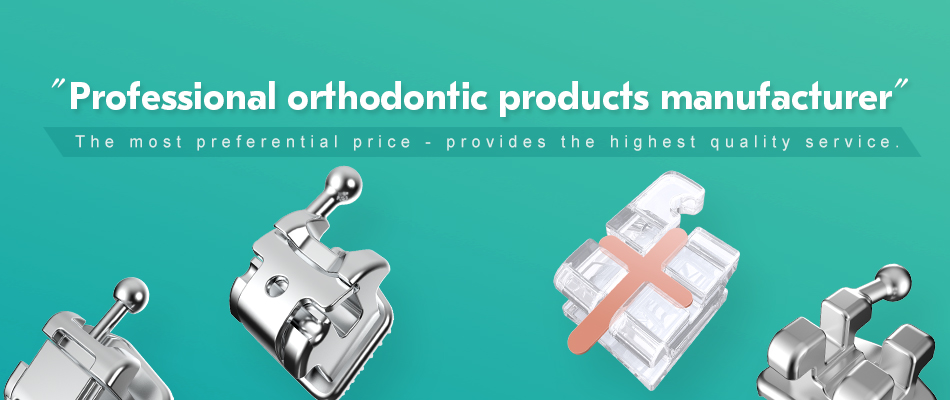
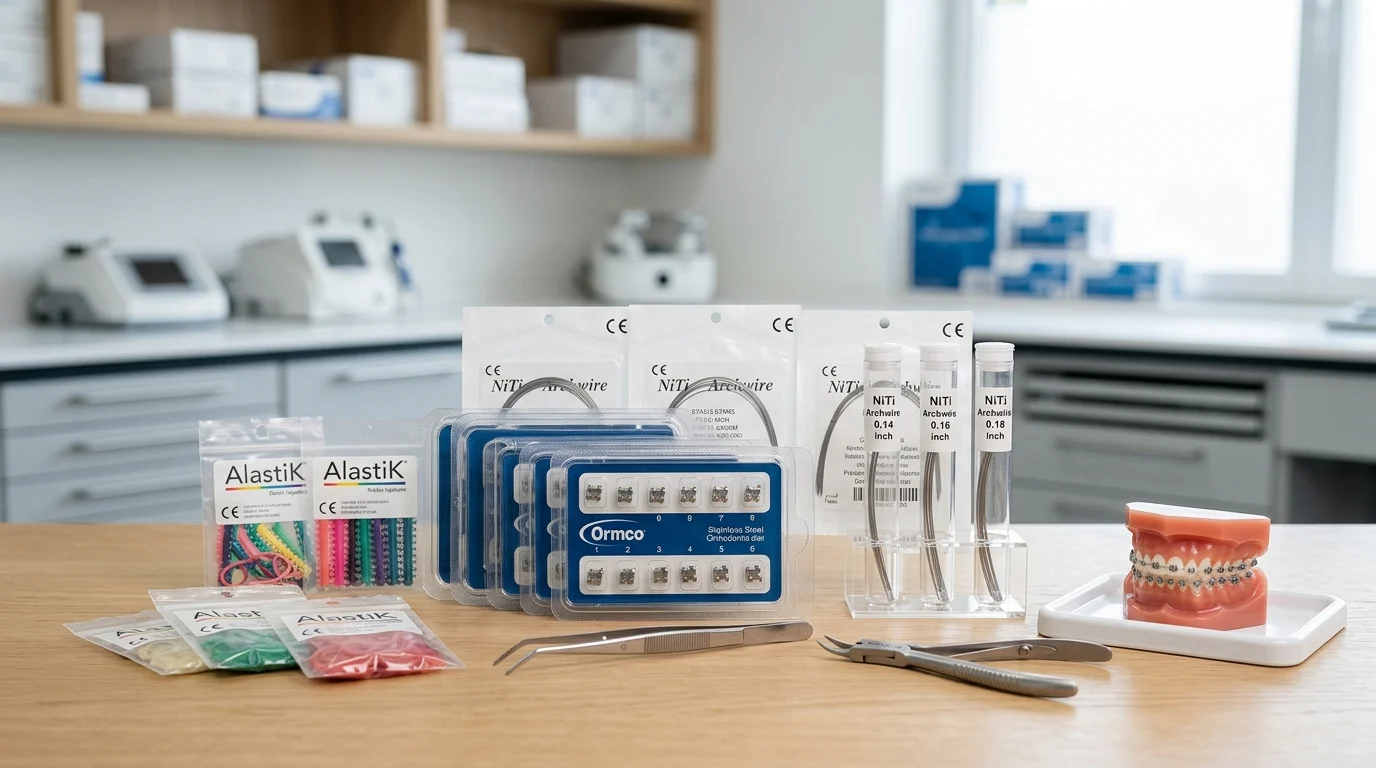
Orthodontic products are categorized based on their invasiveness and duration of use. Most active orthodontic devices, such as metal brackets, ceramic brackets, and nickel-titanium archwires, are classified as Class IIa medical devices. To legally affix the CE mark to a Class IIa device, the supplier must hold a valid ISO 13485:2016 certification and be audited by an accredited European Notified Body.
Buyers must request the manufacturer’s Declaration of Conformity (DoC), the Notified Body CE certificate, and the ISO 13485 certificate. A critical verification step is ensuring the specific product categories are explicitly listed in the certificate’s scope.
| Product Category | Typical MDR Classification | Required Documentation Focus |
|---|---|---|
| Orthodontic Brackets | Class IIa | Biocompatibility, shear bond strength, clinical efficacy |
| Archwires (NiTi / SS) | Class IIa | Heavy metal toxicity, continuous force degradation |
| Elastomeric Ligatures | Class I / Class IIa | Cytotoxicity, tear resistance over 30-day intraoral use |
| Orthodontic Instruments | Class I (Reusable) | Sterilization validation, corrosion resistance |
MDR Alignment and Technical Documentation
MDR alignment demands extensive Technical Documentation (Tech File) for every product family. Unlike the older directives, MDR requires proactive Clinical Evaluation Reports (CER) and continuous Post-Market Clinical Follow-up (PMCF). A compliant CE Certified Orthodontic Products Supplier must prove that their devices perform exactly as intended without compromising clinical safety.
This means the supplier must have dedicated regulatory affairs personnel actively updating risk management files according to ISO 14971:2019. When exploring products from a prospective supplier, buyers should inquire about the availability of Summary of Safety and Clinical Performance (SSCP) documents, which are now mandatory for higher-risk devices and heavily scrutinized during Notified Body audits.
How to Compare CE Certified Orthodontic Products Suppliers
Once a shortlist of certified manufacturers is established, the next step is differentiating between them based on operational excellence and commercial viability. Two suppliers may hold identical CE certificates but offer vastly different procurement experiences.
Comparing suppliers requires a holistic approach that weighs manufacturing capacity, technological capabilities, and the true cost of importing and distributing the devices over their entire lifecycle.
Key Evaluation Criteria
When evaluating a CE Certified Orthodontic Products Supplier, key criteria include production lead times, technological infrastructure, and supply chain transparency. A top-tier manufacturer should offer standard production lead times of 30 to 45 days for bulk orders. Anything extending beyond 60 days may indicate capacity constraints or raw material sourcing issues.
Additionally, evaluate their precision manufacturing capabilities. Advanced suppliers utilize CNC milling with tolerances of +/- 0.02 mm for bracket slots and Metal Injection Molding (MIM) technology to ensure single-piece bracket integrity. Requesting capability matrices and machinery lists can help verify if the supplier actually manufactures the goods or simply subcontracts the production to unverified third parties.
Cost of Ownership and Clinical Reliability
Procurement teams often make the mistake of focusing solely on the initial unit price. However, the Total Cost of Ownership (TCO) is a far more accurate metric. For example, a non-certified or poorly manufactured bracket might cost $0.50 per unit, while a premium CE-certified bracket costs $0.85. If the cheaper bracket suffers from a 4% base debonding rate—leading to extra chair time, emergency patient visits, and reputational damage—the true cost of the cheaper bracket far exceeds the $0.35 initial savings.
Clinical reliability directly influences distributor profitability. A reliable supplier provides consistent torque and angulation in their prescriptions, ensuring predictable clinical outcomes for orthodontists. By factoring in defect rates, return merchandise authorizations (RMAs), and regulatory compliance costs, the higher initial investment in a verified CE supplier consistently yields a lower TCO over a 12-to-24-month procurement cycle.
How to Assess Quality and Supply Chain Stability
Verifying documentation is only the first phase of risk management. Assessing the ongoing quality control processes and the financial stability of the supply chain ensures that the manufacturer can deliver consistent batches month after month.
A robust assessment methodology protects distributors from unexpected production halts, substandard material substitutions, and unfavorable commercial disputes.
Supplier Verification Steps
Supplier verification should begin with a direct check of the Notified Body. Every valid CE certificate for Class IIa and higher devices includes a 4-digit Notified Body identification number. Procurement teams must cross-reference this number on the European Commission’s NANDO database to ensure the auditing body is authorized to certify dental products.
Following certificate verification, buyers should request a virtual or physical site audit. This audit should evaluate incoming raw material inspection, in-process quality control (IPQC), and final outbound lot release testing. A legitimate CE Certified Orthodontic Products Supplier will maintain meticulous batch records, retaining samples of every lot for a minimum of 5 to 10 years, depending on the device’s shelf life.
Commercial Terms and MOQ Review
Commercial terms are a strong indicator of a supplier’s operational maturity. Standard Minimum Order Quantities (MOQs) in the orthodontic sector typically range from 500 to 2,000 sets for standard brackets, and up to 5,000 units for custom OEM packaging. Exceptionally low MOQs might suggest the supplier is pulling from stagnant inventory rather than executing fresh production runs.
Payment terms also reflect supply chain stability. An established manufacturer usually operates on a standard 30% advance payment via T/T, with the remaining 70% due prior to shipment after quality inspection reports are provided. To discuss specific procurement requirements, MOQs, and custom contract terms, buyers are encouraged to reach out directly via the supplier’s contact us portal.
Common Warning Signs
During the assessment phase, several red flags can indicate a high-risk supplier. The most common warning sign is a mismatch between the company name on the CE certificate and the company name on the commercial invoice, which often reveals unauthorized brokering.
Another severe warning sign is the refusal to share redacted audit reports or an inability to explain their CAPA (Corrective and Preventive Action) procedures. If a supplier claims a 0.0% defect rate, it generally points to a lack of genuine post-market surveillance, as no mass-manufacturing process is entirely immune to statistical variance.
| Assessment Area | Acceptable Standard | Critical Warning Sign (Red Flag) |
|---|---|---|
| Certification | Valid 4-digit NB number on NANDO | Self-certified Class IIa devices |
| Traceability | Laser-marked lot numbers on packaging | Generic packaging with no batch data |
| Facility Audit | Open to third-party ISO audits | Refusal of virtual or physical site visits |
| Raw Materials | Medical-grade 17-4 PH Stainless Steel | Unwillingness to provide material safety data sheets (MSDS) |
Decision Framework for Choosing the Right Supplier
Building a resilient orthodontic portfolio for 2026 requires a structured decision framework that balances regulatory demands with commercial realities. The final choice of a CE Certified Orthodontic Products Supplier dictates the trajectory of a distributor’s market growth.
By systematically analyzing compliance, cost, and risk, organizations can transition from transactional purchasing to strategic manufacturing partnerships.
Balancing Compliance, Cost, and Risk
Effective procurement utilizes a risk matrix to evaluate potential partners. Compliance is a binary requirement—a supplier either meets the 2026 MDR standards or they do not. Once compliance is established, buyers must balance unit costs against supply chain risks, such as geopolitical instability or shipping delays.
Many successful global distributors employ an 80/20 allocation strategy. They allocate 80% of their volume to a primary, highly vetted CE certified manufacturer to secure tiered volume discounts and priority production slots. The remaining 20% is allocated to a secondary certified supplier to maintain leverage and ensure a backup supply line in case of unforeseen disruptions.
Final Selection Criteria
The final selection should hinge on a supplier’s capacity for continuous improvement and innovation. Look for partners who invest in R&D, such as developing self-ligating systems with lower friction coefficients or aesthetic brackets with improved stain resistance.
Furthermore, establish Key Performance Indicators (KPIs) in the supplier agreement. A competitive contract should target a 98% On-Time Delivery (OTD) rate and aim for a 2% year-over-year efficiency gain or cost reduction through process optimization. Choosing a supplier that aligns with these long-term clinical and commercial metrics guarantees a sustainable and profitable product pipeline.
Further reading:
Key Takeaways
- The most important conclusions and rationale for CE Certified Orthodontic Products Supplier
- Specs, compliance, and risk checks worth validating before you commit
- Practical next steps and caveats readers can apply immediately
Frequently Asked Questions
What documents should I request from a CE certified orthodontic products supplier?
Ask for the Declaration of Conformity, CE certificate, ISO 13485:2016 certificate, and proof that your product category is covered in the certificate scope.
Why is MDR compliance so important for orthodontic products in 2026?
By 2026, legacy MDD routes are ending. Non-compliant products may face customs delays, market rejection, and stock shortages for clinics and distributors.
How can I verify if a supplier’s CE claim is genuine?
Check the notified body certificate, confirm validity dates, match product names to the certificate scope, and review the supplier’s quality and company details on denrotary.com/about-us/.
Which orthodontic products usually need CE certification under MDR?
Common examples include metal brackets, ceramic brackets, NiTi archwires, stainless steel archwires, elastomerics, and reusable orthodontic instruments sold into the EU market.
How does working with a CE certified supplier reduce procurement risk?
It improves traceability, supports consistent batch quality, lowers defect risk, and helps prevent regulatory disruptions that can damage your inventory flow and reputation.

Post time: Jun-07-2026