

Introduction
For orthodontic brands, distributors, and clinics, choosing where brackets are made affects far more than unit price. A reliable factory in China can influence product consistency, manufacturing precision, lead times, regulatory readiness, and long-term supply stability. This article explains what actually separates dependable bracket manufacturers from low-cost but risky suppliers, including production technology, quality control, export experience, and communication standards. By the end, readers will have a practical framework for evaluating Chinese orthodontic brackets factories and making sourcing decisions that support both clinical performance and business growth.
Why choose a reliable orthodontic brackets factory in China
The global dental supply chain has increasingly centralized in Asia, with China emerging as the dominant hub for precision dental manufacturing. Selecting a reliable factory in this region is no longer just about aggressive pricing; it is a strategic decision centered on advanced manufacturing capabilities, material science, and scalable output.
Cost control, scale, and product consistency
Modern Chinese manufacturing facilities leverage Metal Injection Molding (MIM) and advanced CNC machining to produce brackets with exacting tolerances. By operating at massive scale, these factories can reduce unit production costs by 30% to 50% compared to Western counterparts without compromising structural integrity. This cost advantage allows distributors and dental brands to maintain healthy profit margins while offering competitive pricing to orthodontic clinics. Furthermore, automated production lines ensure that whether an order is for 1,000 or 100,000 sets, the clinical performance of the brackets remains strictly consistent.
Supplier stability, communication, and export experience
Beyond pure manufacturing capability, the maturity of a supplier’s export operations is critical. Top-tier factories possess over a decade of dedicated export experience, meaning they have deep familiarity with international shipping logistics, customs documentation, and regional market preferences. This stability mitigates supply chain disruptions. Effective communication is also a hallmark of a reliable partner; factories with dedicated, multilingual account managers can resolve technical clarifications in hours rather than weeks, ensuring that product specifications translate perfectly from blueprint to final delivery.
What to evaluate in orthodontic brackets before selecting a supplier
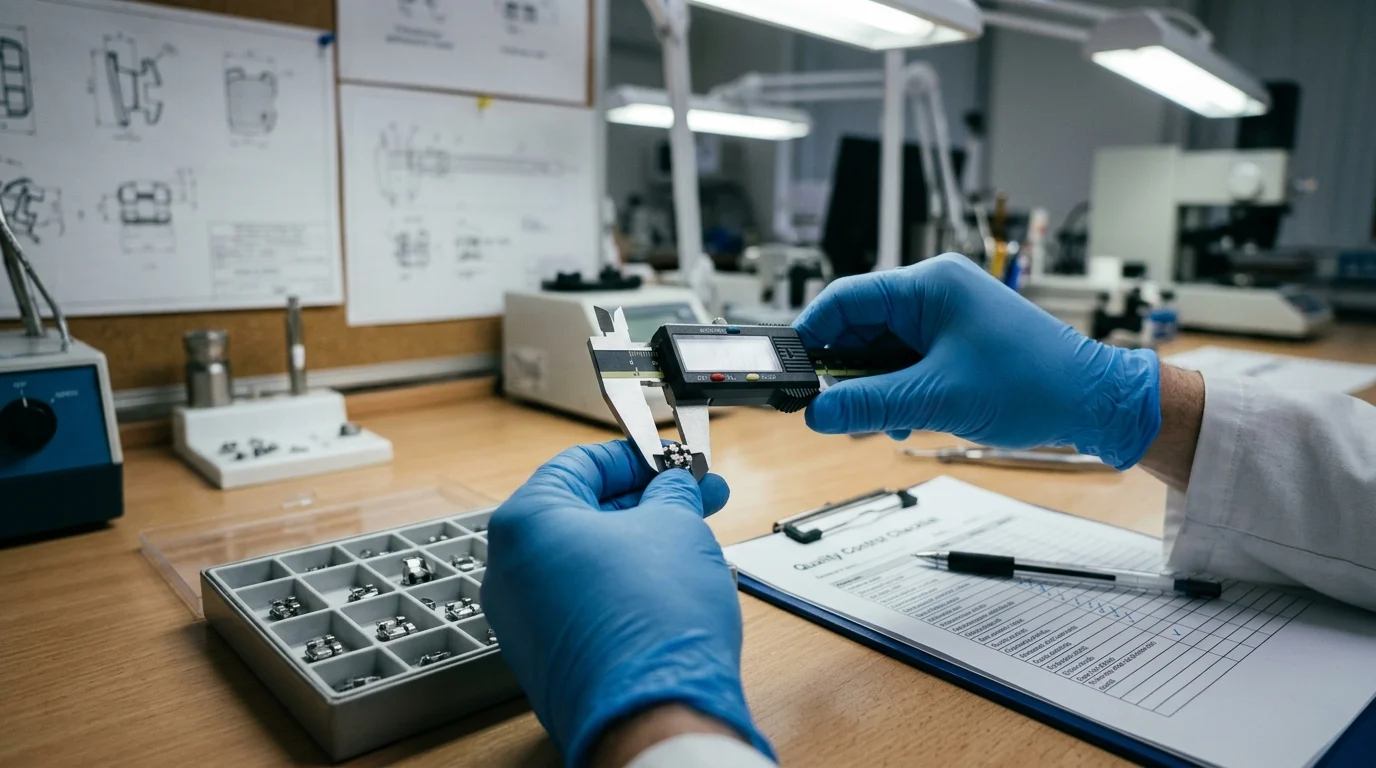
Assessing the technical specifications of dental hardware is the most critical phase of supplier vetting. Distributors must look beyond marketing claims and examine the metallurgical and geometric properties of the products.
Material grade, bracket type, and slot precision
The foundation of any high-quality bracket is its material composition. Industry-standard metal brackets should be forged from 17-4 PH (precipitation-hardening) stainless steel, which offers superior corrosion resistance and tensile strength compared to standard 300-series alloys. For aesthetic options, polycrystalline alumina is preferred for its stain resistance and durability. Slot precision is another non-negotiable metric. Standard systems utilize either 0.018-inch or 0.022-inch slots, and a reliable manufacturer must hold manufacturing tolerances to ±0.001 inches to ensure predictable torque and wire engagement during clinical treatment.
Key comparison points between manufacturers
When comparing different manufacturers, buyers must evaluate base retention technology, profile thickness, and minimum order quantities. A superior bracket typically features an 80-gauge mesh base or a micro-etched surface designed to achieve a shear bond strength of 8 to 12 MPa, significantly reducing clinical debonding rates.
| Feature | Conventional Metal | Ceramic / Aesthetic | Self-Ligating |
|---|---|---|---|
| Primary Material | 17-4 PH Stainless Steel | Polycrystalline Alumina | Advanced Stainless Alloys |
| Typical MOQ | 1,000 sets | 500 sets | 500 – 1,000 sets |
| Slot Tolerance | ±0.001 inches | ±0.002 inches | ±0.001 inches |
| Base Bond Strength | 8 – 12 MPa | 10 – 14 MPa | 8 – 12 MPa |
How a reliable factory demonstrates quality and compliance
In the highly regulated medical device sector, a manufacturer’s commitment to quality control and international compliance dictates their viability as a long-term partner.
Quality systems, inspection, and traceability
Robust quality management systems are the backbone of reliable production. Leading factories implement strict 100% optical inspection protocols for critical dimensions like slot depth and torque angles, ensuring that defect rates remain strictly below the industry benchmark of 0.5%. Traceability is equally vital; every batch must be tracked via unique lot numbers from raw material sourcing through to final packaging. This level of rigorous oversight guarantees that any anomalies can be isolated immediately, protecting both patient safety and the distributor’s brand reputation.
Certifications, registration support, and sterilization control
Navigating the regulatory landscape requires a partner with comprehensive certification portfolios. A dependable factory will maintain active ISO 13485:2016 certification and be capable of providing the extensive technical documentation required for CE MDR compliance in Europe or FDA 510(k) clearance in the United States. Furthermore, if the products are supplied pre-sterilized, the facility must validate its gamma irradiation or ethylene oxide (EtO) sterilization processes. For deeper insights into how a dedicated orthodontic brackets manufacturer structures its regulatory compliance, buyers should request audit reports and documentation packages early in the vetting process.
Sourcing, logistics, and partnership steps for dependable supply
Establishing a seamless supply chain requires a structured approach to sourcing, from the initial qualification of samples to the establishment of steady-state logistics.
Sampling, audits, and minimum order review
The procurement cycle should always begin with rigorous sample testing. Buyers typically request 5 to 10 sets to evaluate slot accuracy, base adhesion, and overall finish. Once clinical viability is confirmed, an audit—either virtual or conducted by a third-party agency—verifies factory capacity and ethical labor practices. Minimum Order Quantities (MOQs) are a critical logistical factor; standard catalog items often require MOQs of 500 to 1,000 sets, while custom OEM designs may demand 2,000 sets or more to offset tooling costs. Standard lead times typically range from 15 to 30 days, heavily dependent on the complexity of the order.
Process for distributors, importers, and dental brands
The operational workflow varies significantly depending on the buyer’s profile. Distributors purchasing off-the-shelf designs prioritize inventory availability and rapid shipping. In contrast, dental brands seeking OEM or ODM services require extensive collaboration on packaging design, private labeling, and bespoke bracket prescriptions. Evaluating standard orthodontic brackets catalogs provides a baseline, but the true test of a supplier is their ability to scale production and integrate with the importer’s specific inventory management systems.
| Sourcing Phase | Typical Duration | Key Buyer Action |
|---|---|---|
| Sample Evaluation | 2 – 3 Weeks | Clinical testing of 5-10 bracket sets for slot accuracy. |
| Factory Audit | 1 – 2 Weeks | Verify ISO 13485 compliance and production capacity. |
| Trial Order | 30 – 45 Days | Monitor lead time adherence on a 500-set minimum order. |
| Volume Production | Ongoing | Establish quarterly forecasting and shipping schedules. |
Decision criteria for choosing the right supplier
Finalizing the choice of a manufacturing partner is a multi-dimensional decision. Relying solely on a single metric, such as unit cost, often leads to supply chain vulnerabilities and compromised clinical outcomes.
Balancing price, quality, compliance, and customization
A successful procurement strategy balances unit price against quality assurance, regulatory support, and customization capabilities. For example, accepting a 10% higher unit cost is a sound investment if it secures a partner with a documented defect rate under 0.5% and full regulatory documentation. Conversely, a supplier offering rock-bottom prices but lacking ISO certifications or exhibiting a 3% bracket failure rate will ultimately cost distributors far more in returns, lost clinic contracts, and damaged reputation. Buyers should formalize these requirements when outlining their orthodontic brackets specifications during initial negotiations.
Why a disciplined selection framework matters
Implementing a disciplined selection framework protects importers from the high costs of switching suppliers mid-cycle. A structured matrix that scores candidates on technical precision, communication speed, financial stability, and scalability ensures an objective decision. Ultimately, the goal is to forge a strategic partnership rather than a transactional purchasing arrangement. Factories that invest in continuous R&D and maintain transparent, data-driven quality control are uniquely positioned to support the long-term growth and market expansion of their global dental partners.
Further reading:
Key Takeaways
- The most important conclusions and rationale for orthodontic brackets
- Specs, compliance, and risk checks worth validating before you commit
- Practical next steps and caveats readers can apply immediately
Frequently Asked Questions
Why choose a reliable orthodontic brackets factory in China?
A reliable Chinese factory can combine lower unit costs with precise MIM/CNC production, stable quality, and export support. This helps distributors scale profitably without sacrificing slot accuracy or batch consistency.
What bracket material should buyers prioritize?
For metal brackets, prioritize 17-4 PH stainless steel for strength and corrosion resistance. For aesthetic cases, polycrystalline alumina is a practical choice because it resists staining and wear.
What slot precision is acceptable for orthodontic brackets?
Standard bracket slots are typically 0.018-inch or 0.022-inch. A dependable supplier should hold tolerances around ±0.001 inches for predictable wire engagement and torque control.
How can buyers verify bracket quality before placing large orders?
Ask for inspection reports, lot traceability, material details, and sample testing. Practical checks include slot measurements, base bond strength, and confirmation of 100% optical inspection on critical dimensions.
Can DenRotary support export and documentation needs?
Yes. Based on the site context, DenRotary highlights export experience, product support, and customs documentation assistance, which can help reduce delays and specification errors during international orders.

Post time: Jun-06-2026