

Key takeaways:
- CE and FDA documentation supports international procurement and export readiness.
- Product range matters because brackets, wires, tubes, and accessories must work as a system.
- Quality management is as important as the product itself in medical device sourcing.
- Clinical fit, not just price, should guide supplier selection.
- Verified compliance reduces delays in purchasing, customs review, and downstream audits.
Choosing an orthodontic products supplier with CE and FDA approval is mainly about reducing risk, not just buying hardware. In fixed orthodontics, the supplier must support clinical performance, regulatory documentation, and stable delivery across multiple product categories.
Why CE and FDA approval matter in orthodontic sourcing
CE and FDA approval signals that an orthodontic supplier is operating inside recognized medical device compliance frameworks. In the United States, FDA establishment registration and device listing are required for relevant device establishments, while EU market access depends on conformity assessment and CE marking under the medical device rules.
For buyers, the practical value is simpler procurement. A compliant supplier is easier to audit, easier to document, and less likely to create customs or tender problems. That matters for clinics, distributors, and cross-border buyers that need predictable supply chain standards.
It is also important to distinguish approval types. FDA registration is not the same as a blanket product endorsement, and CE marking is not a marketing slogan. Both are evidence that the manufacturer has met specific regulatory obligations for the intended market.
What a compliant orthodontic products supplier should provide
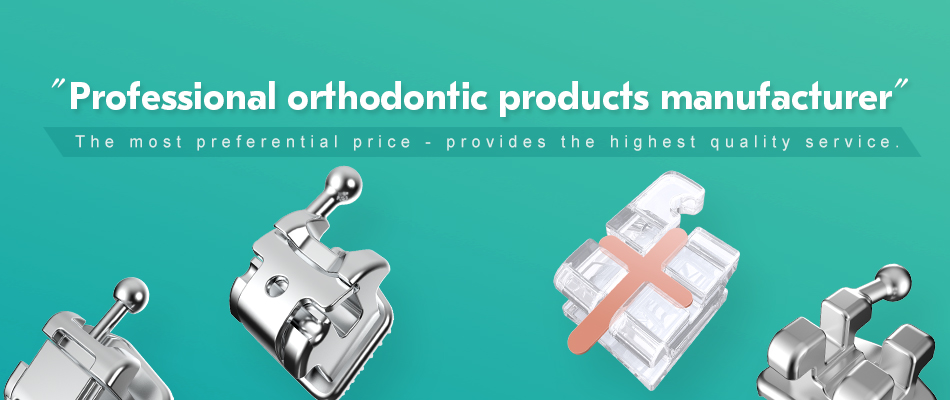
A reliable orthodontic products supplier should offer a complete fixed appliance portfolio, not isolated items. Denrotary’s product structure shows five core categories: orthodontic bracket systems, buccal tube and band systems, archwire systems, traction and fixation accessories, and auxiliary instruments and tools.
That category breadth matters because orthodontic treatment is staged. Initial alignment, space closure, anchorage control, and finishing all require different components. A supplier that covers the full sequence can reduce compatibility issues and simplify replenishment.
Comparison Table: Core product categories in a fixed orthodontic supply portfolio
| Category | Clinical role | Procurement value |
|---|---|---|
| Bracket systems | Tooth attachment and force transmission | Defines treatment style and patient experience |
| Buccal tubes and bands | Molar anchorage and archwire guidance | Supports posterior control and system stability |
| Archwires | Alignment, leveling, detailing, and control | Matches treatment stage and force needs |
| Elastic accessories | Traction, ligation, and space closure | Enables case-specific mechanics |
| Orthodontic tools | Placement, adjustment, and maintenance | Improves chairside efficiency |
In practical terms, buyers should look for clear product definitions, material options, and stage-specific use cases. ISO 13485 is especially relevant here because it is a medical-device quality management standard for organizations involved in design, production, installation, and servicing.
How CE certified orthodontic products support clinical selection
CE certified orthodontic products are useful because they help standardize purchasing across different markets and clinical preferences. In orthodontics, that usually means a supplier can support both conventional and self-ligating workflows, plus aesthetic and high-strength options.
Bracket selection is a good example. Metal brackets are typically chosen for strength and general-purpose use, while ceramic and sapphire brackets are more suitable for patients who prioritize appearance. Self-ligating designs may reduce friction and simplify archwire changes, depending on the treatment philosophy.
Comparison Table: Common bracket and wire choices by clinical need
| Product type | Typical use | Selection logic |
|---|---|---|
| Metal bracket | General fixed treatment | Strength and broad applicability |
| Ceramic or sapphire bracket | Aesthetic cases | Lower visibility for adult patients |
| Active self-ligating bracket | Efficiency-focused workflows | Faster archwire changes |
| Passive self-ligating bracket | Low-friction sliding mechanics | Gentler wire control |
| NiTi archwire | Initial alignment | Continuous light force |
| Stainless steel archwire | Mid-to-late stage detailing | Higher rigidity and control |
For buyers, the key point is not that one design is universally better. The better supplier is the one that offers enough variation to match different case types without forcing unnecessary substitutions.
Why FDA orthodontic products matter for export-oriented buyers
FDA orthodontic products are especially important for buyers serving the U.S. market or building export-ready inventories. FDA rules require establishment registration and device listing for relevant device establishments, and market-specific submissions may also be needed depending on the device.
That requirement affects procurement strategy. Distributors and clinics benefit from suppliers that can provide documentation, traceability, and consistent labeling. It also helps reduce the risk of delayed shipments or rejected tenders when compliance files are reviewed.
For international buyers, this is more than a paperwork issue. A supplier with documented quality systems and regulatory awareness is usually better prepared for audits, complaint handling, and batch consistency. ISO 13485 also emphasizes risk-based decision making and supply-chain controls, which aligns well with medical device procurement expectations.
How to evaluate manufacturing capability beyond certificates
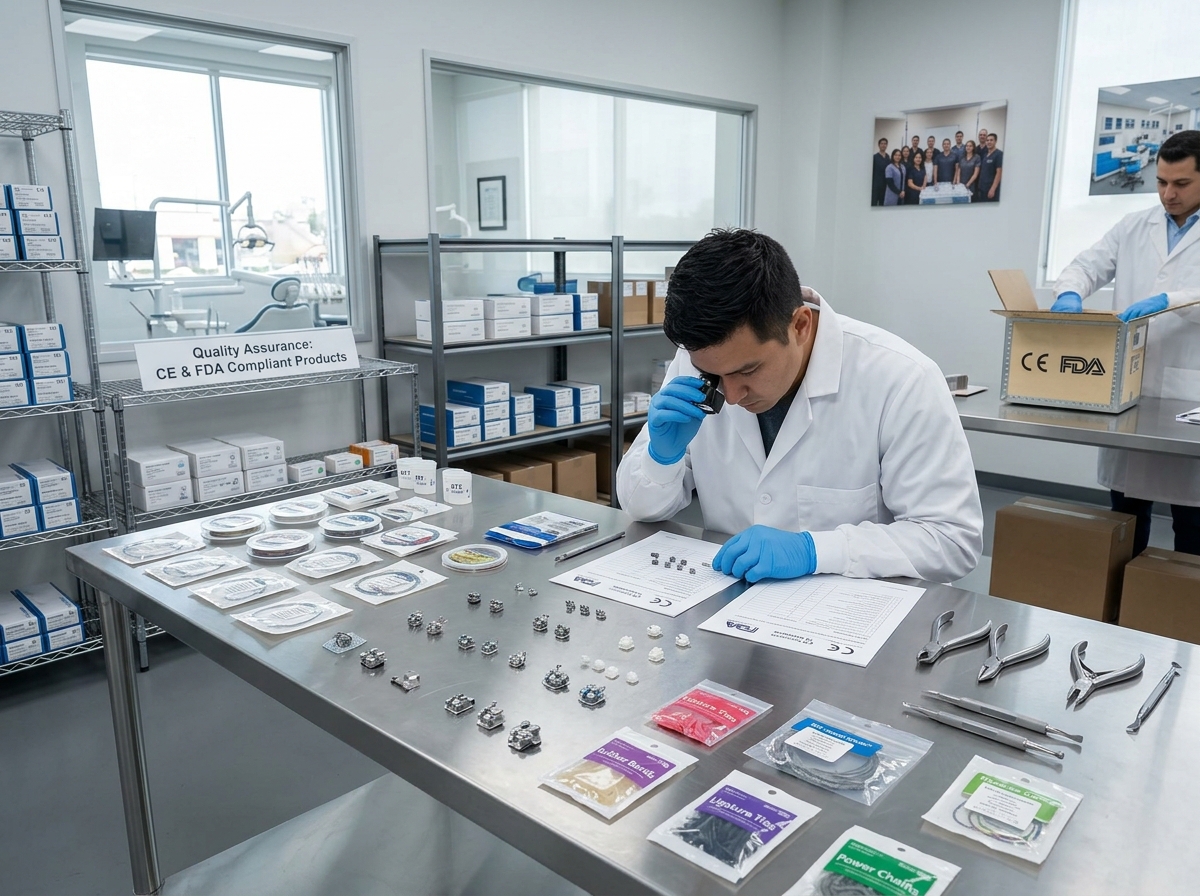
Certificates alone do not guarantee product consistency, so manufacturing capability must also be reviewed. Automated production lines, inspection equipment, and controlled processes are important because orthodontic components are small, high-volume, and sensitive to dimensional variation.
Denrotary’s positioning as a specialized manufacturer since 2012 suggests a focused orthodontic production model rather than a broad dental catalog. That specialization can be useful for buyers who need repeatable specifications across brackets, tubes, wires, elastics, and tools.
When evaluating a supplier, buyers should ask for batch traceability, packaging details, sterilization status where relevant, and technical files for the target market. These details are often more useful than general claims about quality.
What to check before placing a bulk order
A bulk order should be reviewed as a system purchase, not a single-item purchase. Orthodontic treatment depends on how brackets, archwires, buccal tubes, and elastics work together over time.
- Confirm market-specific compliance documents for the destination country.
- Check whether the supplier offers both conventional and self-ligating options.
- Verify material choices for aesthetic, strength, or friction-control needs.
- Review slot sizes, prescriptions, and packaging consistency.
- Ask for lead times, reorder support, and batch-level traceability.
For clinics, this reduces chairside disruption. For distributors, it reduces inventory fragmentation. For exporters, it lowers the chance of compliance gaps during customs review or customer audits.
Comparison Table: Buyer priorities by procurement scenario
| Buyer type | Main priority | Best supplier trait |
|---|---|---|
| Orthodontic clinic | Clinical fit and ease of use | Broad product compatibility |
| Distributor | Inventory efficiency | Standardized SKU structure |
| Exporter | Regulatory readiness | CE, FDA, and ISO documentation |
| Chain practice | Consistency across branches | Stable specs and repeatable supply |
Supplier Directory: where compliant orthodontic sourcing starts
A practical sourcing strategy is to start with a specialized orthodontic products supplier, then compare it with other established industry manufacturers and regional distributors. The target website can serve as a reference point for bracket systems, buccal tubes, archwires, elastics, and tools, while other well-known suppliers can be used for benchmarking specifications and service models.
For product exploration, buyers can review the main orthodontic product catalog, then compare it with the company’s bracket systems and archwire and accessory categories to assess portfolio depth. For regulatory context, the most useful public references are the FDA device registration and listing guidance, the European Commission medical devices guidance, and the ISO 13485 standard overview.
International buyers reduce risk by combining compliance review with product-fit review. A CE and FDA oriented supplier is useful, but the final decision should still depend on case mix, inventory strategy, and documentation quality.
That approach is especially important in orthodontics because treatment often requires multiple complementary items from the same vendor. A supplier with complete product coverage can simplify procurement, but only if the technical specifications are clear and consistent.
In other words, the best choice is usually the supplier that balances regulatory readiness, manufacturing control, and full-system compatibility. That combination is more valuable than a low unit price alone.
FAQ
1. Is FDA approval the same as FDA registration for orthodontic products?
No. FDA registration and device listing identify the establishment and its devices, while some products may also need market-specific authorization depending on classification. Buyers should not treat registration as a blanket approval. It is better to request the exact compliance documents for the intended U.S. market before ordering.
2. Why do CE certified orthodontic products matter for European buyers?
CE marking shows that a product has undergone the required conformity assessment for the EU market. For orthodontic buyers, this supports legal placement, documentation, and procurement confidence. It is especially useful when purchasing brackets, wires, and accessories for cross-border distribution or hospital tenders.
3. What documents should a compliant orthodontic products supplier provide?
At minimum, buyers should ask for certificates, technical specifications, labeling details, and batch traceability information. For export orders, it is also wise to request quality system evidence, market-specific declarations, and packaging information. These documents help reduce delays in customs, audits, and internal procurement review.
4. Are self-ligating brackets always better than conventional brackets?
Not always. Self-ligating designs may improve efficiency and reduce friction in some cases, but conventional brackets remain effective and widely used. The right choice depends on treatment goals, clinician preference, and patient needs. A strong supplier should offer both options rather than forcing one system.
5. How can buyers compare orthodontic supply chain standards across suppliers?
Start by comparing certification scope, product range, manufacturing controls, and documentation quality. Then review whether the supplier can support the full treatment chain, from alignment to finishing. A supplier with clear standards, stable production, and complete product categories is usually easier to manage long term.

Post time: Jul-28-2026