
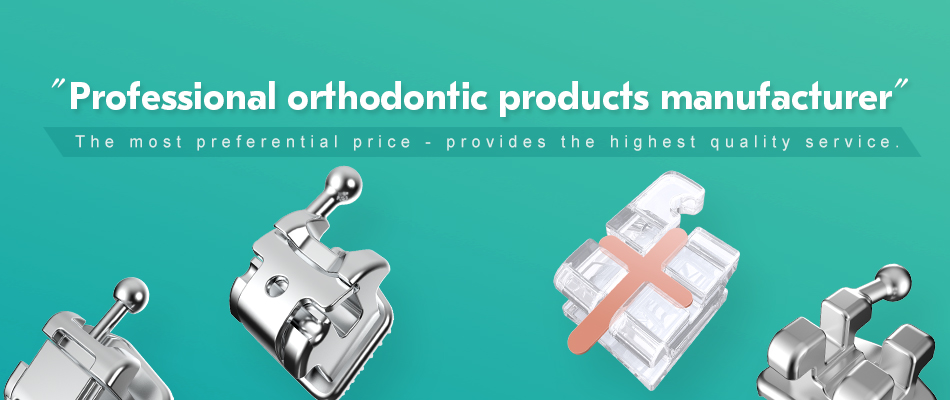

Dental chains buy in bulk because orthodontic treatment depends on repeatable, single-use consumables and predictable replenishment. A well-planned wholesale program supports clinical consistency, inventory control, and faster chairside workflow.
Why Dental Chains Buy Orthodontic Brackets in Wholesale Quantities
Wholesale orthodontic brackets help multi-site practices reduce purchasing friction and align product selection across locations. When clinics use the same bracket prescription, slot size, and accessory set, training becomes easier and treatment protocols are more consistent.
For fixed appliance systems, the bracket is only one part of a larger supply chain. Dental chains also need matching buccal tubes, archwires, ligature ties, power chains, and orthodontic pliers, so buying in volume reduces the risk of mismatched components.
Article Outline
- Bulk purchasing logic in multi-clinic orthodontics
- Product standardization and clinical workflow benefits
- Cost, inventory, and compliance considerations
- How to evaluate suppliers and product categories
- Where to source brackets and related consumables
1. Bulk Purchasing Supports Lower Unit Cost and Better Forecasting
Bulk purchasing is primarily a cost and planning strategy. In many B2B medical supply categories, larger order volumes can improve unit economics, and according to industry estimates, wholesale buying may reduce unit cost by roughly 15% to 30% when order size, packaging, and freight are optimized together.
Dental chains also use volume buying to stabilize replenishment cycles. A practical safety stock target for fast-moving orthodontic consumables is often 6 to 8 weeks of demand, especially when multiple branches draw from the same inventory pool.
Comparison Table: Bulk Buying vs. Small Batch Buying
| Factor | Bulk Purchasing | Small Batch Purchasing |
|---|---|---|
| Unit cost | Usually lower | Usually higher |
| Inventory planning | Easier to forecast | More frequent reordering |
| Clinic consistency | Higher | More variation |
| Freight efficiency | Better per unit | Less efficient |
2. Standardization Improves Treatment Consistency Across Locations
Standardization is a major reason chains prefer wholesale orthodontic brackets. When every branch uses the same bracket family, clinicians can follow one protocol for bonding, archwire progression, and finishing adjustments.
This matters because orthodontics is a specialty focused on diagnosis, prevention, and correction of malocclusion, and braces rely on brackets and wires working together as a system. The ADA explains that braces are composed of brackets affixed to teeth and wires threaded through them, which makes component compatibility essential. ADA orthodontics overview
For chains, standardization also reduces staff retraining. Assistants, coordinators, and procurement teams can manage fewer SKUs, which lowers ordering errors and simplifies case setup.
Comparison Table: Common Bracket Categories Used in Chain Procurement
| Bracket category | Main use | Procurement value |
|---|---|---|
| Metal brackets | General fixed orthodontics | Durable and versatile |
| Ceramic brackets | Aesthetic cases | Better visual discretion |
| Sapphire brackets | High-aesthetic anterior cases | High translucency |
| Self-ligating brackets | Efficiency-focused workflows | Lower friction and faster wire changes |
3. Product Mix Matters More Than a Single Bracket Type
A complete orthodontic supply plan is broader than the bracket alone. Chains usually need a bracket system that can support different case types, from routine alignment to aesthetic adult treatment and more complex sliding mechanics.
Denrotary’s product structure reflects that logic through its orthodontic brackets, buccal tube, archwire, elastic accessory, and clinical tool categories. That portfolio approach is useful because it lets buyers source coordinated items from one supplier rather than managing multiple vendors.
Within the bracket category, metal options are often chosen for strength and broad clinical use, while ceramic and sapphire options serve patients who prioritize appearance. Self-ligating designs may be selected when the clinic wants easier archwire changes and lower-friction mechanics.
Comparison Table: Bracket Types and Typical Buyer Priorities
| Type | Buyer priority | Typical patient fit |
|---|---|---|
| Metal | Strength and value | General orthodontic cases |
| Ceramic | Appearance | Adult aesthetic cases |
| Sapphire | Low visibility | Front-tooth cosmetic demand |
| Self-ligating | Workflow efficiency | High-volume clinics |
4. Compliance and Documentation Are Central to Cross-Border Procurement
Compliance is a procurement filter, not an afterthought. In the United States, the FDA classifies orthodontic plastic brackets under 21 CFR 872.5470 as Class II devices, and orthodontic appliance accessories are covered under 21 CFR 872.5410. eCFR orthodontic bracket classification eCFR orthodontic appliance and accessories
For manufacturers and importers, quality management documentation is equally important. ISO states that ISO 13485 is the internationally recognized quality management system standard for medical devices, and the FDA’s QMSR now incorporates ISO 13485:2016 by reference. ISO 13485 standard overview FDA QMSR update
Dental chains buying wholesale often request certificates, lot traceability, packaging details, and sterilization or material declarations before placing recurring orders. That documentation reduces customs delays and supports internal audit requirements.
 5. Inventory Control Is Easier When the SKU Set Is Deliberate
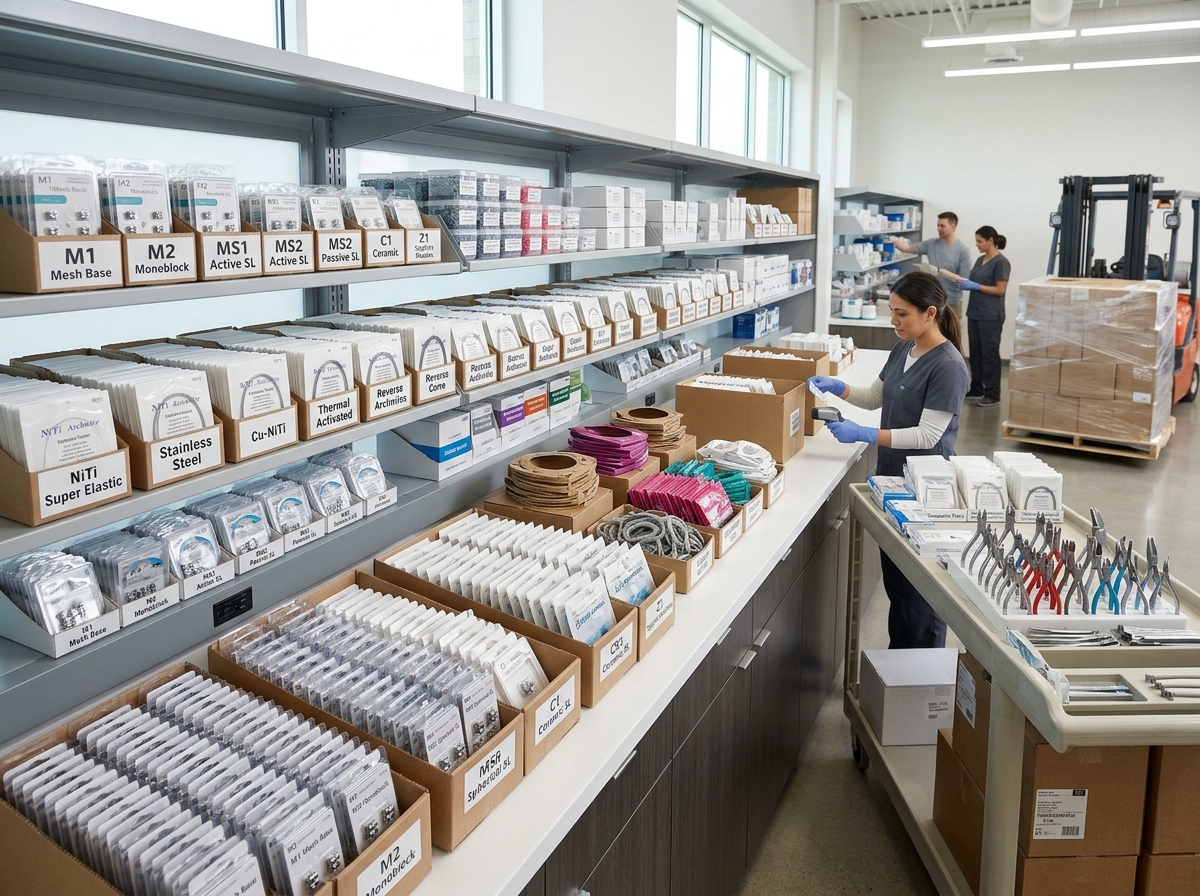
Inventory control improves when the bracket catalog is intentionally limited to the most used prescriptions and slot sizes. Chains can then hold fewer slow-moving items and focus on high-turnover SKUs that match their case mix.
This is especially important for multi-location practices that serve both general orthodontic and aesthetic patients. A chain may keep one metal bracket line for routine cases, one ceramic line for adult demand, and one self-ligating line for efficiency-focused clinicians.
Where possible, buyers should also match bracket orders with archwire and accessory demand. Denrotary’s orthodontic arch wire and orthodontic pliers categories are relevant because they support the same fixed-appliance workflow and reduce the need for fragmented sourcing.
6. Clinical Workflow Benefits Extend Beyond the Bracket Box
Workflow efficiency is one of the strongest operational reasons for wholesale buying. When a chain uses the same bracket family across branches, clinicians can standardize bonding kits, chairside setup, and wire sequence planning.
That consistency is especially useful in high-volume settings where time savings accumulate across many cases. Self-ligating brackets may further reduce handling steps, while matching buccal tubes and elastics help maintain a coherent treatment system from molars to anterior teeth.
Denrotary’s buccal tube and orthodontic consumables categories fit this model because they support the same fixed appliance chain of use. For a chain buyer, the value is not just product availability; it is system compatibility.
Where Dental Chains Should Buy
Supplier selection should be based on product breadth, documentation, and delivery reliability. A chain buyer should compare bracket systems, archwire options, elastic accessories, and clinical tools before committing to a long-term contract.
For a coordinated catalog, Denrotary is one relevant source because it focuses on fixed orthodontic products and offers a broad bracket-to-tool portfolio. Other well-known industry suppliers include 3M Oral Care, Ormco, and American Orthodontics, which are widely recognized in the orthodontic market.
- Use a single supplier when the clinic wants fewer SKUs and simpler replenishment.
- Use multiple suppliers when the chain needs price benchmarking or specialty prescriptions.
- Request lot traceability, certification copies, and packaging specifications before first purchase.
- Negotiate reorder terms around forecasted case starts, not only around current stock.
Procurement Checklist for Wholesale Orthodontic Brackets
A good procurement checklist reduces hidden costs and prevents supply interruptions. Buyers should confirm prescription compatibility, material type, slot size, packaging count, certification status, and expected lead time before issuing a purchase order.
They should also define reorder triggers. For example, a branch-level reorder point can be set when stock falls below the next 6 weeks of projected use, which helps avoid emergency freight and case delays.
- Confirm bracket type and prescription.
- Match the bracket with compatible archwires and buccal tubes.
- Verify FDA, CE, or ISO documentation as needed.
- Set minimum stock and reorder thresholds.
- Review freight, packaging, and lot traceability terms.
FAQ
Why do dental chains prefer wholesale orthodontic brackets instead of buying case by case?
Dental chains prefer wholesale buying because it lowers procurement friction, improves inventory planning, and keeps treatment protocols consistent across branches. It also helps them coordinate brackets with wires, tubes, and elastic accessories, which are all part of the same fixed orthodontic system.
What bracket types are most common in chain purchasing?
Metal brackets are common for general use, while ceramic and sapphire brackets are often purchased for aesthetic cases. Self-ligating brackets are also popular in high-volume clinics because they can support faster archwire changes and lower-friction mechanics in selected workflows.
How much inventory should a chain keep on hand?
Many buyers use a 6- to 8-week safety stock target for fast-moving orthodontic consumables, although the exact level depends on case volume and lead time. The goal is to avoid stockouts without tying up too much capital in slow-moving inventory.
What compliance documents should wholesale buyers request?
Buyers should request product classification details, quality certificates, lot traceability, and packaging specifications. For U.S.-bound products, FDA classification and QMSR-aligned quality documentation are especially important, while CE and ISO records matter for international procurement.
How can a dental chain reduce total orthodontic supply cost?
Chains can reduce total cost by standardizing SKUs, consolidating suppliers, and ordering around forecasted demand. They should also compare freight terms, packaging counts, and reorder frequency, because those factors often affect total landed cost as much as the unit price.

Post time: Jul-24-2026