

Introduction
By 2026, orthodontists increasingly choose self-ligating brackets because they address two constant demands at once: efficient treatment workflows and a better patient experience. Unlike traditional brackets that rely on elastic ties, these systems use built-in clips or doors to secure the archwire, reducing friction, shortening adjustment appointments, and simplifying routine visits. This article explains the clinical and practical reasons behind that preference, including how self-ligating brackets can influence chair time, hygiene, force control, and overall treatment management. With that context, the discussion can move into why this bracket design has become a standard consideration in modern orthodontic practice.
Why Self-Ligating Brackets Matter in Orthodontics
The landscape of orthodontics has fundamentally shifted by 2026, prioritizing systems that maximize clinical efficiency without compromising patient outcomes. At the center of this transformation is the widespread adoption of self-ligating brackets, which eliminate the need for elastomeric ligatures in favor of built-in mechanical doors or clips. This evolution in hardware design addresses both the biological imperatives and operational realities of modern dental practices.
Patient Expectations and Chair Time Pressure
Orthodontic practices face unprecedented pressure to optimize chair time while meeting high patient expectations for comfort and aesthetics. Traditional elastomeric ties degrade over time, losing up to 50% of their initial force within 24 hours, whereas self-ligating systems maintain consistent, low-friction mechanics throughout the treatment phase. By eliminating the manual placement and removal of individual o-rings, clinicians can reduce archwire change times by 20% to 30%, saving an average of two to three minutes per patient arch during routine adjustments.
Market Factors Driving Adoption
From a market perspective, the financial dynamics of running a high-volume clinic necessitate faster throughput and fewer emergency visits. Industry data indicates the self-ligating bracket market continues to grow at a steady compound annual growth rate (CAGR) of over 8.5%. Clinics adopting these systems report a measurable decrease in unscheduled appointments caused by broken or discolored elastic ties. This directly improves their bottom line, allowing practitioners to scale operations efficiently while maintaining high standards of care.
What Self-Ligating Brackets Are
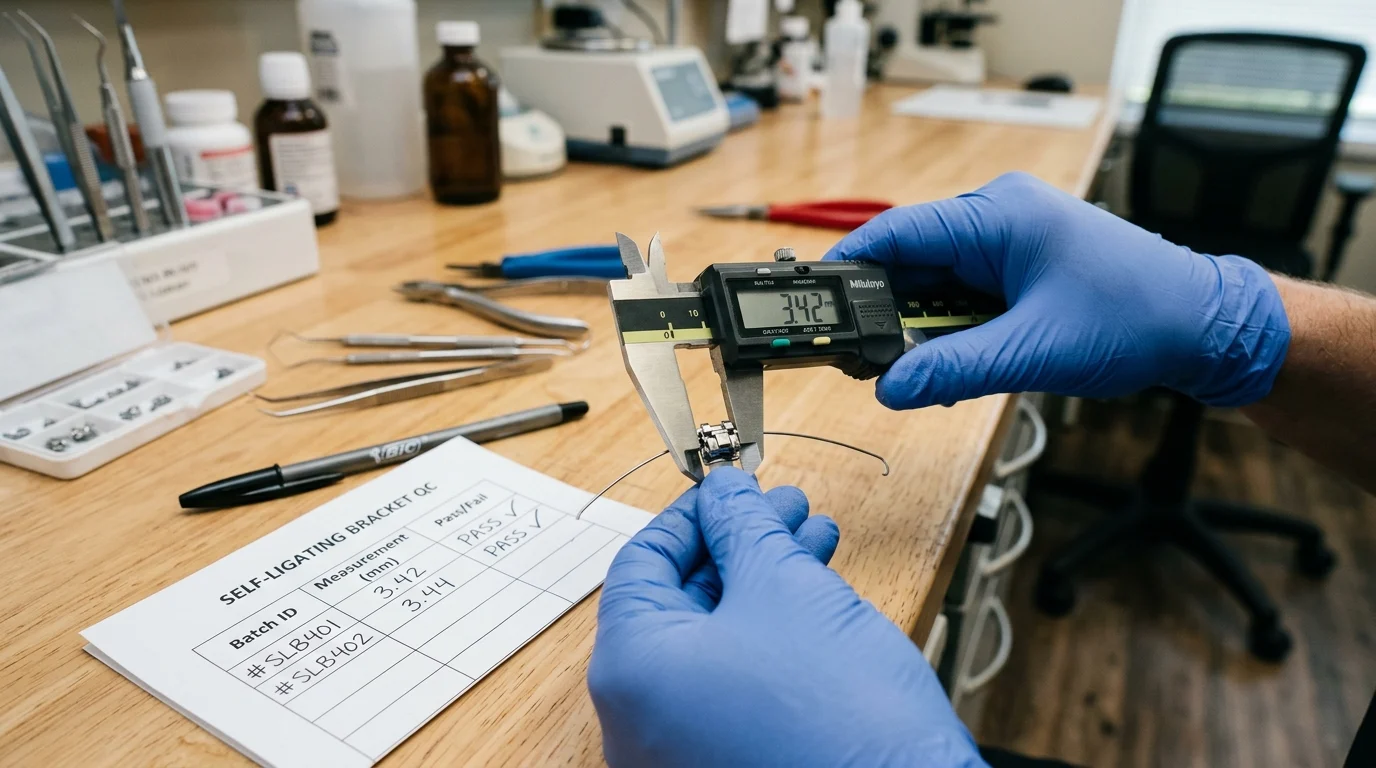
Understanding the mechanical advantages of modern orthodontic hardware requires a close look at the bracket interface. Unlike legacy systems that rely on external materials to secure the archwire, self-ligating brackets feature an engineered structural housing that transforms how force is applied to the dentition.
How They Work vs Conventional Brackets
Conventional brackets utilize elastomeric or metal ties that press the wire into the slot, creating a high-friction environment that resists tooth movement. In contrast, self-ligating brackets use a sliding door or spring clip mechanism. This design creates a tube-like structure that allows the archwire to slide freely, reducing initial friction by 40% to 60% compared to traditional tied brackets. The result is a more biological approach to tooth movement, where lighter, continuous forces can achieve alignment without overpowering the periodontal ligament.
Passive vs Active Bracket Designs
The self-ligating category is further divided into two primary mechanical designs: passive and active. Passive brackets feature a rigid door that does not press against the archwire, leaving clearance within standard 0.018-inch or 0.022-inch slots for maximum sliding mechanics during early leveling and aligning. Active brackets use a flexible spring clip that actively seats the wire into the base of the slot as the wire size increases, providing superior torque control during the finishing stages of treatment.
| Bracket Type | Mechanism | Friction Level (Early Stage) | Wire Engagement | Optimal Phase of Treatment |
|---|---|---|---|---|
| Passive Self-Ligating | Rigid sliding door | Very Low (<50g resistance) | Loose in slot | Early leveling and aligning |
| Active Self-Ligating | Flexible spring clip | Moderate (75g-150g resistance) | Pressed into slot base | Finishing, detailing, and torque control |
How Self-Ligating Brackets Compare with Conventional Brackets
When evaluating clinical protocols in 2026, the contrast between self-ligating and traditional elastomeric systems extends far beyond the physical components. The choice of bracket dictates the entire workflow of a patient’s orthodontic journey, impacting everything from biological responses to clinical scheduling.
Key Performance Factors to Evaluate
Performance evaluation centers on the consistency of force application and sliding mechanics. Traditional brackets often subject teeth to heavy, intermittent forces immediately after an adjustment, which taper off rapidly as ligatures decay. Self-ligating systems deliver a continuous, gentle force profile typically ranging between 50 and 150 grams. This continuous low force minimizes hyalinization of the periodontal ligament, theoretically accelerating bone remodeling and allowing for smoother, more predictable tooth movement across complex malocclusions.
Appointment Intervals, Hygiene, and Friction
The elimination of elastomeric ties has profound implications for treatment logistics and oral hygiene. Standard protocols for traditional braces require adjustments every four to six weeks to replace degraded ties. With self-ligating brackets, the mechanical integrity of the clip allows appointment intervals to be safely extended to 8 to 10 weeks. Furthermore, without the porous surface of elastomeric rings to harbor bacteria, patients experience an average 15% reduction in plaque accumulation. This significantly lowers the risk of white spot lesions and gingival inflammation over the course of treatment.
How to Choose the Right Self-Ligating Bracket System
Integrating a new bracket system into a clinic requires careful alignment of clinical objectives with supply chain realities. Transitioning to advanced orthodontic product lines demands strategic planning across both patient case selection and inventory management to ensure seamless adoption.
Case Selection and Archwire Planning
Maximizing the benefits of self-ligation depends heavily on archwire sequencing. Clinicians frequently pair these brackets with advanced Copper NiTi wires, using specific thermal activation thresholds (such as 27°C or 35°C) to deliver precise forces based on the patient’s oral temperature. Because passive systems exhibit more play between the wire and the slot, orthodontists must carefully plan their torque expression. This often involves stepping up to heavier rectangular wires (e.g., 0.019 x 0.025-inch) earlier in the treatment sequence to achieve the desired root angulation.
Procurement, Training, and Manufacturer Support
On the operational side, selecting a vendor involves evaluating unit economics, staff training requirements, and manufacturer reliability. While premium self-ligating brackets command a higher initial unit cost—often ranging from $15 to $30 per bracket compared to $3 to $8 for conventional equivalents—the investment is offset by operational efficiencies. Clinics must also consider Minimum Order Quantities (MOQs), which typically sit between 50 and 100 patient sets for bulk pricing tiers.
| Procurement Metric | Conventional Brackets | Self-Ligating Brackets | Impact on Practice |
|---|---|---|---|
| Average Unit Cost | $3.00 – $8.00 | $15.00 – $30.00 | Higher upfront material cost |
| Typical Bulk MOQ | 100+ sets | 50 – 100 sets | Capital allocation requirements |
| Chairside Inventory | Requires ties/o-rings | Bracket and wire only | Streamlined tray setups |
| Staff Training Time | 2-4 hours | 8-12 hours | Initial learning curve for door/clip mechanics |
When Self-Ligating Brackets Are the Right Choice
Despite the clear mechanical advantages, self-ligating brackets are not a universal panacea for every orthodontic scenario. Discerning when to deploy these advanced systems requires a balanced evaluation of clinical indications and practice management goals.
Best-Fit Patient Profiles and Treatment Goals
These systems excel in specific patient profiles, particularly those requiring significant arch expansion or the resolution of severe crowding (e.g., 5 to 8 millimeters of anterior crowding). Because the low-friction environment allows teeth to slide along the archwire with minimal resistance, clinicians often observe spontaneous arch development that can reduce the need for extractions. Additionally, adult patients with compromised periodontal health are excellent candidates, as the continuous light forces minimize stress on weakened supporting bone structures.
A Decision Framework for Clinical and Business Tradeoffs
Ultimately, the decision to standardize on self-ligating brackets involves calculating the Return on Investment (ROI) of clinical time. If extending appointment intervals and reducing wire change times allows an orthodontist to see two to three additional patients per day, the higher bracket costs are rapidly absorbed by increased clinic revenue. Practices looking to optimize their workflows and explore implementation strategies should seek specialized consultation and support to ensure their chosen system aligns with both their clinical philosophy and long-term business trajectory.
Further reading:
Key Takeaways
- The most important conclusions and rationale for self-ligating brackets
- Specs, compliance, and risk checks worth validating before you commit
- Practical next steps and caveats readers can apply immediately
Frequently Asked Questions
What makes self-ligating brackets different from conventional braces?
They use a built-in clip or door instead of elastic ties, so the archwire slides with less friction and force stays more consistent between visits.
Why do orthodontists prefer self-ligating brackets in 2026?
They cut archwire change time, reduce tie-related breakages, and support efficient, high-volume scheduling while maintaining controlled tooth movement.
Are passive and active self-ligating brackets used for the same treatment stage?
Not usually. Passive designs are favored for early leveling with minimal friction, while active designs help with torque control and finishing.
Do self-ligating brackets help with oral hygiene?
Yes. Without elastic ties, there are fewer plaque-retentive areas and no stained o-rings, making cleaning easier for many patients.
Where can clinics source self-ligating orthodontic products from Denrotary?
Clinics can review bracket and orthodontic product options through Denrotary’s product pages and contact the company directly for specifications and supply details.

Post time: Jun-30-2026