

Introduction
Orthodontic practices in 2026 are choosing self-ligating brackets for reasons that go beyond trend or branding. These systems change how archwires interact with brackets, reduce reliance on elastomeric ties, and can simplify routine adjustments across busy schedules. For clinicians, that means potential gains in chair time, hygiene control, and workflow efficiency; for patients, it often translates into fewer maintenance issues and longer intervals between visits. This article explains why self-ligating brackets have become a practical standard in modern orthodontics, focusing on the clinical, operational, and patient-centered factors that drive their growing preference.
Why Self-Ligating Brackets Matter in Modern Orthodontics
The landscape of orthodontic treatment is undergoing a permanent shift, driven by the demand for clinical efficiency and enhanced patient experiences. As clinics scale their operations in 2026, the reliance on traditional elastomeric ligatures is giving way to more advanced mechanical solutions. Self-ligating systems have evolved from a niche premium offering into a foundational standard for modern practices aiming to optimize their workflows.
By replacing the need for elastic or steel ties with integrated mechanisms, these systems fundamentally alter the biomechanics of tooth movement and the logistics of daily clinic management. Understanding the multifaceted impact of this technology is essential for orthodontists and practice managers evaluating their inventory and clinical protocols.
Patient expectations and chair time efficiency
Modern orthodontic patients prioritize discretion, comfort, and convenience. Traditional systems often require adjustments every 4 to 6 weeks, whereas self-ligating systems allow intervals to be extended to 8 to 10 weeks during the initial leveling and aligning phases. This reduction in appointment frequency aligns perfectly with the expectations of adult professionals and busy families.
Furthermore, the elimination of elastomeric ties reduces chair time significantly. Orthodontists report saving an average of 5 to 10 minutes per archwire change. Over a standard schedule of 40 to 50 patients per day, this efficiency translates into hours of reclaimed clinical time, allowing for more comprehensive consultations or an increased daily patient capacity.
Practice growth and workflow pressures
The operational pressures on dental practices have never been higher, with overhead costs, staffing shortages, and inflation squeezing profit margins. In this environment, workflow optimization is not merely an advantage; it is a necessity for survival and growth.
By standardizing treatment protocols around self-ligating systems, practices can increase their active patient volume by up to 15% without requiring additional clinical staff or operatory space. The simplified wire-engagement process also flattens the learning curve for orthodontic assistants, reducing the time required for training and minimizing the physical fatigue associated with tying conventional steel ligatures.
Market factors shaping adoption
Global supply chain stabilization and the expansion of digital orthodontics have accelerated the adoption of advanced bracket systems. As intraoral scanning and custom-milled wires become standard, the precision of the bracket slot becomes critical to realizing a fully customized digital treatment plan.
Market data indicates that adoption rates for advanced systems have surpassed 60% in high-volume metropolitan clinics. When evaluating self ligating brackets, forward-thinking practices recognize that the initial material investment is quickly offset by the compounding returns of streamlined inventory, reduced chair time, and enhanced clinical predictability.
What Self-Ligating Brackets Are and How They Work
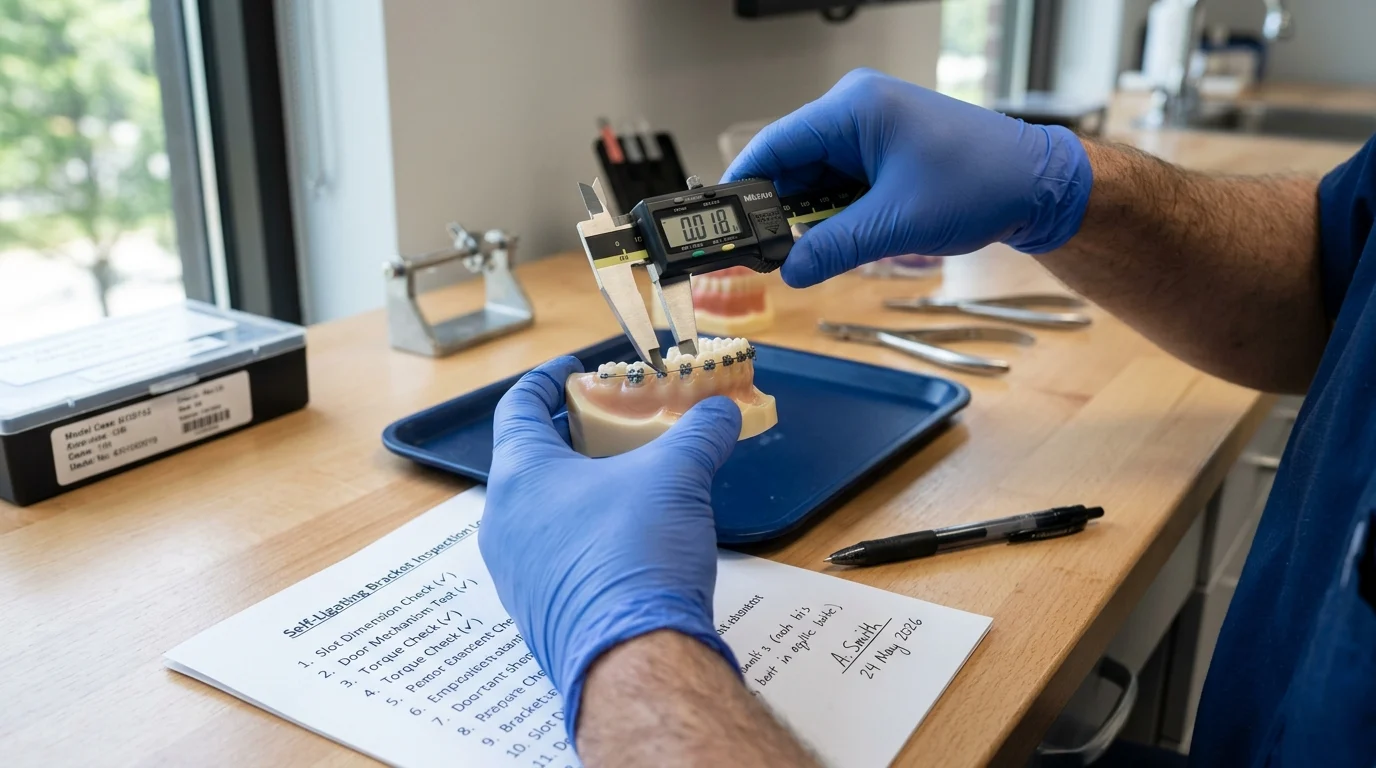
At their core, self-ligating systems eliminate the need for external ligatures by incorporating a mechanical door, clip, or slide directly into the bracket body. This specialized design securely houses the archwire within the slot while fundamentally changing the frictional characteristics of the appliance.
Understanding the mechanical nuances between different proprietary systems is critical for orthodontists who need to predict tooth movement accurately and select the appropriate inventory for their specific clinical philosophy.
Core clinical and mechanical features
The primary clinical advantage of these systems is the reduction of binding and friction, particularly during the initial stages of treatment where light, continuous forces are paramount. Without the compressive force of an elastomeric tie pressing the wire against the base of the slot, teeth can slide along the archwire with significantly less resistance.
Modern self ligating brackets are typically manufactured using metal injection molding (MIM) technology. This allows for highly complex, low-profile designs—often ranging from 2.0mm to 2.5mm in profile height—that maximize patient comfort without sacrificing the structural integrity of the clip mechanism.
Passive vs active bracket systems
Self-ligating systems are broadly categorized into two distinct mechanical philosophies: passive and active. Passive systems utilize a rigid sliding door that converts the bracket slot into a tube. The door does not exert active pressure on the archwire, allowing for maximum freedom of movement and minimal friction during initial leveling.
Active systems, conversely, employ a flexible spring clip that encroaches into the slot. As thicker rectangular wires are introduced in the later stages of treatment, the active clip presses against the wire, seating it fully into the slot to maximize torque and rotational control.
| Feature | Passive Self-Ligating | Active Self-Ligating |
|---|---|---|
| Mechanism | Rigid sliding door | Flexible spring clip |
| Initial Friction | Extremely low | Low to moderate |
| Wire Interaction | Wire sits freely in the slot | Clip presses on larger wires |
| Best Used For | Severe crowding, rapid expansion | Precise finishing, root torque control |
Key technical specifications to compare
When comparing systems, dimensional accuracy is the most critical technical specification. The industry standard slot sizes remain 0.018-inch and 0.022-inch, but the manufacturing tolerance of these slots dictates clinical success. Premium systems maintain strict slot tolerances of ±0.001 inches, ensuring that the prescribed torque and angulation are accurately expressed.
Other vital specifications include the base design, which often features 80-gauge mesh or micro-etched patterns to achieve optimal shear bond strengths of 10 to 15 MPa. Additionally, the opening and closing forces of the clip mechanism must be calibrated; forces exceeding 300 grams can cause patient discomfort during adjustments, while forces below 100 grams risk accidental spontaneous opening during mastication.
Self-Ligating vs Conventional Brackets
The debate between self-ligating and conventional twin brackets centers on the balance between biomechanical efficiency, material costs, and operator control. While conventional brackets have a long history of clinical success, their reliance on external ligatures introduces variables that can complicate treatment trajectories.
By objectively comparing these two modalities across key performance indicators, practice owners can make informed, data-driven decisions regarding their clinical inventory.
Treatment efficiency and archwire performance
Conventional brackets tied with elastomeric rings suffer from rapid force degradation. Studies show that elastomers can lose up to 50% of their initial force within the first 24 hours in the oral environment, and they accumulate plaque and absorb moisture over time. This increases friction and slows down sliding mechanics.
Self-ligating systems bypass this degradation entirely. The rigid or semi-rigid clips maintain consistent slot geometry throughout the treatment interval. This allows for the use of high-technology copper-nickel-titanium (CuNiTi) wires that deliver light, continuous forces over 8 to 10 weeks, resulting in more biologically compatible tooth movement and fewer wire changes.
Cost, learning curve, and trade-offs
The most prominent barrier to adopting advanced systems is the upfront material cost. A standard full-mouth kit of conventional brackets may cost a clinic between $10 and $20, whereas a high-quality self-ligating kit typically ranges from $30 to $60, depending on the manufacturer and materials (metal vs. ceramic).
Additionally, there is a learning curve associated with the proprietary opening and closing instruments required for self-ligating doors. Staff must be trained to handle the mechanisms delicately to prevent clip deformation. However, the trade-off is realized in the reduction of consumable costs (fewer elastomers, fewer wires) and the substantial decrease in required chair time.
When each system is the better choice
No single bracket system is universally superior for every clinical scenario. Conventional brackets remain an excellent choice for cases requiring complex, localized biomechanics where the orthodontist needs to selectively tie teeth with steel ligatures to maintain absolute control over individual tooth torque and rotation.
Conversely, self-ligating systems excel in cases characterized by severe crowding, where arch expansion and minimal friction are the primary goals. They are also the superior choice for practices prioritizing high patient throughput.
| Metric | Conventional Brackets | Self-Ligating Brackets |
|---|---|---|
| Average Kit Cost | $10 – $20 | $30 – $60 |
| Adjustment Interval | 4 – 6 weeks | 8 – 10 weeks |
| Chair Time per Visit | 15 – 20 minutes | 5 – 10 minutes |
| Friction Level | High (with elastomers) | Low to Very Low |
How to Evaluate Clinical and Supplier Fit
Integrating a new bracket system into a clinic’s workflow requires rigorous evaluation of both the clinical product and the manufacturing partner. A system that performs beautifully in a demonstration model must also withstand the harsh, dynamic environment of the human mouth over an 18-to-24-month treatment period.
Procurement managers and clinical directors must look beyond marketing claims, focusing instead on empirical evidence, quality assurance standards, and the logistical reliability of the supply chain.
Evidence, case selection, and failure risks
The primary clinical risk associated with self-ligating systems is mechanical failure of the door or clip. Calculus build-up or aggressive brushing can jam the sliding mechanisms, while improper use of opening instruments can bend or break active clips. A clinically viable system should demonstrate a clip failure rate of less than 2% over the lifecycle of a comprehensive treatment.
Case selection during the initial transition is also vital. Orthodontists should evaluate the system’s performance on mild-to-moderate Class I crowding cases before applying them to complex surgical or extraction cases, ensuring that the anticipated sliding mechanics align with the actual clinical outcomes.
Supplier quality and regulatory review
The regulatory compliance of a supplier is a non-negotiable benchmark for procurement. Quality manufacturers must hold current ISO 13485 certification for medical device manufacturing. Furthermore, depending on the region of practice, the brackets must possess FDA 510(k) clearance in the United States or a CE mark under the European MDR.
When contacting suppliers regarding self ligating brackets, buyers should also inquire about supply chain elasticity and Minimum Order Quantities (MOQ). Standard MOQs for clinical trials might start at 50 kits, while bulk pricing tiers typically activate between 200 and 500 kits. Reliable suppliers will provide detailed metallurgical reports confirming the use of biocompatible materials like 17-4 PH stainless steel.
Pilot testing and implementation steps
A full-scale transition to a new bracket system should never be executed overnight. Clinics should implement a phased pilot testing protocol. Step one involves purchasing 10 to 20 kits and assigning them to a single practitioner to treat a controlled cohort of patients.
During this 6-month pilot phase, the clinical team must rigorously track specific metrics: bond failure rates, the incidence of clip jamming, ease of wire engagement, and patient feedback regarding mucosal comfort. Only after these metrics meet the clinic’s baseline standards should the procurement team authorize a full inventory replacement.
Decision Framework for Choosing a System
The decision to adopt a self-ligating system is ultimately a strategic business calculation intertwined with clinical philosophy. Practice owners must weigh the upfront capital expenditure against the long-term operational efficiencies, aligning the choice with their specific practice model and growth trajectory.
A structured decision framework prevents emotional or purely trend-driven purchasing, ensuring that the chosen appliance system actively contributes to the clinic’s profitability and standard of care.
Best fit by practice profile
The return on investment (ROI) for self-ligating systems varies drastically based on practice volume. High-volume Dental Service Organizations (DSOs) and large group practices seeing upwards of 60 to 80 patients per day stand to gain the most. In these environments, the cumulative hours saved on archwire changes can yield a positive ROI within 6 to 8 months, allowing the practice to absorb more new patient starts.
Conversely, a boutique solo practitioner seeing 20 patients a day may not fully realize the financial benefits of the time saved. For these smaller profiles, the decision framework should lean heavier on clinical preferences, patient comfort marketing, and the desire to extend appointment intervals to improve the clinician’s daily quality of life.
Balancing performance and total cost
Evaluating the Total Cost of Ownership (TCO) requires looking past the invoice price of the bracket kit. TCO encompasses the cost of the brackets, the specialized premium wires required to maximize their efficiency, the proprietary opening instruments, and the reduction in consumable elastomers.
When the reduction in chair time is monetized—calculating the clinic’s hourly overhead rate against the minutes saved per appointment—the higher initial
Further reading:
Key Takeaways
- The most important conclusions and rationale for self ligating brackets
- Specs, compliance, and risk checks worth validating before you commit
- Practical next steps and caveats readers can apply immediately
Frequently Asked Questions
What makes self-ligating brackets different from traditional brackets?
They use a built-in clip or slide instead of elastic ties, reducing friction and simplifying wire changes for faster appointments.
Do self-ligating brackets reduce chair time in busy orthodontic practices?
Yes. Many clinics save about 5–10 minutes per archwire change, which helps increase daily efficiency and patient capacity.
How often are appointments needed with self-ligating brackets?
During early leveling and aligning, visits can often be spaced 8–10 weeks apart instead of the usual 4–6 weeks.
Should a clinic choose passive or active self-ligating brackets?
Choose passive for lower friction in initial alignment, and active when more clip engagement with the archwire fits your treatment approach.
Where can orthodontic practices source self-ligating brackets for workflow optimization?
Practices can review self-ligating bracket options and product details through DenRotary’s product pages to compare fit, profile, and clinic needs.

Post time: Jun-21-2026