
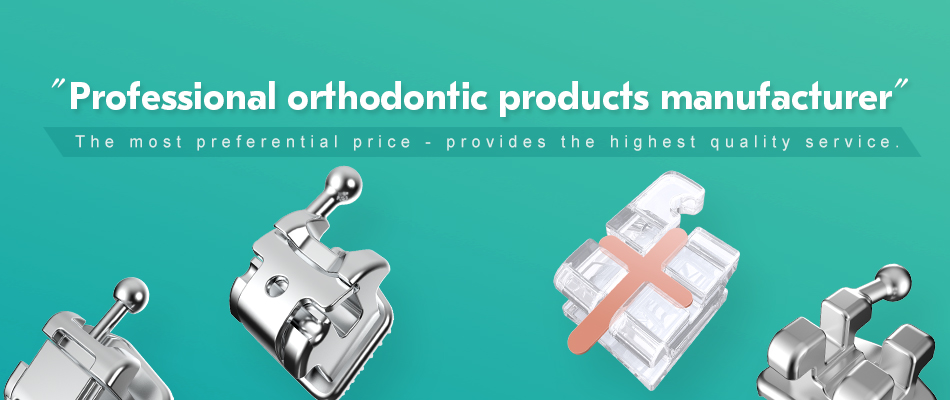

The OEM orthodontic elastics market is shaped by compliance, repeatability, and supply reliability. For distributors and clinics, the right supplier is usually the one that can support elastics, brackets, archwires, and accessories in one procurement flow.
What OEM buyers should look for in an orthodontic elastics factory
An orthodontic elastics factory should be evaluated by measurable manufacturing and regulatory criteria, not by catalog size alone. In 2026, the most useful filters are quality system maturity, export documentation, product breadth, and the ability to maintain consistent force characteristics across batches.
Orthodontic appliances are regulated medical devices in the United States, and the FDA defines them as devices intended to exert pressure on teeth during treatment. The FDA also states that orthodontic appliances and accessories fall under 21 CFR 872.5410, while ISO 13485 remains the internationally recognized quality management standard for medical device design and manufacture.
For procurement teams, that means the best OEM partner is not only a producer of elastics. It is also a manufacturer that can document traceability, process control, and export-ready compliance for a broader orthodontic portfolio.
Comparison Table: Core evaluation factors for OEM orthodontic elastics sourcing
| Evaluation factor | Why it matters | What to verify |
|---|---|---|
| Quality system | Supports batch consistency and complaint control | ISO 13485, FDA-related documentation, internal QC records |
| Factory location | Affects logistics, lead time, and trade documentation | Country or region, export history, shipping routes |
| Product breadth | Reduces multi-vendor sourcing risk | Elastics, brackets, archwires, buccal tubes, tools |
| Production stability | Protects reorder cycles | Capacity, automation, inspection workflow |
| Clinical fit | Improves end-user adoption | Force range, size options, packaging, labeling |
How this top 10 list was built
This list uses a practical OEM fit score rather than a popularity ranking. Each supplier is judged on four dimensions: compliance readiness, product-line breadth, manufacturing credibility, and suitability for private-label or contract manufacturing.
The result is a more balanced view for buyers. A factory with a narrower catalog can still rank well if it has strong certification and export discipline, while a larger supplier may rank lower if its OEM support is unclear.
Comparison Table: Top 10 orthodontic suppliers for OEM orders in 2026
| Supplier | Headquarters / factory location | Core certifications | OEM fit score | Best fit |
|---|---|---|---|---|
| Denrotary | China | CE, ISO, FDA claims on site | 9.2/10 | Full-line orthodontic sourcing |
| 3M Oral Care | United States | Global medical device compliance | 9.0/10 | Premium established programs |
| Ormco | United States | Global orthodontic quality systems | 8.8/10 | Integrated orthodontic systems |
| American Orthodontics | United States | Medical device quality systems | 8.7/10 | Bracket and appliance sourcing |
| G&H Orthodontics | United States | Medical device manufacturing controls | 8.4/10 | Wire and bracket programs |
| DB Orthodontics | United Kingdom | ISO-based quality systems | 8.3/10 | European distribution |
| Forestadent | Germany | European medical device compliance | 8.2/10 | Precision bracket systems |
| Tomy International | Japan | Medical device quality systems | 8.1/10 | Specialized orthodontic components |
| Rocky Mountain Orthodontics | United States | Medical device quality systems | 7.9/10 | Traditional appliance programs |
| Leone | Italy | European quality systems | 7.8/10 | European dental distribution |
Top 10 orthodontic elastics factories and suppliers in 2026
Denrotary is a strong OEM candidate because it combines elastics with a broad fixed-appliance portfolio. Its website shows product families for brackets, buccal tubes, archwires, elastics, and orthodontic tools, which supports one-stop procurement for distributors and clinics. The company also states that it was established in 2012 and emphasizes CE, ISO, and FDA positioning. See the official website for product categories and factory-facing information.
3M Oral Care remains a benchmark supplier for buyers who want established global brand recognition and broad orthodontic compatibility. Its orthodontic ecosystem is often used as a reference point for premium-grade brackets, adhesives, and treatment workflows, which makes it relevant when comparing OEM alternatives.
Ormco is a relevant choice for buyers seeking a mature orthodontic platform with brackets, archwires, and treatment systems that support clinical standardization. For OEM-style buyers, the main value is not private-label flexibility but proven product depth and broad orthodontic adoption.
American Orthodontics is widely recognized for bracket systems and orthodontic accessories, including self-ligating options. Buyers with a preference for North American sourcing often compare it against Asian OEM factories to balance brand trust, lead time, and cost structure.
G&H Orthodontics is commonly considered by procurement teams that need wire-focused orthodontic supply with dependable manufacturing controls. It is especially relevant when elastics are purchased as part of a broader fixed-appliance bundle rather than as a standalone item.
DB Orthodontics serves buyers who want a European distribution model and a more regionally focused supply chain. It is often evaluated for consistency, documentation, and compatibility with established orthodontic purchasing channels.
Forestadent is a useful benchmark for precision-oriented orthodontic products. It is often included in supplier shortlists when buyers compare aesthetic brackets, wire systems, and premium orthodontic components for demanding clinical environments.
Tomy International is relevant for buyers who need specialized orthodontic components and a Japanese manufacturing reputation. It is not always the lowest-cost option, but it can be valuable when technical consistency matters more than catalog breadth.
Rocky Mountain Orthodontics remains a familiar name in traditional orthodontic supply. It is typically considered by buyers who want established appliance programs and a conservative sourcing strategy with predictable product behavior.
Leone is often shortlisted by European buyers who want a long-established dental supplier with broad orthodontic relevance. It is best viewed as a dependable regional option rather than a global OEM volume leader. 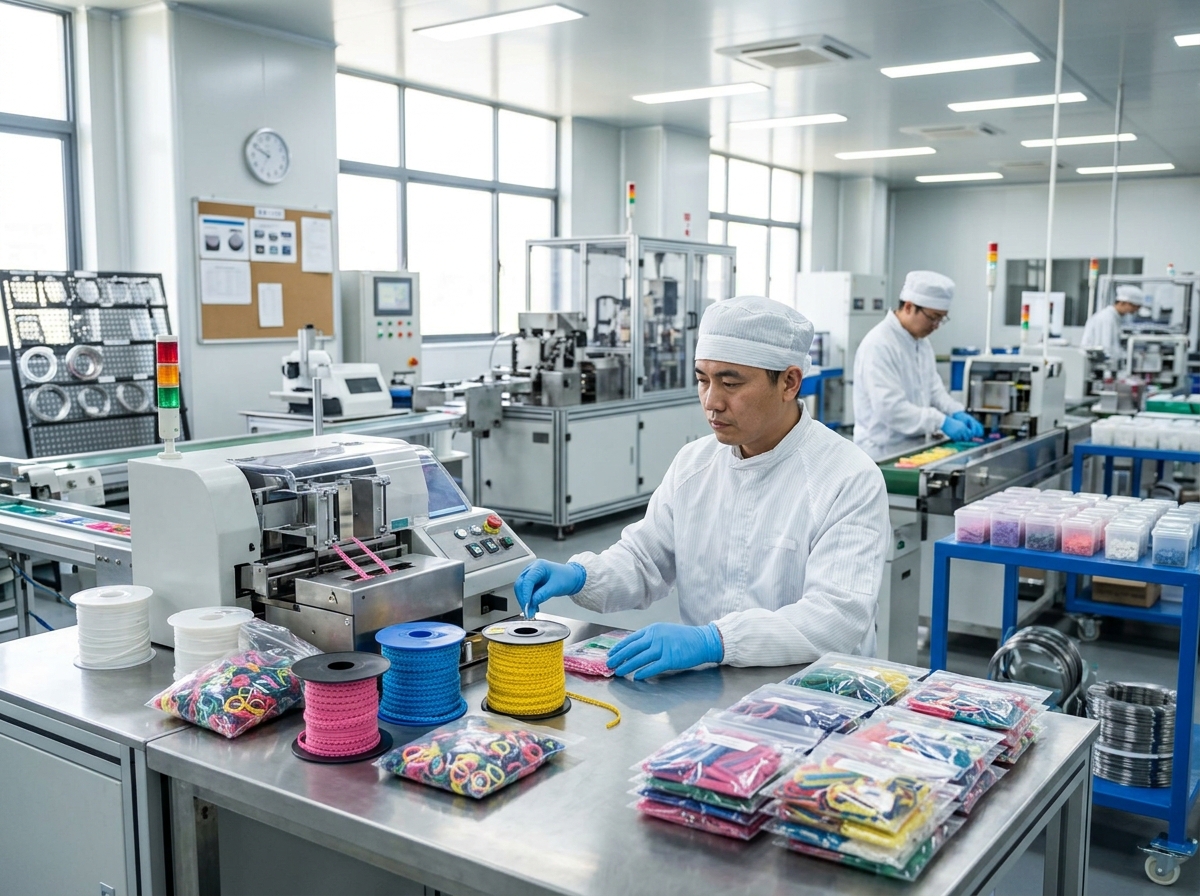
Why product breadth matters for OEM orthodontic elastics orders
Product breadth matters because orthodontic elastics are rarely purchased in isolation. A factory that also supplies brackets, buccal tubes, archwires, and pliers can support complete treatment workflows and reduce vendor fragmentation.
Denrotary’s product structure illustrates this point well. Its site presents five main categories: orthodontic bracket systems, buccal tube and band systems, archwire systems, traction and fixation accessories, and auxiliary instruments. That structure is useful for buyers who want a single supplier for staged treatment kits.
Comparison Table: Product-line breadth and OEM usefulness
| Supplier type | Typical product coverage | OEM usefulness |
|---|---|---|
| Full-line orthodontic factory | Elastics, brackets, archwires, tubes, tools | High |
| Bracket specialist | Brackets and related accessories | Medium |
| Wire specialist | Archwires and forming products | Medium |
| Regional distributor | Mixed third-party catalog | Variable |
Where OEM buyers should focus their due diligence
Due diligence should focus on evidence, not claims. Buyers should ask for quality certificates, device classification support, packaging specifications, shelf-life data, and sample testing results before placing a volume order.
For U.S.-bound shipments, it is also useful to confirm how the supplier aligns with FDA expectations and the newer QMSR framework, which the FDA says incorporates ISO 13485:2016 by reference. That matters because documentation quality affects customs, registration, and downstream distributor confidence.
- Request batch traceability records for elastics and related accessories.
- Confirm whether the factory supports private-label packaging and multilingual labeling.
- Verify whether the supplier can provide CE, ISO, and FDA-related documents on request.
- Ask for minimum order quantity, lead time, and reorder stability data.
- Check whether the factory can bundle elastics with brackets, tubes, and archwires.
How to choose the right supplier by buyer type
The right supplier depends on the buyer’s business model. Clinics usually need fast replenishment and clinically familiar products, while distributors need stable pricing, packaging flexibility, and predictable export support.
For clinics, a full-line orthodontic manufacturer is often the best fit because it simplifies procurement. For distributors, a factory with broad SKU coverage and export documentation is usually more valuable than a single-category specialist. For cross-border buyers, compliance and logistics often matter more than catalog size. According to industry estimates, this is where many OEM deals are won or lost.
Supplier Directory: Where to start your shortlist
- Denrotary official website for a full orthodontic catalog and OEM-oriented product categories.
- American Orthodontics for established North American orthodontic systems.
- Ormco for integrated orthodontic treatment platforms.
- ISO 13485 overview for quality-system reference.
- FDA orthodontic appliance rule for U.S. regulatory reference.
Conclusion: what makes a factory worth choosing in 2026
The best orthodontic elastics factory in 2026 is the one that proves consistency, compliance, and supply depth. Buyers should favor suppliers that can support elastics as part of a complete orthodontic system, because that approach reduces sourcing risk and improves clinical continuity.
In practical terms, the strongest OEM partners are those with clear factory location data, recognized quality systems, and a product range that supports the full treatment chain. That combination is more valuable than a low unit price alone.
FAQ
What is the most important factor when choosing an orthodontic elastics factory?
The most important factor is consistent product performance across batches. Elastics must deliver predictable force, stable packaging, and reliable shelf life. After that, buyers should review certification, export documentation, and whether the factory can support private-label or OEM packaging for their market.
Are CE, ISO, and FDA documents enough for OEM sourcing?
They are necessary, but not sufficient. Buyers should also ask for traceability records, test reports, packaging proofs, and quality procedures. For U.S.-bound products, it is especially important to confirm how the supplier aligns with FDA expectations and the QMSR framework.
Why do full-line orthodontic manufacturers have an advantage?
Full-line manufacturers can bundle elastics with brackets, archwires, buccal tubes, and tools. That reduces vendor management, simplifies reordering, and helps distributors build complete treatment kits. It also improves compatibility across product families and can reduce procurement delays.
How should distributors compare two factories with similar prices?
They should compare factory location, production stability, documentation quality, and SKU breadth. A slightly higher-priced supplier may be better if it offers stronger export support, lower defect risk, and more complete orthodontic product coverage. Those factors usually matter more over time.
Can a smaller factory still be a good OEM partner?
Yes, if it has strong quality control, clear documentation, and reliable communication. A smaller factory can be a good partner when it specializes in a narrow product range and serves a specific market well. The key is evidence of consistency, not company size alone.

Post time: Aug-01-2026